[In July 2025 the president upgraded this park from a historic site to a historical park]. Per Tripadvisor, this site doesn’t even make the top 10 things to do in Salem Massachusetts. Honestly, I would recommend the Peabody Essex Museum, the House of Seven Gables, and a nighttime witch walking tour before I’d send someone here. Not that it isn’t an interesting site that describes the port’s peak between the Revolution and the War of 1812, it’s just that there’s a lot of fascinating history in Salem outside the park.
In the several 18th century buildings near the wharf run by the park service, you can learn about the British East India Company, trade with the West Indies, slave traders, Polish immigrants, and more than you wanted to know about how goods cleared customs and were taxed (Hawthorne worked there but spent his time thinking up The Scarlet Letter). There’s a replica tall ship, the Friendship, docked on the wharf, but it’s under restoration—looks better inside. The 19th century Derby Light Station above still functions (solar, upgraded from oil) and sits at the end of historic Derby Wharf, which is quite long and gives folks a nice view of the harbor.
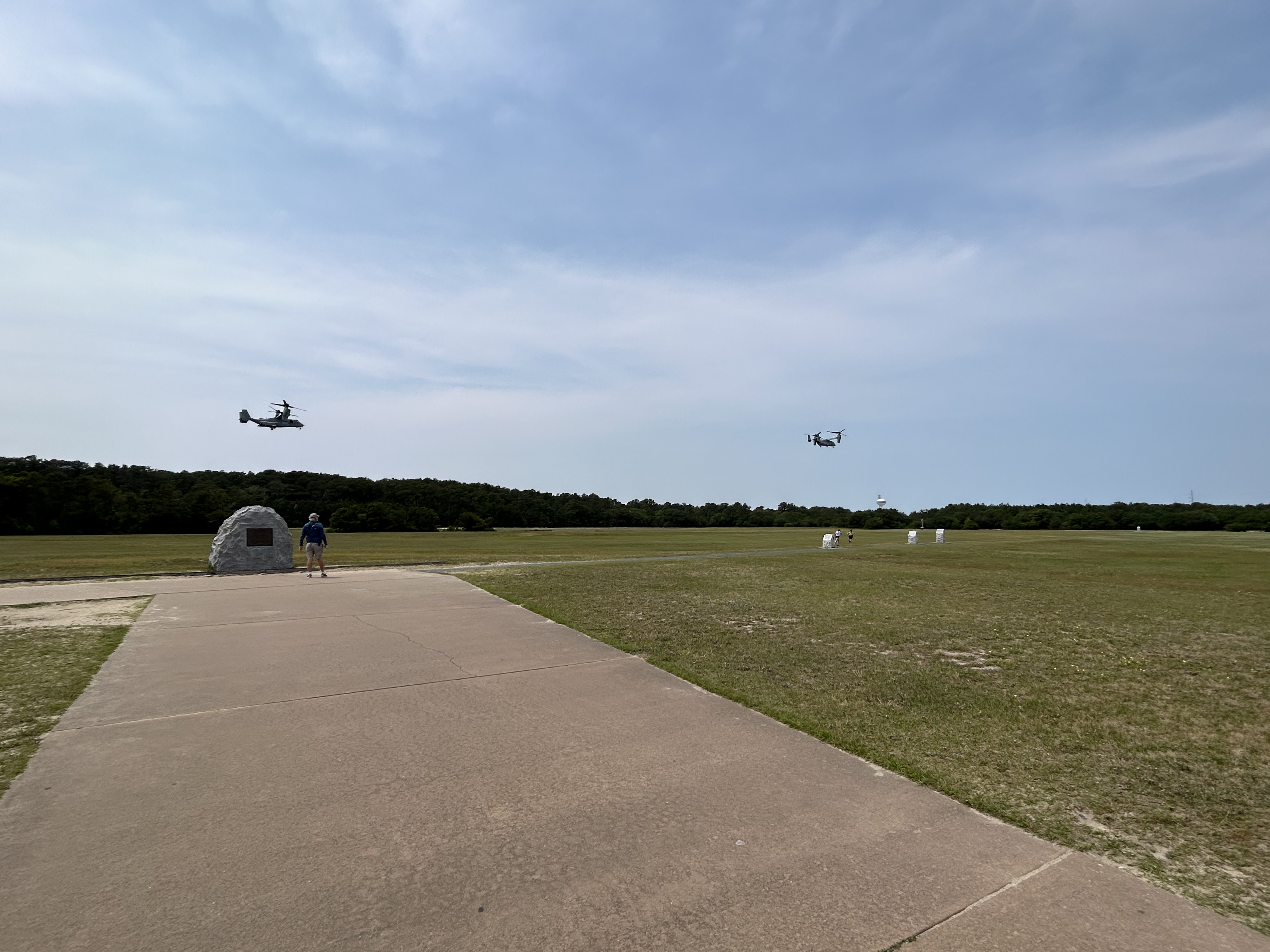
The boulder under the Osprey to the left marks the first flight takeoff, and the three stone markers under the right Osprey mark the first three landings. The fourth landing is marked by the white stone marker visible to the far right.
While the first flight happened here in North Carolina—at Kill Devil Hill near Kitty Hawk—due to favorable wind conditions and relatively soft sand, most of the work and final testing of a workable aircraft that could turn was done in Dayton. Inside the museum here you can see a full scale reproduction of the 1903 Flyer, and outside there’s a sculpture depicting the first flight. It’s a beautiful spot with a huge monument on the hill where they conducted gliding tests, and, yes, it’s still very windy.
Inside the Zane Grey museum in Lackawaxen PA, there are a couple of photos Grey took that make me extremely envious. One is him in 1920 sitting under Rainbow Bridge—which is a park site that I honestly can’t figure out how to visit—, and another is of his three masted schooner Fisherman in 1932, on one of his many adventures at sea. Grey introduced the world to the great American West, writing dozens of novels selling millions of copies in several languages along with movie and TV adaptations. I consider myself a bit of a traveler now, but many times I’ve reached a remote place, only to find that Grey beat me there by 100 years, on horseback or by boat. My grandfather and uncle inspired me with their travel stories, and I now have their journals of their trips out west with me to compare notes (thanks Nim!). I also have a decent collection of Zane Grey ebooks, although I read them mostly for the journey descriptions. Zane and his wife loved this place on the Delaware River, and I’m sure he’d have loved to see so many people taking their families out on small boats right off his front porch.
This Virginia park spans the history of Colonial America, from the first settlement and seat of English government to Yorktown which marked the end of British military control. While in theory the park can be visited in a day, take two. The pretty town of Yorktown is nice with a little beach. Jamestown has several areas to see, and the park road connecting them runs through Colonial Williamsburg, which alone is worth time. This is my favorite colonial era park.
Yorktown has a very good visitor center, film and two auto tours. Even I was able to follow what happened, and long story short, the victory was as much or more French than American. Alexander Hamilton led the successful joint French & American assault on the last two key British defensive positions, one of which is eroding into the bay. The Rhode Island Light Infantry Regiment—largely African American—were critical in the assault, which employed bayonets on unloaded muskets to ensure both silence and an aggressive attack. Washington maneuvered his armies & Lafayette executed the siege in their most successful and determinative battle of the war with the assistance of the French fleet blocking the large mouth of the Chesapeake Bay. There are also remnants of the Confederate defense of Richmond on the same battlefield, although that is not the main focus of the park.
Jamestown needs explanation. Simply, there are three parts: 1) the park service Loop Road which is a swampy wooded drive or bike ride through the eastern end of the island, 2) the state’s very well funded living history settlement, and 3) the oldest Jamestowne part that has been run by a private group which predates the park service and is now an affiliated National Historic Site. All three are amazing. I saw a bald eagle, baby turtles, deer and more. At the settlement you can climb aboard recreations of all three ships, visit a Native American village, a reconstruction of the fort and an impressive museum, and there are many helpful staff throughout, some clothed in period garb, making the history extremely accessible. But don’t miss the third part, Olde Jamestowne.
This is the original remote outpost of the Elizabethan era that excited imaginations at the time, including Shakespeare whose Tempest is based on a shipwreck here. The most exciting work today is happening above in the oldest section of the park: an active archaeological dig with many world class discoveries. The fort there is built on the original fort site, and one of the archaeologists who began the dig in the 1990s gave a guided tour. There’s also a museum showcasing their discoveries.
Pocahontas married her husband John Rolfe in the church to her right, her husband witnessed the arrival of the first Africans at Fort Comfort (now Monroe), and the most recent excavation of a well is happening over her left shoulder. One of the gruesome discoveries was evidence of cannibalism among the settlers, but other discoveries speak to the diversity of the colony and its early peace with the natives, thanks mainly to the young woman above.
As befits any mystery, little remains of the fabled Lost Colony of Roanoke Island NC. There is a map, a cross and “CRO” carved in a post, archaeological remains, and various accounts, both trustworthy and not. The fort above is a reconstruction. The English brought explorers, scientists, soldiers and settlers here in a few journeys in the late 16th century, but the location was deemed a failure. There was little metal, poor soil and no deep water port, and several supply ships were lost in the shallows & storms. Most of the expedition returned to England.
It was however an excellent location for piracy with many hidden coves and inlets behind the barrier islands to wait for the Spanish treasure galleons riding the Gulf Stream back to Spain with stolen Aztec and Incan gold. Many of the last colonists here had wanted to land near Jamestown, but their pirate captain dropped them here instead. When war broke out between England and Spain, Queen Elizabeth kept all English ships at home to protect against the Spanish Armada invasion of 1588. So the colonists were abandoned by the Queen for years, while they were expecting supplies within months.
Likely, they became desperate and split up with a group traveling north and others initially staying behind to wait for help. There are reports that some armed men were killed in Native American skirmishes north of here, so those remaining must have decided to go to a nearby island to seek help from the Croatoans whose chief spoke some English and had been a guest of Sir Walter Raleigh in England for 6 months. The colonists were presumed dead by the English at the time, but much later reports of a few blue-eyed Croatoans suggest at least a few survived. And the cross and letters were likely a shorthand way of letting the English know where they were without letting the Spanish know.
I arrived too early to see the stage performance here which starts in June, and I declined to pay admission to tour the Elizabethan Gardens. But the rangers and museum tell the story, along with more stories about piracy—Sir Francis Drake raided St Augustine in 1586 and brought back some Roanoke colonists on his way home—, about the Freedman’s Colony of 1862 and more modern ventures. Coming from New England, I appreciate the efforts to honor our English heritage, such as the monument here to the first English child born in the Americas. Virginia deserves more credit for being the first English colony, after all, Captain John Smith named ‘New England’ after leaving Jamestown and mapping the north east coast. Still, it would be nice to have more information about what happened to the other ethnicities who lived here, especially the Native Americans.
Please understand this is not Madam CJ Walker, the hair care entrepreneur and millionaire, but a contemporary, Maggie Lena Walker, who helped lay the foundations of the Civil Rights movement through her civic efforts. Maggie’s mother was a slave in the house of Elizabeth Van Lew, a wealthy Richmond lady and top Union spy. Evidently, Maggie’s mother conveyed some of that rebellious spirit to her daughter, who helped organize a school strike when denied the benefits given to white students. Throughout her life, Maggie Walker worked to advance her community, becoming the first African American woman to found and run her own bank, to run an insurance company, a newspaper, a department store and many other civic leadership roles, especially those designed to educate and employ African Americans. Her solidarity with like minded friends including Mary McLeod Bethune and Nannie Burroughs, helped combat Jim Crow, advance women’s suffrage and promote Civil Rights. Even in the old Confederate capital, she helped build a prosperous African American community that avoided both physical destruction like Tulsa and also financial destruction during the Great Depression. The Jackson Ward of Richmond is famous for beautiful old homes, delicious restaurants (try Mama J’s catfish!), businesses and sites where Jazz greats performed. The tour of her home is fascinating and covers history which is so important for all Americans to understand today.
One of the prettiest partner sites in the park, the Old Swedes Church dates back to 1698 when the King of Sweden funded it to support his small community. (If you do the tour, take the stories about the ghosts and the character who requested the funds with a grain of salt—there are a number of hoaxes out there). The Swedes arrived here in a Dutch ship, the Kalmar Nyckel in 1638, traded with the Native Americans for beaver pelts, and they built a fort named after their progressive young Princess Christina. Eventually, the British took over the area, but there’s now a fabulous recreation of the 17th century tall ship—which does day sails in summer—next to the site of the fort.
Delaware was spared most of the battles of the Revolution, besides a skirmish at a bridge and a naval engagement in the river, and also had no Civil War battles, but its history is nonetheless fascinating. The name comes from Baron De La Warr, the first Governor of the Virginia colony. The land was part of the King’s grant to William Penn—on the condition he take his Quaker friends with him—and was technically part of Pennsylvania until 1787. At the south end of the park, John Dickinson’s plantation holds tours about his writings in favor of independence, his signing of the Constitution and his decision to free his slaves by 1786. Delaware was a key vote during the decision to issue the Declaration of Independence. Two of its three delegates split, and the third, who was ill, rode overnight to cast his vote in favor and to exhort the other state delegates to join. The first state ratification of the Constitution was done in Dover, near the Green, but the tavern were it took place is gone.
Delaware Quakers were active in the Underground Railroad, and there’s a statue of Harriet Tubman and Thomas Garrett in Wilmington. One African American conductor was arrested, jailed, and auctioned off in front of the old State House in 1848. As Samuel Burris was being carted off into slavery, his purchaser whispered to him, “not to fear, you have been purchased with abolitionist gold and I will spirit you away to Philadelphia”.
Due to the main visitor center behind the Old Court House in New Castle still being under construction, and due to the plethora of partner organizations, the sites and tours may seem a bit disorganized or amateurish, but the locals know their history and are proud of it. The Old Court House has many original artifacts, portraits and exhibits to see on the interesting tour. Try eating at one of the old Colonial Era taverns or tea rooms, and you’ll likely learn more lore from the locals.
Before the Revolution, Charles Ridgely grew his fortune making iron and exporting it to Europe for finished goods. His land had all the essential elements for this business, nearby Baltimore had the port, he purchased his own merchant fleet, and even received tax incentives from the British government. He diversified into other businesses, growing corn, fruit, and bottling casks of port to sell in the city. And he didn’t pay most of his workers.
When the war began, Ridgely sold iron and supplies to the Americans. His craftsmen were skilled, and he was likely the largest enterprise in the country at the time. For cheap, he purchased the lands confiscated from Loyalists. But he didn’t adhere to the ideals of the American Revolution. In fact, he built the largest, most purely British Georgian mansion above, while the country was just finishing fighting its War of Independence from the British King George.
His nephew inherited the home in 1790 and served in Congress and as Maryland Governor, arguing for peace with Britain. By the 1820s, Hampton was 25,000 acres and included cattle, horse racing and marble quarries. For six generations, the Ridgely family held on to this property and protected the family wealth. The work was done by over 300 slaves at any one time, and the plantation was known to be one of the state’s largest and hardest driving plantation, where other slaves feared to be sold as punishment.
The ranger was unable to point to any contributions made to society by the Ridgely family over 200 years, but she did have much evidence that they enjoyed an aristocratic life and drank copiously. They had a huge ice cave dug into the hill, filled in winter, so they could enjoy ice cream during the summer. (They lived in their Baltimore house during the winter). The four main rooms have been marvelously restored to different time periods, Colonial, the Governor (photo), pre Civil War and post Civil War, each with elaborate displays that would make European nobility blush. The hall and rooms are filled with large portraits of the vain slaveholders, none of whom made the choice to see their slaves as equally human.
The overseers house, farm buildings and some slave quarters have been restored as well, and all can be seen from the front step, far down the hill. The park service has done admirable research on the life of the slaves, and I learned how generations of young Ridgely children were taught to maintain the system of control. Slavery impacts every aspect of humanity, and the stories here are told with some meticulous details to evoke hundreds of years of cruelty. The house was donated to the park service by a wealthy foundation in part to preserve the fine art collection.
Cleveland’s mayor, the first African American elected mayor of a major city, Carl Stokes, faced an environmental crisis. The Cuyahoga River, above, caught fire in 1969. And it wasn’t the first time. Mayor Stokes led journalists on a pollution tour and tied the issue to poor and underserved communities, many of color, which often suffered most. He led the fight for change.
In many ways, this park is a great example of what can be done, when we make the effort to restore nature. While interstate highways still cross over the park, they do so from extremely high bridges, separate from the deep valley below. Many tributary watersheds are protected by municipal and state parks and other reserves. Instead of removing the old railroad line along the river, there’s a classic old train line with restored historic whistle stops for hikers, bikers, and even kayakers to return after traveling through the park one way. An old inn on the canal has been repurposed as a museum. An old mill village is now a visitor center with a store selling drinks, sandwiches and ice cream (black raspberry chocolate chip is the best). The tow path, which both separated the canal from the river and provided a walkway for teams of oxen to pull barges, makes a perfect, nearly level, dry, packed gravel path for bikers, hikers and equestrians to travel for miles through the woods, admiring both wildlife and the beautiful scenery.
This is my favorite park for bicycling. I biked from Frazee House to Peninsula, above, about 20 miles round trip, in order to see some of the northern and middle sections where the path runs close to the river and far from the road. I saw both a Bald and a Golden Eagle, the first with the help of a park volunteer who let me look through his telescope. Brandywine Falls also surprised me by being larger than expected in Ohio, and the Ledges is another popular hike. I also hiked through Beaver Marsh at the southern end to look for more birds and watched a Great Blue Heron fishing for about an hour, among the geese, various ducks, redwing blackbirds, giant snapping turtles and other wildlife. Wonderful!
Railroads being perhaps the largest and most important industry in the land over 100 years ago, it was cheaper to buy the US Attorney General and easier to influence President Cleveland to send in troops than to reinstate wages for the 250,000 striking Pullman railroad workers. The leader of the strike, Eugene Debs, was thrown in jail and emerged as a Socialist. On the plus side, we got Labor Day.
The feudal administration building above was center to a huge company town, with dozens of blocks of row houses, hotels, cafes, wheelhouse, stable, church, hospital and fire station. The neighborhood has suffered more than its share of fires, including the right wing of the building above, but this new park is rebuilding and revitalizing this fascinating area. The Florence Hotel is still closed for restoration, and some of the partner museums are only on weekends in spring. There were some tours going on, but I found no information about them in the visitor center above. Walking the row houses is worth the effort, as many are still lived in and well-loved today.





 Zero Carbon Travel