Theodore Roosevelt Inaugural National Historic Site

This is a quirky little site. Even Teddy didn’t spend much time here. He arrived in response to McKinley’s assassination, left when told he would recover, returned upon hearing he would die, and was inaugurated in 30 minutes by a local judge.

One of Teddy’s first official acts here was to invite Booker T. Washington to the White House. Teddy was also famously friends with John Muir, and he also befriended activist Jane Addams—who eventually won a Nobel Peace Prize and deserves a park site of her own. You can tell a lot about a person by his friends.

There are only a handful of rooms to see, but there are interactive exhibits about the Pan American Expo—where McKinley was shot by an anarchist—issues of Teddy’s Presidency, his friends & advisors, his draft first speech, and the room above where he was sworn into office. The tour evokes the hasty events here well. And if you get hungry, there’s a bar down the street that claims to have invented Buffalo Wings.

First Ladies National Historic Site

Ida Saxton McKinley’s house above is managed by the site, and was preserved by a private foundation before the park service got involved. The tour is interesting, with some original artifacts, and the ranger did a good job of comparing this famous widowed first lady with Jackie Kennedy. While times change, the political importance of presenting a positive public image remains. 

The museum and visitor center a block away has rotating exhibits of the various First Ladies, and Nancy Reagan was on display. Jackie Kennedy’s display begins on May 2nd. Not sure why Michelle Obama’s poster has to be in the most difficult to find corner of the basement, but whatever. One of the park films was on fashion and power, and it did an excellent job of explaining the political power of First Ladies like Dolly Madison and Jackie Kennedy, who used White House events, interior design, fashion and adroit diplomacy to support their husbands’ administrations, often more effectively. 

Ronald Reagan’s Boyhood Home

Reagan lived here in Dixon, Illinois, 100 years ago, from 1920 to 1924, as a young boy. Ronnie’s Mother encouraged him to act in church plays, which led to his career in Hollywood, his nick-name ‘the Gipper’ for his role in a movie about Notre Dame football star Knute Rockne, to becoming the President of the Screen Actors Guild and honing a skill set that served him well in politics.

Reagan’s economic policies of cutting top tax rates and deregulation contributed to an immediate economic boom and later increased inequality. Domestically, he favored harsh treatment of drug dealers, although his CIA was secretly involved in the Colombian drug trade which sold crack in US cities. His foreign policies followed his anti-communist views forged in Hollywood during the Blacklist days and contributed to the collapse of the Soviet Union as well as to the rise of some anti-Democratic regimes, especially in Latin America. Many of his team’s efforts were covert, including asking Iran not to release the hostages until Reagan took office, supporting the Mujahideen, etc. Reagan was extremely popular, both when winning a landslide reelection and in polls after leaving office. But there was definitely a dark side to his administration, as seen in the callous disregard for the victims of the AIDS epidemic, which contributed to thousands of deaths.

For many years a private foundation has given free tours here, declining to become an official park site, due to Reagan’s philosophy that “government is the problem”. After the death of their main benefactor, the foundation was reportedly ready to sell the property to the National Park Service, which is the last step needed for it to become an official park site. In 2021, the Young America Foundation, which also runs Reagan’s ranch in California, purchased the property. There are persistent unfounded rumors that Republican Presidents are denied as many park sites as Democratic Presidents, but the truth is that often private foundations choose to manage Republican Presidential sites, either out of disapproval of government management or out of a desire to keep control over the President’s legacy and present their version of the administration’s history. While I made it to his home in time for the last tour of the week, unfortunately, it was closed for a middle school event. Oh well, at least I made it to his door, while touring many historic homes on this trip.

Herbert Hoover National Historic Site

Hoover may have been a Stanford graduate who made his fortune working on foreign mine extraction projects, but he grew up poor in this tiny house in a rural Iowa Quaker village. Note the outhouse in back and his father’s blacksmith shop on the right. His hardworking father died of heart failure and his even harder working mother later died of typhoid and pneumonia. Herbert’s relatives took him and his two siblings in, and he grew up in a school principal uncle’s house in Oregon.

I also visited his Presidential Library & Museum next door, run by the National Archives. They go to great lengths to rehabilitate Hoover’s reputation, since he was widely blamed for the Great Depression. They point to his conservation efforts for example, but neglect to mention that his 5 million acres are not as much as Teddy Roosevelt’s 150 million acres. The museum helped convince me that Hoover was a generous humanitarian who saved many lives in Belgium, Russia and elsewhere by running food aid programs, who was elected with extremely high expectations, and who implemented a variety of positive programs (not just the dam). I genuinely think he was a smart and nice guy.

But, Hoover was an ardent believer in solving social problems with volunteerism and without government intervention. Even though he had warned Coolidge about the dangers of stock speculation, Hoover was all about efficiency, not reform. Hoover had seen massive, desperate social failure all around the world, including being trapped in the foreign enclave during the Boxer Rebellion with his wife (see movie, ’55 Days at Peking’). But he still believed that if government supported business leaders and capitalists, then everything could be solved with goodwill and determination.

He was wrong. FDR crushed him and immediately implemented massive social programs including unemployment payments, government work programs, and Social Security. In retrospect, Hoover should have been able to look at his own family’s struggle with poverty and the tragedies of his parents’ deaths and consider that maybe government intervention would have helped them in their hour of need. Instead, he shared the common views among the ruling elites, that government programs like military protection for foreign business interests in China are good but that government programs like unemployment relief are bad.

Lincoln Home National Historic Site

It’s not his hat, but the small desk is where Lincoln wrote his early speeches. In the parlor downstairs, he held the funeral service for his son, Edward, and years later was invited to be the Republican nominee for President. In this house, he refined his political views and his arguments against slavery. Lincoln drew from his early childhood and boyhood experiences to become the most powerful advocate for freedom.

“As I would not be a slave, so I would not be a master. This expresses my idea of democracy. Whatever differs from this, to the extent of the difference, is no democracy.”

Abraham Lincoln in 1858

Lincoln understood the fundamental flaw in our country, that the ideal of equality did not apply to all and that Democracy and slavery are absolutely incompatible. He knew that most voters held racist views and did not want war to bring about immediate equality. So he was careful, not always the loudest abolitionist, and he opposed John Brown’s raid. But Lincoln was determined to end slavery, crafted a greater variety of effective, convincing arguments against slavery, introduced legislation and used his arguments in debates against Douglas.

“That is the real issue. That is the issue that will continue in this country when these poor tongues of Judge Douglas and myself shall be silent. It is the eternal struggle between these two principles — right and wrong — throughout the world. They are the two principles that have stood face to face from the beginning of time; and will ever continue to struggle. The one is the common right of humanity and the other the divine right of kings. It is the same principle in whatever shape it develops itself. It is the same spirit that says, “You work and toil and earn bread, and I’ll eat it.” No matter in what shape it comes, whether from the mouth of a king who seeks to bestride the people of his own nation and live by the fruit of their labor, or from one race of men as an apology for enslaving another race, it is the same tyrannical principle.”

Final Lincoln-Douglas debate

Beyond the home tour, I found the neighborhood fascinating. One of the neighbors was a conductor on the Underground Railroad who gave the President-elect his inaugural ride to the depot. One was a Jewish family whose son helped build 5,000 Rosenwald schools to educate African Americans across the south. And one is currently being used as a local office for Senator Dick Durban. Springfield is all about Lincoln, and they have set aside 4 surrounding blocks of period houses, a short walk from the his Presidential Library and Museum. The museum there is modern, multi-media and includes an excellent map visualization of Civil War casualties over time. Explore the neighborhood, stay in an atmospheric B&B and eat at a fine restaurant. I did, at reasonable cost, and learned Springfield is on Route 66.

Lincoln Boyhood National Memorial

When Lincoln’s father left Abe’s birthplace in search of a new home that wouldn’t be stolen, he took the family here, deep into the forest to make their new home from scratch. The park has a living historical farm (above) with crops, chickens and sheep that does a good job of showing life in the early 1800’s, when Abe lived here from age 7 to 21. Much emphasis is placed on the log cabins, to show Lincoln’s humble roots. The visitor center film explains the loss of his closest family members, mostly buried here. There is a trail with stones commemorating Lincoln’s lifetime milestones.

But for me, it is the initial experience that Lincoln had that defines him. His family had literally arrived at the end of the road, being “the poorest people”, and his father must have said, ‘let’s keep going, we’ll make our own road from here’. And they did. Lincoln became a log splitter in boyhood, because the first step at the end of that road was to chop down trees to make a path.

Yes, he was poor and hard-working. But more importantly, Lincoln was a path-making thinker. Unlike formally educated people who are provided answers and common ways of thinking, Lincoln had precious few educational resources available to him, requiring him to be a self-starting, inventive thinker, to use common sense and observation to extrapolate answers to a broad range of questions he had. His mother, who had taught his father how to read, died, and his step mother brought three children with her and about as many books. Faced with a life of endless labor without security that his father had endured and given him, Lincoln viewed knowledge as his pathway into a bigger and broader world.

One of his formative experiences on an early journey was when he got sued for ferrying folks out to catch passing steamboats. The ferry operator said that he was encroaching on their business without a license. Lincoln, arguing his own case in court, said that he wasn’t carrying people all the way across the river, just halfway. And he won.

Another was when he traveled down the Ohio and Mississippi rivers to Natchez, where he saw slaves auctioned. His family was against slavery, but seeing the cruelty up close made a powerful impression on him. He would spend the rest of his life convincing people to abolish slavery.

Where other people in his time may have been educated to believe that slavery was normal and even justifiable, Lincoln was used to forming his own thoughts. Arguing against those who thought slavery normal, he noted that none of them are willing to volunteer for it themselves. He argued to those who believe that slavery is justified by skin shade, intellect or self-interest, that they should logically become the slaves of anyone lighter in color, smarter or greedier than they are. His arguments persuaded people.

The times were leading to an inevitable bloody conflict to choose slavery or Democracy, and Lincoln would be the one to find the path forward.

LBJ Memorial Grove on the Potomac

I bet LBJ would joke that this monolith is a middle finger salute to DC. But the grove is a tribute by his wife to his environmental legacy, recognizing LBJ’s unsurpassed legislative achievements in one term: the Wilderness Act, the Clean Water and Clean Air Acts, the National Historic Preservation Act, the Endangered Species Act, and the Wild and Scenic Rivers Act. While meant to reflect nature and his Texas roots, the monolith looks unfinished, like the work ahead of us to save our climate.

Dwight D. Eisenhower Memorial

Ike was a farm boy, raised by Mennonite pacifists, who chose military school because tuition was free. His only outstanding role at West Point was leading the cheerleading squad. But the military valued his leadership skills, and George Marshall picked him to plan the European war effort, form the allies into an effective team and lead them to victory in North Africa, Southern Italy, D-Day, and Germany.

A popular President, Ike expanded the social safety net, created the interstate highway system (thanks), started NASA, spied on the Soviets, and sent troops into Little Rock Central High School. When leaving office, he warned about the “unwarranted influence [of] the military-industrial complex”.

“Only an alert and knowledgeable citizenry can compel the proper meshing of the huge industrial and military machinery of defense with our peaceful methods and goals.”

Ike Eisenhower

Theodore Roosevelt Island

“It is true of the Nation, as of the individual,
that the greatest doer must also be a great dreamer.”

Teddy Roosevelt

On the re-wilded island in the Potomac River amid a couple miles of wildlife trails, there’s a statue of Teddy Roosevelt along with a few granite inscriptions of his thoughts and exhortations on youth, manhood, nature and the state. Nature is slowly reclaiming the plaza’s landscaping, and nobody was there on a drizzly weekday morning. So I felt like I had stumbled across a forgotten sacred space in the forest. Once, a man of great vision, recognizing the importance of wilderness to our spirit and future, fought to protect nature from being wasted by myopic man. He challenged us to overcome our misfortunes, “find delight in the hardy life of the open”, and do our duty to preserve our natural resources for the next generation. Let us not forget him. Let us honor his vision.

“There are no words
that can tell of the hidden spirit of the wilderness,
that can reveal its mystery, its melancholy and its charm”

Teddy Roosevelt

Franklin Delano Roosevelt Memorial

“We have faith that future generations will know here, in the middle of the twentieth century,
there came a time when men of good will found a way to unite, and produce,
and fight to destroy the forces of ignorance, and intolerance, and slavery, and war.”

FDR in 1943

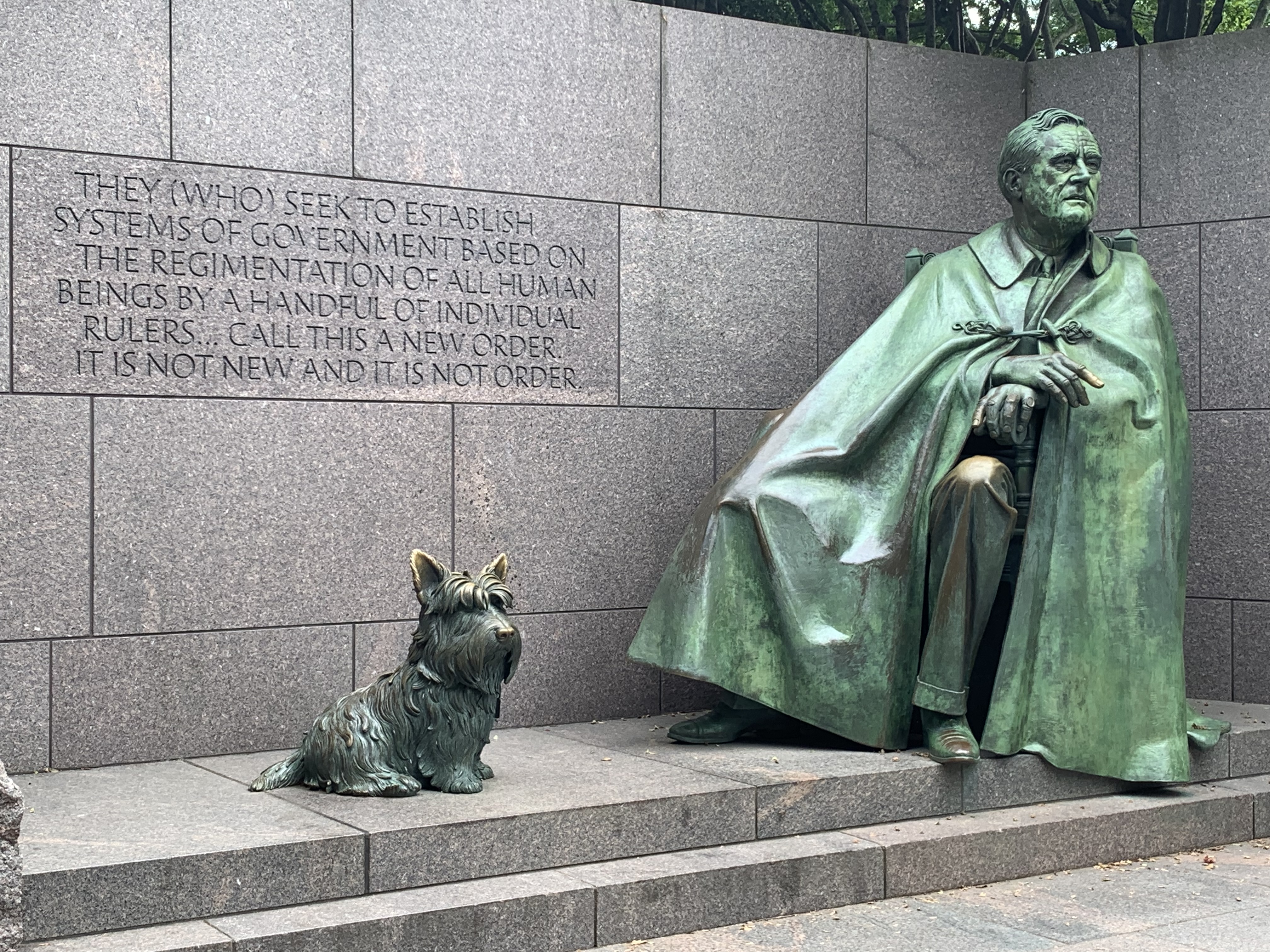
Wander through the FDR memorial amid the waterfalls and trees, reading his words and reflecting on his extraordinary life, and feel the impact his leadership had upon the world. He struggled against being defined by polio, against the Great Depression, to bring a new deal to Americans, through WWII and for peace, until his wife Eleanor took up his torch at the UN. In speaking plainly with people FDR became the lightning rod that harnessed the energy of everyone’s dashed dreams and fearful hopes to make the world better. The desperation of the times brought Americans “a rendezvous with destiny” and required more of FDR than any other President: putting 1/4 of the country back to work, creating a new social contract with a safety net, becoming “the great arsenal of Democracy”, and fighting for a dream of world peace.

“Unless the peace that follows recognizes that the whole world is one neighborhood
and does justice to the whole human race,
the germs of another world war will remain as a constant threat to mankind.”

FDR in 1943