Cleveland’s mayor, the first African American elected mayor of a major city, Carl Stokes, faced an environmental crisis. The Cuyahoga River, above, caught fire in 1969. And it wasn’t the first time. Mayor Stokes led journalists on a pollution tour and tied the issue to poor and underserved communities, many of color, which often suffered most. He led the fight for change.
In many ways, this park is a great example of what can be done, when we make the effort to restore nature. While interstate highways still cross over the park, they do so from extremely high bridges, separate from the deep valley below. Many tributary watersheds are protected by municipal and state parks and other reserves. Instead of removing the old railroad line along the river, there’s a classic old train line with restored historic whistle stops for hikers, bikers, and even kayakers to return after traveling through the park one way. An old inn on the canal has been repurposed as a museum. An old mill village is now a visitor center with a store selling drinks, sandwiches and ice cream (black raspberry chocolate chip is the best). The tow path, which both separated the canal from the river and provided a walkway for teams of oxen to pull barges, makes a perfect, nearly level, dry, packed gravel path for bikers, hikers and equestrians to travel for miles through the woods, admiring both wildlife and the beautiful scenery.
This is my favorite park for bicycling. I biked from Frazee House to Peninsula, above, about 20 miles round trip, in order to see some of the northern and middle sections where the path runs close to the river and far from the road. I saw both a Bald and a Golden Eagle, the first with the help of a park volunteer who let me look through his telescope. Brandywine Falls also surprised me by being larger than expected in Ohio, and the Ledges is another popular hike. I also hiked through Beaver Marsh at the southern end to look for more birds and watched a Great Blue Heron fishing for about an hour, among the geese, various ducks, redwing blackbirds, giant snapping turtles and other wildlife. Wonderful!
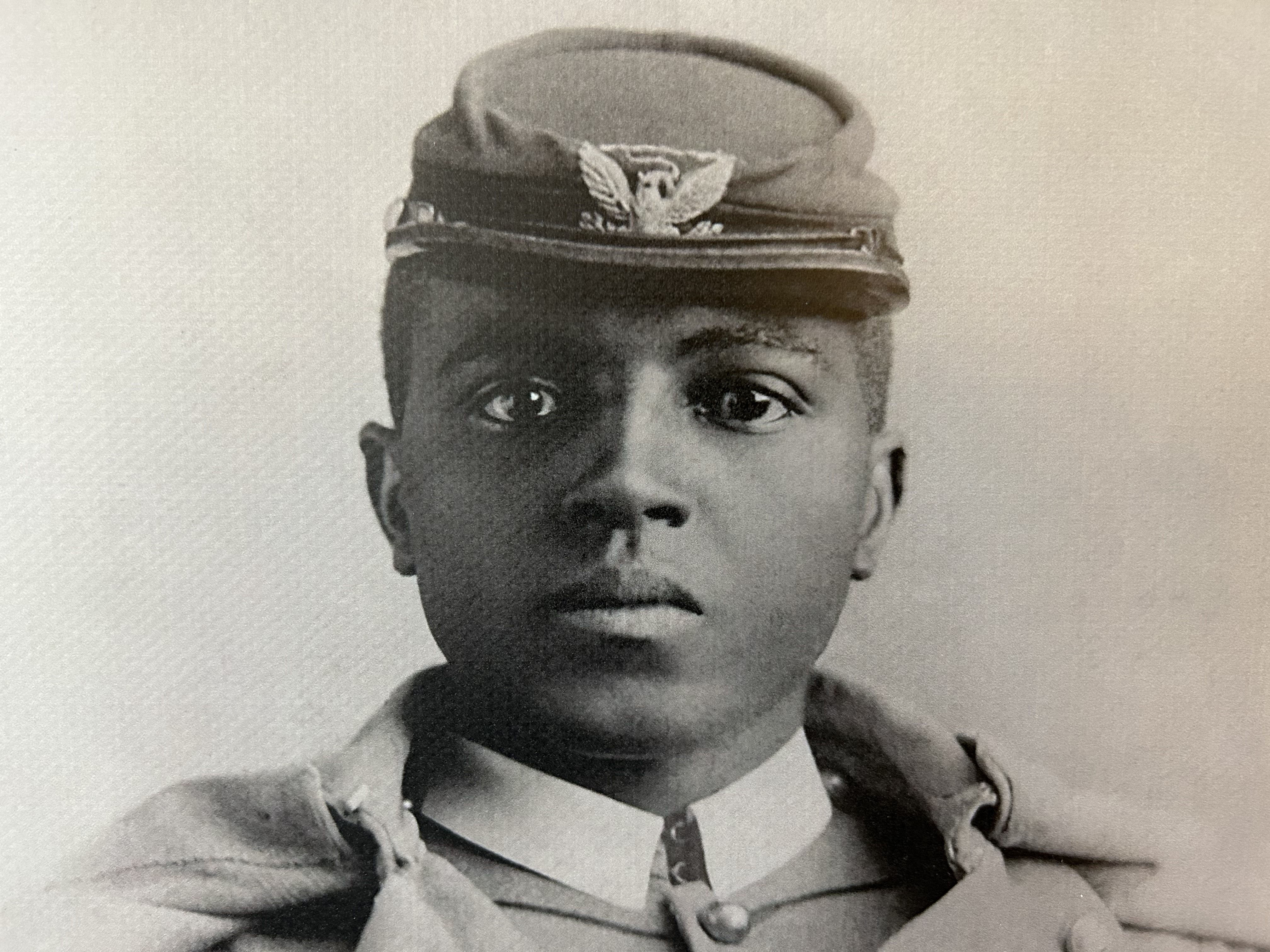
Charles Young’s father was born into slavery, escaped and joined an African American heavy artillery regiment in the Civil War. His mother and grandmother were also born into slavery but were educated and taught Charles as a boy.
Charles Young was the third African American West Point graduate to become an officer, and in 1901 he became the first African American Captain in the Army. Young was also the first African American superintendent of a National Park, Sequoia, and he eventually became the first African American Colonel in our Army.
The park here reflects the community in Wilberforce, which is the site of the first University owned and operated by African Americans. Young taught military tactics and how to be a soldier. The University also employed luminaries including WEB DuBois, voting rights activist Hallie Q. Brown, and the poet Paul L. Dunbar, all of whom enjoyed the hospitality and vibrant discussions held regularly at the Young family home, once a stop on the Underground Railroad. The Young house is still in the midst of extensive renovations, and there’s a small exhibit inside a nearby seminary library.
Young was an excellent officer, who overcame great prejudices during his interesting career, but the site is also dedicated to the many African Americans who served with him and after him. In the west, these soldiers were known as Buffalo Soldiers, due to their curly black hair, and their service is recognized at 20 different national parks, including Forts Bowie, Davis, Larned, Point, Union and Vancouver. Tragically, much of their service was against Native Americans.
Railroads being perhaps the largest and most important industry in the land over 100 years ago, it was cheaper to buy the US Attorney General and easier to influence President Cleveland to send in troops than to reinstate wages for the 250,000 striking Pullman railroad workers. The leader of the strike, Eugene Debs, was thrown in jail and emerged as a Socialist. On the plus side, we got Labor Day.
The feudal administration building above was center to a huge company town, with dozens of blocks of row houses, hotels, cafes, wheelhouse, stable, church, hospital and fire station. The neighborhood has suffered more than its share of fires, including the right wing of the building above, but this new park is rebuilding and revitalizing this fascinating area. The Florence Hotel is still closed for restoration, and some of the partner museums are only on weekends in spring. There were some tours going on, but I found no information about them in the visitor center above. Walking the row houses is worth the effort, as many are still lived in and well-loved today.
‘Free’ Frank McWorter mined saltpeter as a slave, purchased first his wife’s, then his and ultimately 14 more family members’ freedom and founded this town with 12 dozen plots in 1836, the first African American registered & surveyed town in America. It was a mixed race community as Frank sold lots to all, and it became an important stop on the Underground Railroad. Fugitive slaves were assisted across the rivers, hidden in wagons and at least one basement and were even accompanied to Canada. Unfortunately, at the end of the 19th century the actual railroad bypassed the town in favor of a white town, so eventually folks moved away.
None of the early buildings survive, but there are a few old buildings built on their foundations, providing years of fun for archaeologists. There are a dozen or so signs explaining whether the plot belonged to the shoemaker, wheelwright, carpenter, seamstress, physician, teacher, merchant, cabinet maker, the blacksmith or the Post Office (above). Many of those tradespeople provided invaluable services to fugitive slaves. I wasn’t able to load the VR app which superimposes cartoon pioneers on your screen to help you visualize, but I was fine without. This brand new park is not in the completely uninteresting town of New Philadelphia, Illinois, an hour north, but it is about 30 miles east of the interesting town of Hannibal, MO.
On April 22nd, the park film was screened in Springfield, and, being a park nerd, I attended the gala park service premiere (cookies were served). Several members of the community responsible for gaining recognition for the site were there. The film was produced mainly by staff from the Lincoln Home. Just as Lincoln’s presence here attracted freedom-seekers, the folks here are broadening out understanding of history.
Reagan lived here in Dixon, Illinois, 100 years ago, from 1920 to 1924, as a young boy. Ronnie’s Mother encouraged him to act in church plays, which led to his career in Hollywood, his nick-name ‘the Gipper’ for his role in a movie about Notre Dame football star Knute Rockne, to becoming the President of the Screen Actors Guild and honing a skill set that served him well in politics.
Reagan’s economic policies of cutting top tax rates and deregulation contributed to an immediate economic boom and later increased inequality. Domestically, he favored harsh treatment of drug dealers, although his CIA was secretly involved in the Colombian drug trade which sold crack in US cities. His foreign policies followed his anti-communist views forged in Hollywood during the Blacklist days and contributed to the collapse of the Soviet Union as well as to the rise of some anti-Democratic regimes, especially in Latin America. Many of his team’s efforts were covert, including asking Iran not to release the hostages until Reagan took office, supporting the Mujahideen, etc. Reagan was extremely popular, both when winning a landslide reelection and in polls after leaving office. But there was definitely a dark side to his administration, as seen in the callous disregard for the victims of the AIDS epidemic, which contributed to thousands of deaths.
For many years a private foundation has given free tours here, declining to become an official park site, due to Reagan’s philosophy that “government is the problem”. After the death of their main benefactor, the foundation was reportedly ready to sell the property to the National Park Service, which is the last step needed for it to become an official park site. In 2021, the Young America Foundation, which also runs Reagan’s ranch in California, purchased the property. There are persistent unfounded rumors that Republican Presidents are denied as many park sites as Democratic Presidents, but the truth is that often private foundations choose to manage Republican Presidential sites, either out of disapproval of government management or out of a desire to keep control over the President’s legacy and present their version of the administration’s history. While I made it to his home in time for the last tour of the week, unfortunately, it was closed for a middle school event. Oh well, at least I made it to his door, while touring many historic homes on this trip.
Taos Pueblo has been continuously occupied for over 1,000 years—perhaps far longer—, much older than European settlements, and it is a World Heritage Site. Archaeologists have not extensively excavated the area—because the Red Willow people are still living there—, but there is evidence of trade with Mesa Verde and other early Native American settlements dating back many centuries. The multistory building above is home to many families, and folks on the upper floors climb ladders to access their apartments. While modern doors and windows have been added, the families, community and tribal government preserve the village in its original form, using mostly traditional building materials and avoiding electricity and plumbing anywhere within the village.
The pueblo sits below the Sangre de Cristo Mountains, a significant portion of which were returned to the community by President Nixon, including the Blue Lake and the headwaters of the Red Willow Creek. The creek runs through the middle of the village, is the sole source of water and flows into the Rio Grande. The Rio Grande Gorge southwest of Taos is strikingly beautiful, as are the Palisades near Eagle’s Nest northeast. The pueblos in this area are at the crossroads of ancient trading routes from coast to coast and to Central America.
Taos means Red Willow in the Tiwa language, and it is a town in an area crowded with history. Coronado arrived in 1540, and the Spanish built the first San Geronimo Church in 1620. When their Native dances, songs and worship were prohibited, the people here joined the Pueblo Revolt, which destroyed this any many other churches and forced the Spanish to retreat to what is now Mexico. The Spanish eventually reconquered the area and rebuilt the church. After the Spanish were forced to cede their territory to end the Spanish American War, the US Cavalry eventually was sent to subdue the people, who took refuge in the church. There were no survivors of the artillery bombardment, and the old church grounds are now a cemetery. The new San Geronimo Church contains a statue of the Virgin Mary from the old church, and the villagers practice both their indigenous Nature-focused religion and Catholicism with indigenous elements.
The locals give tours, sell handicrafts and run bakeries and cafes. Al’Thloo’s (grandmother’s) Cafe serves excellent Piñon Coffee and a Taos Pueblo Taco on freshly baked Frybread. The proprietress explained that the creek is currently near record flooding, due to the unnatural heat this Spring, and she informed me about the havoc that the Climate Crisis is having on snowpack, wildfires, drought, irrigation, crops and ranching. Her husband fought in WWII, and her family has been involved in supporting Native American causes for decades from here to Standing Rock. I wish more people were as clear-eyed and passionate as she is.
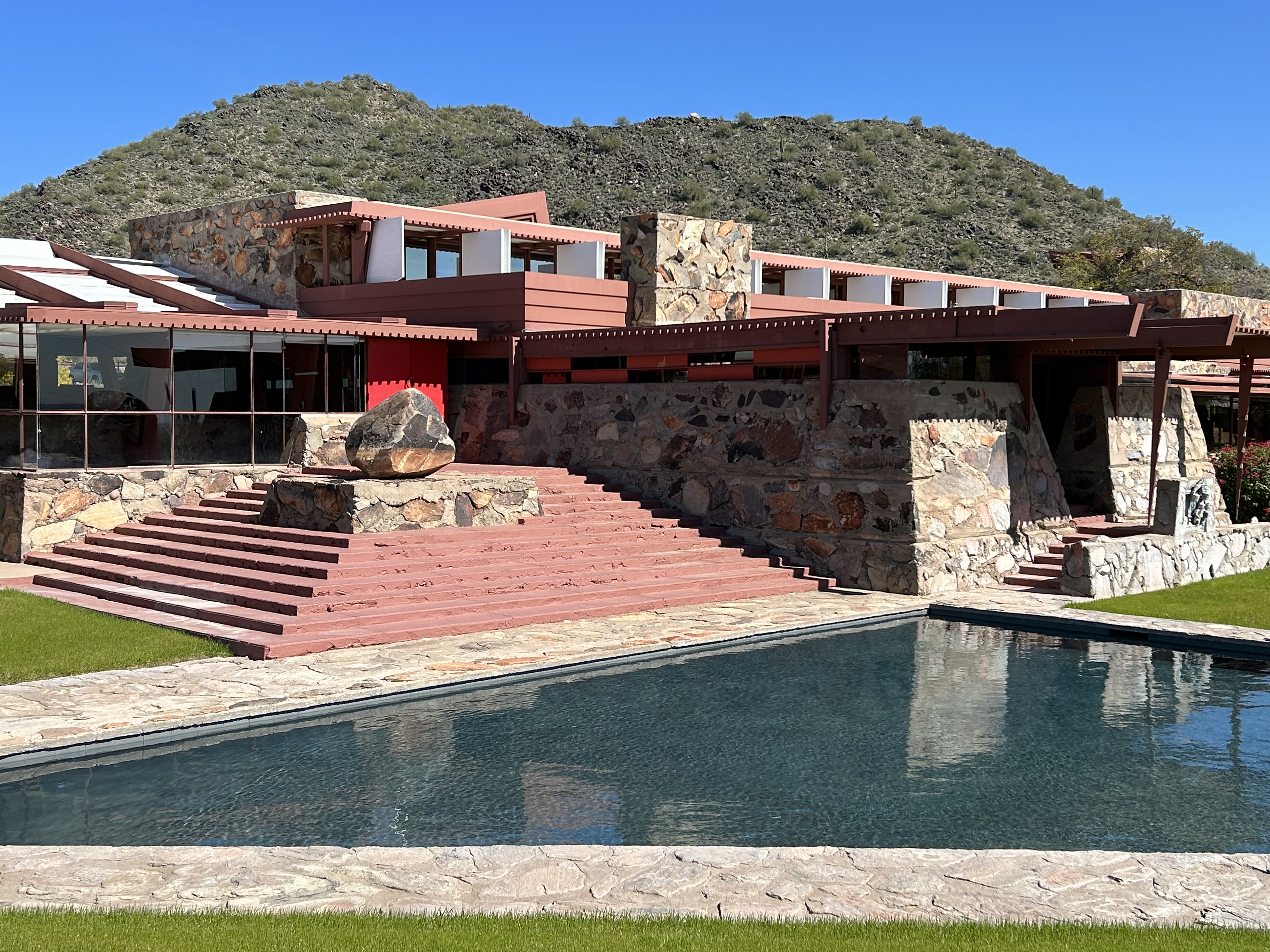
Frank Lloyd Wright’s winter home until his death in 1959, this World Heritage site is a remarkable example of his architecture. The architect preferred to build just below the top of a hill, on the ‘brow’ or taliesin in Welsh. The triangular pool brings the background mountains into the foreground, and the front walk forms a point like the bow of a ship to admire distant mountains, like islands across the undulating desert landscape where cholla cactus looks like coral. Besides the bright red door behind the rock and the small ornately carved scene to the right, there are Chinese influences throughout, including many more carvings, an elaborate story panel, a round garden door, a bell, a dragon and other architectural touches. Inside you can sit in his origami chairs and study the internal structure of a nautilus or the draft blueprint of the Guggenheim. Wright brought his students and apprentices to live and work, and he established an institute dedicated to his school of architecture. Situated in the tony Scottsdale neighborhood, the audio tour of the property is detailed, takes you around step by step and explains his architectural philosophy. Guided tours are also available, and schedules & numbers are strictly limited to keep a steady flow through the small parking lot and on the tours.
In 1969, just below the confluence of the Rio Grande, Devils and Pecos Rivers, a dam was built, creating Lake Amistad (friendship en Español). The lake caused the mouths of the Pecos River and Seminole Creek (above) to silt up, and now that the water level has fallen (like Lake Mead and Lake Powell) they’re cut off from the Rio Grande (see far right). Most of the boat ramps, like the small dock at the cave above, are no longer accessible. The lake is far below minimum expectations, because the US diverts virtually all the Rio Grande water before it even reaches Big Bend. From there most of the river comes from Mexico’s Río Conchos. The park is run in partnership with many agencies, and the two towns that share the border are friendly and have joint cultural festivals annually. Mexico maintains a small fishery, US residents enjoy bass fishing, and the border is marked with buoys. I took one of the old highway ‘spurs’ straight down to the water, but it was too hot to kayak in winter.
Panther Cave, across the canyon above, is on the far western park boundary. While the park film absurdly claims that “no Native Americans have any ties to the area”, the canyon is Seminole Canyon, and the cave is an important site for prehistoric cave art. The Amistad visitor center has information and large reproductions of the cave art, and the excellent Seminole Canyon State Park has morning ranger-led tours to another similar cave and a few miles of hiking trails to see the view above. Before man dammed and drained the rivers and destroyed the riparian ecosystems, Native Americans must have traveled up the Rio Grande to Albuquerque, where some of the oldest petroglyph art was created at the same time as the art here. Sitting on the cliff above observing the wildlife, I imagined prehistoric people hunting, traveling by canoe, drawing on the cave walls and protecting their families from panthers, until thunder warned me to seek shelter.
From 1889 to 1965, the school was segregated, separate but equal by ‘social pressure’ (i.e. racism) in Texas: Hispanic only. Our diversity is a great strength and should be celebrated, not used to divide us. When the Civil Rights movement integrated Marfa’s schools, Blackwell closed. Later some of the proud alumni organized to preserve their school building and grounds, and President Biden has now designated it an official park site, joining other schools in the system, such as Abiel Smith, Penn, Brown, and Little Rock, and joining César Chávez in covering modern Latino history.
[Updated] On 17 July 2024, Blackwell became the 430th park unit, after completing acquisition of property from Marfa’s school district. When I visited, Blackwell was only open noon to 4pm on weekends—not the same time zone as El Paso—, and restoration plans were being decided. Inside are personal photos that bring back the old days, describing Principal Blackwell, teachers, students, athletes and community events. Hopefully, future exhibits will help bring those stories to life with a park film.
In 1955, Hollywood came to Marfa to film James Dean, Elizabeth Taylor and Rock Hudson in Giant. Before that the biggest thing to happen in Marfa was their baseball team, the Indians, competing for the championship in ‘29 and ‘48. Nowadays, Marfa is known for eclectic art exhibits and UFO’s. Just outside of town is a Prada display by the roadside, and if you go the other way, people watch the mysterious lights on the horizon that just have to be aliens. (Really, there’s no other explanation possible!).
I passed nearby Marfa when visiting Fort Davis, and it’s fascinating to me that the original stone school here was built while the fort was still in operation. I recommend staying at one of the quirky campgrounds like El Cósmico which has Tesla engineer designed Jupe shelters and getting local wine and pizza at Para Llevar (to go en Español). And just wander around this weird town that defies becoming a ghost.
Reconstruction began in November of 1861, when US Navy & Army forces destroyed two forts and took Port Royal, because when all the white planters fled in the Confederate retreat, 10,000 slaves took over their sea island plantations. Union policy at the time was to declare the former slaves “contraband” or illegal property seized by the military. But the pressure was on President Lincoln to resolve their status permanently. First, he quietly authorized the Union’s first black regiment—the 1st South Carolina Volunteer Infantry which by November of 1862 mustered 1000 men and engaged in battle—, and then he finalized his executive order to free the slaves.
“all persons held as slaves within any State… in rebellion against the United States, shall be then, thenceforward, and forever free”
Emancipation Proclamation of President Abraham Lincoln
Among the great mossy oaks here at Camp Saxton on the 1st day of January in 1863, our nation’s first black regiment gathered here with their friends and families to all become the first people freed by Lincoln’s Emancipation Proclamation. Then the 1st SC Volunteers received their regimental colors as proud soldiers of the Union Army, under the command of one of John Brown’s conspirators in the raid on Harpers Ferry. Harriet Tubman was also here as a volunteer spy and liberator, and in June she guided three gunboats and the 2nd SC Volunteers up the Combahee River 25 miles north in a dangerous raid that freed 700 slaves. Other African American regiments from Kansas, Massachusetts and other states in both the north and south soon followed, and by the end of the war, 200,000 African Americans enlisted to make up 10% of the Union Army.
As soon as Port Royal was liberated, Philadelphian abolitionists Laura Towne, Ellen Murray and Charlotte Forten, who was African American, arrived and began the most important part of reconstruction: teaching. While not the first African American school, in 1862 they founded the Penn School to teach people who had been denied formal education for generations. The Gullah Geechee people had created their own language and had kept many cultural traditions alive, including the delicious Lowcountry boil or Frogmore stew, and, when given the opportunity for formal education, they began learning basic, practical skills to live independently, everything from shoemaking and auto repair to cooking and nursing. At the Penn Center, I met a Gullah Geechee woman who still speaks the language and who was treated as a child by one of the first physicians to graduate from the Penn School.
The Gullah Geechee sea islands remained in Union hands throughout the war and became central to the Union “anaconda” naval blockade. The hero Robert Smalls (see Fort Sumter), after helping convince Lincoln to enlist African Americans, purchased the home of his previous owner here, using his congressionally awarded bounty for the Planter, and represented this district in Congress for five terms. The beautiful, historic neighborhoods of Beaufort were retained by the descendants of freed slaves by strict preservation laws, resulting in a sharp contrast with nearby predominantly white golfing communities like Hilton Head. In a historic echo, 100 years after the Union used Beaufort as a base to fight the Confederacy, the Reverend Dr Martin Luther King, Jr and the Southern Christian Leadership Conference chose the Penn Center as a base for their Civil Rights campaigns, including planning the March on Washington and the Poor People’s Campaign. Dr King wrote his I Have A Dream speech here in Gantt cabin on the Penn Center campus.
Plan your visit thoughtfully. To the west, Camp Saxton is hidden at the water’s edge between a navy base, the ruins of Fort Frederick and a residential neighborhood. In town, the visitor center in the historic zone’s old firehouse has very knowledgeable rangers who skillfully and kindly disabused me of my misconceptions. To the east, the Penn Center has exhibits (for a donation) on the school, the Gullah Geechee community and the important Civil Rights work done here. There are two dozen historic building on campus including a dock and a Rosenwald school. Many, such as the Brick Baptist Church, aren’t presently open to the public, but Darrah Hall is open with park staff, information and exhibits. A wonderful volunteer discussed whether the Reconstruction Era ever really ended. Plan more time for the Penn Center partner exhibits, less time for the downtown Beaufort visitor center and enough time at Camp Saxton to stand under the Emancipation Oaks (and take a better photo than I did).





 Zero Carbon Travel