George’s great grandfather owned 10,000 acres of Virginia tidewater. The three places Washington lived before he became a national figure were all managed by private foundations, but now the park service runs his birthplace where he lived until he was 3 or 4. There’s a small site in town that covers his boyhood. And then there’s the very popular Mount Vernon site, with living history and the beautiful original home restored to how it looked when George & Martha lived there. The tours at Mt Vernon are in depth and excellent, but this site is quiet and peaceful.
Both George & Martha inherited slaves before their marriage, and many of them had families together at Mount Vernon. The slaves they owned when they died (mostly George’s) were freed around 1800, but Martha’s slaves reverted to a male heir and wound up at Arlington House, where they worked for Robert E. Lee, until freed by that heir’s will in 1862. If only George could have used his office to free all the slaves, he could have saved Martha’s slaves from broken families and generations of more misery and also averted Civil War. One descendent of Martha’s slaves nevertheless saved important artifacts of George Washington’s life when the Union took Arlington House.
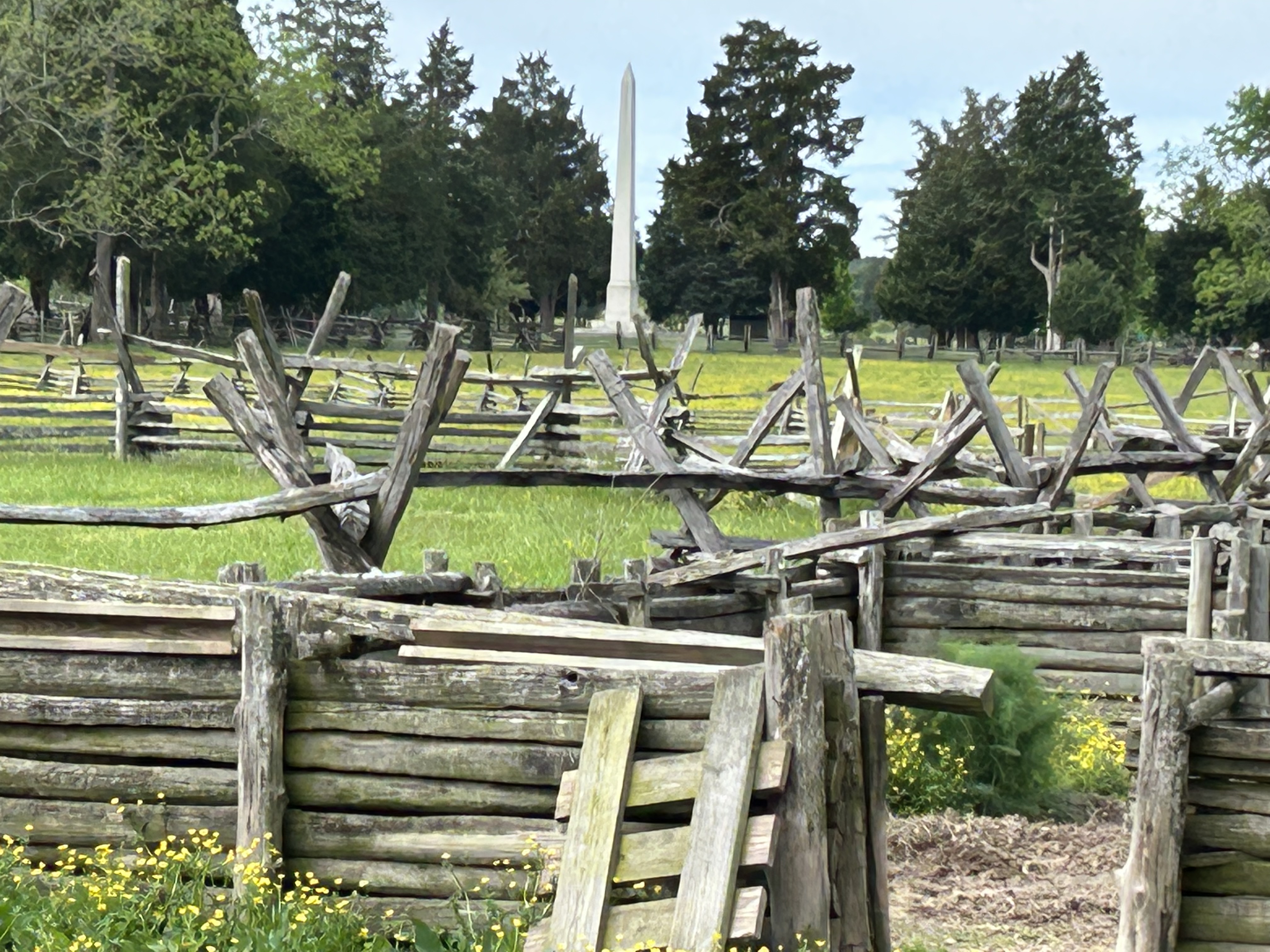
George’s birth site doesn’t get as many visitors as Mount Vernon upriver, but it is beautiful and educational. The old park film is still good, and the hiking includes a lovely 1 mile nature trail near the shore. The buildings are from the wrong era, so I skipped the inside tour. The obelisk above was moved to the entrance at a time when they realized that they didn’t know exactly where George was born on the site, but the park service has now found the foundation of the house that was here at the time of his birth. They’re still deciding how to present or restore it, but in the meantime enjoy viewing the fields, farm animals and the Potomac.
[Update, due to the recent tragic demolition of the above Jackie Kennedy garden, the colonnade on the right and the East Wing, tours have been suspended until sometime in 2026 or later.]
I took the tour! After standing outside the fence last year, I finally got organized and made a reservation. You need to make reservations through your Congressperson—even if you didn’t vote for them—to request a date within 3 weeks to 3 months in advance. Tours are currently given Tuesday through Saturday mornings, and they’re very popular. I requested any date in April, and they said no, the first available was in May. They confirm 2-3 weeks before. So, I changed my schedule, and a few months later, I’m walking through the East Portico, through the historic red, green, blue and other historic rooms. The best experience is to download the WHExperience App from the Historical Society and get all the details on your phone. The staff inside will answer questions and reveal a few fascinating stories, but they’re also there to make sure people behave. It’s difficult to imagine a more historic site, since the residents literally make history. I enjoyed both the recent photographs and the historic portraits.
If you can’t get a reservation, you can peer through the fence on either the north or south sides—pedestrians are once again allowed to walk up to the fence to take a decent photo. There is also a visitor center (no reservations needed) near the East Gate with a movie, detailed model and exhibits. Oh, and my sister reminded me to always put the park site location in my posts—she’s in Real Estate and location is very important—, so, the White House is located at 1600 Pennsylvania Ave, NW, in Washington DC. Thanks!
The house once belonged to the Treasury Secretary Gallatin, was burned by the British and was later named after Alva Belmont, a Vanderbilt divorcee, donor and leader of the women’s movement, who bought it to lobby Congress. The site today primarily recognizes the women’s movement leader Alice Paul (above), who founded the National Women’s Party before women had the right to vote. Finishing what began in Seneca Falls, Paul led the campaign in DC for women’s suffrage and for the Equal Rights Amendment. Here pressure was exerted for gender equality language in the UN Charter and the 1964 Civil Rights Act, among many similar efforts around the world.
The tour allows you to see the many portraits, sculptures and photos of the women’s movement and is very educational. I learned about Inez Milholland, an icon for the movement who inspired the superhero Wonder Woman, Marie Louise Bottineau Baldwin an indigenous woman who marched with the other leaders and later became a lawyer, and more about Ida B. Wells, who refused to march in the back of a parade and joined her state’s delegation from the side. Be sure to ask about segregation, as the topic is apparently only discussed upon request in our new political era.
I did not realize how many women were imprisoned or how many were badly beaten upon their arrest. The photo below shows Alice Paul and Lucy Burns, posing in a cell they once occupied. Over 200 suffragists were imprisoned for protesting in front of the White House, and Alice Paul led a hunger strike that was instrumental in pressuring President Wilson towards passing the 19th Amendment. I recommend the HBO film Iron Jawed Angels to learn about these events. Read more about Women’s History park units.
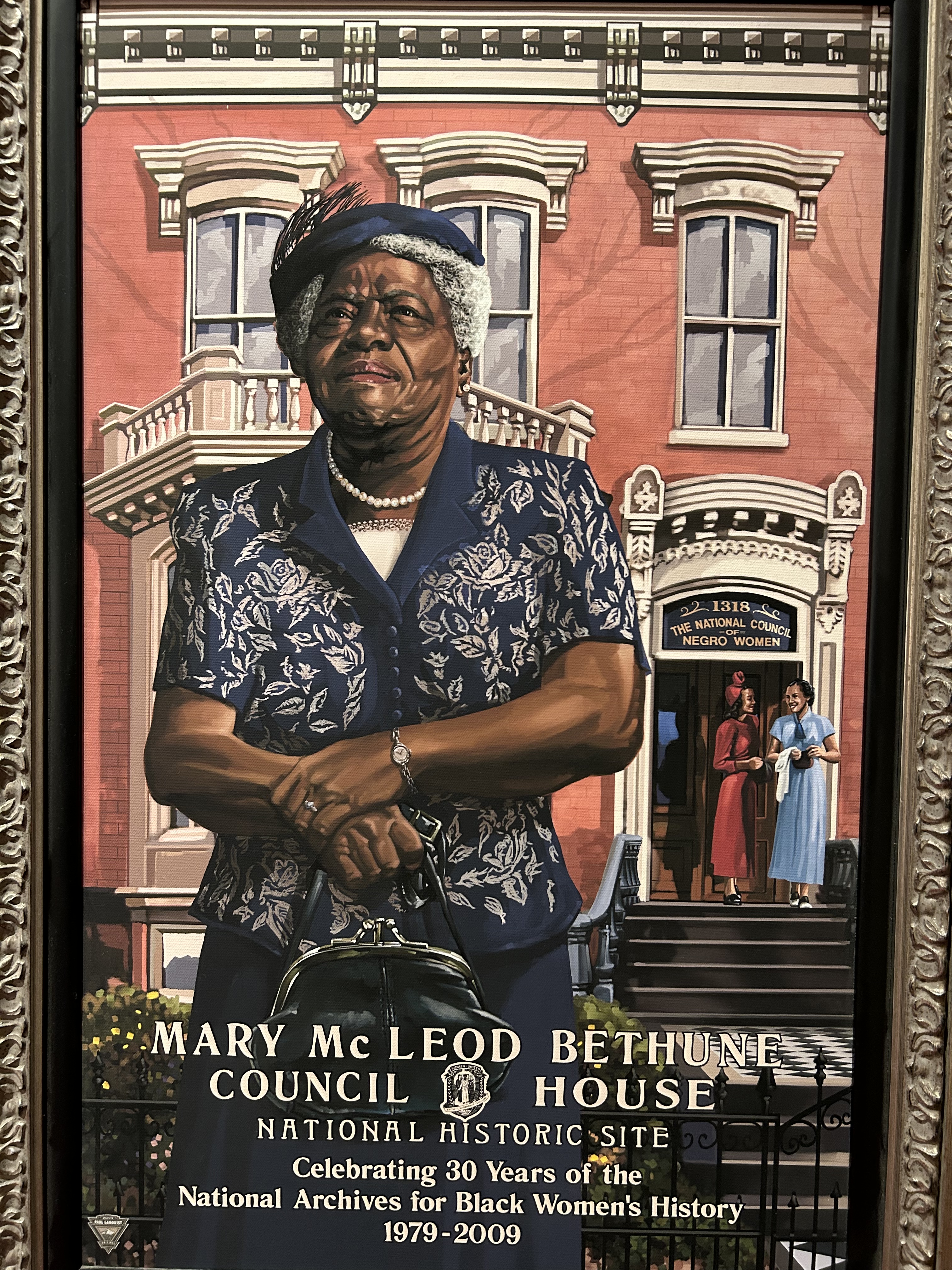
An advisor to half a dozen presidents, founder of schools, civics organizations and the archive above, Mary McLeod Bethune was a dynamo who devoted her life to advancing the lives of people who had been denied equal rights for centuries. Her home office in DC, the headquarters for the African American women’s movement, is just up the street from the White House, where she worked in FDR’s administration, as the first African American woman to lead a federal department. She later was the only African American woman to attend the founding of the UN in San Francisco. She worked with Frederick Douglass, Booker T. Washington, WEB Du Bois, Maggie L Walker, Nannie Burroughs, and Carter Woodson, and she skillfully raised funds from John D. Rockefeller and many white elites at the Palmetto Club in Florida.
The house has recently reopened after some renovations, but the interior rooms and exhibits are still being reorganized. Given the extensive race and gender barriers, the home often had to put up visitors in the top floor, who were unwelcome at DC hotels. The upstairs office was full of busy staff, managing events, publishing articles, and coordinating activities nationally. Downstairs the parlor hosted guests and the conference room hosted important meetings and kept detailed records. The tour guide was exceptionally knowledgeable and provided the context needed to judge the scale of her contributions to our history. Guaranteed to learn here.
While the house is undergoing necessary renovations, it’s appropriate that the sign in the window still displays what was going on during Black History Month this February, because Dr Woodson started that right here in 1926 (originally just a week). Recognizing the need to study and teach African American History correctly, Dr Woodson devoted his life to building the academic and social foundations to publish and teach. The only person of enslaved parents to earn a PhD in History and the second African American to earn a PhD at Harvard—after WEB Du Bois—, Dr Woodson was also Dean at Howard University. He mentored a great many scholars (Langston Hughes worked here briefly), including many African American women. He was good friends with Mary McLeod Bethune, who ran his historical foundation for 16 years. He wrote eight influential books, started two academic journals, and trained a generation of future historians, intellectuals, authors and Civil Rights activists. Today, Dr Woodson is remembered as the Father of African American History. The expanded home is expected to open later this year with a new visitor center.
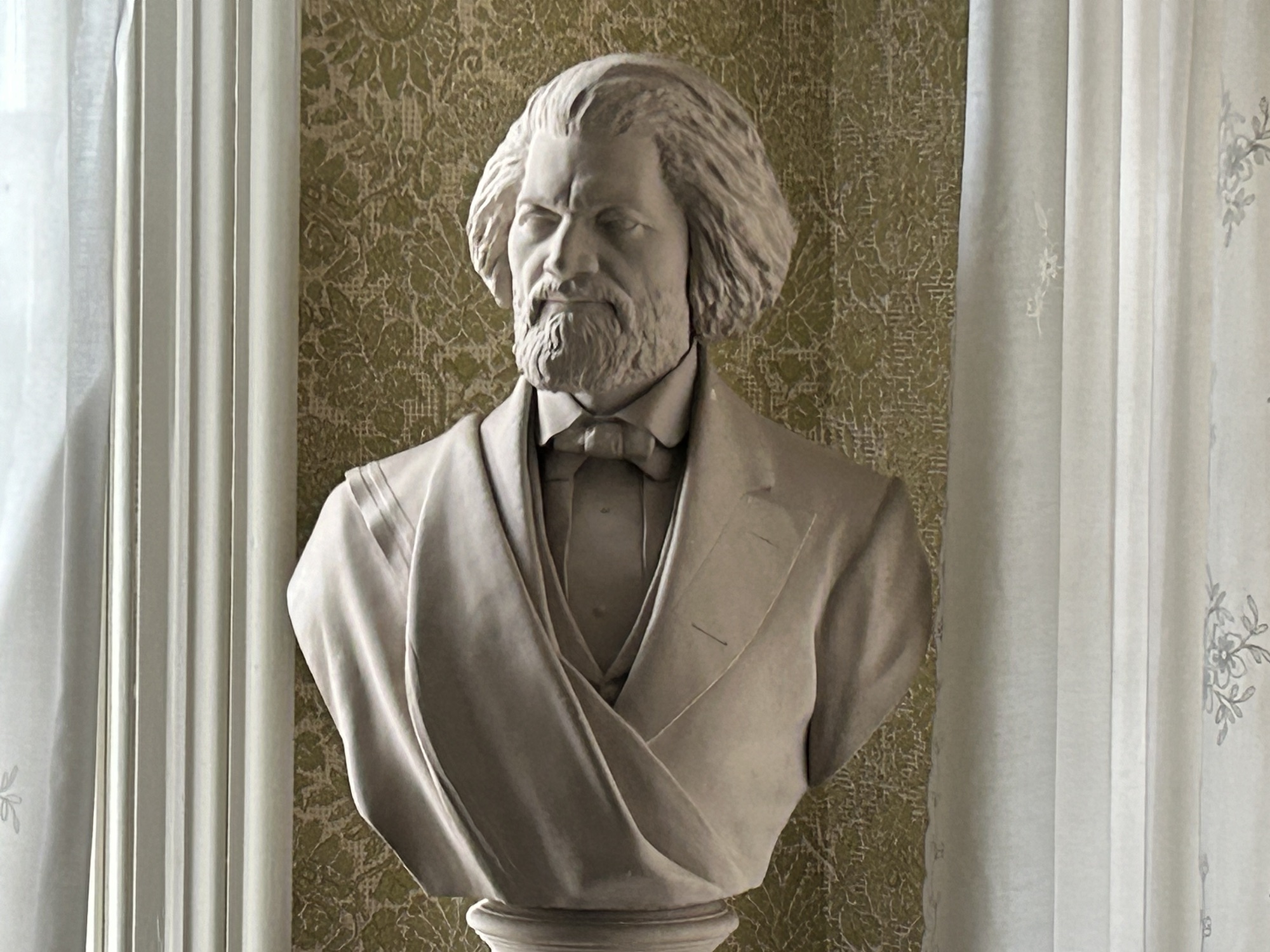
[Update] On my third visit, the site was open after renovations, and the tour allows unique insights into his life. Through hard work, intellect and moral courage, Frederick Douglass became renowned author, public speaker, publisher, adviser to many presidents, US Marshal of DC, diplomat and civil rights leader. He purchased his home on one of the highest hills in our nation’s capital, with a grand view of the Washington Monument. The neighborhood is now historic, and the surrounding area is predominantly African American, some descended from the Civil War refugees who lived in camps near the city for protection. Douglass was cognizant of the lack of African American role models when he was young, so he consciously presented himself well, and gifts like his bust above were meant to inspire another generation of leaders.
Douglass taught himself to read, escaping slavery around age 20, with the help of a free black woman he then married, fleeing to New Bedford where he soon joined abolitionists and his story is published. Pursued by slave hunters, he flees to England, and returns when donors purchase his freedom. He publishes an influential newspaper that supports both abolition and women’s suffrage and several books. During the Civil War, he advises Lincoln and urges African Americans to join the army. After the war, he buys his beautiful home on Cedar Hill overlooking our nation’s capital and continues writing books, public speaking and advocating for human rights. But, perhaps to recall his roots and to inspire him, he did much of his writing in the rough outbuilding—called the Growlery—behind his house, pictured above. Among his many accomplishments, he is often remembered as one of America’s greatest orators.
“Power concedes nothing without a demand. It never did, and it never will.”
Harriet lived in Auburn—when not on the road—from 1859 until her death in 1913. The photo above recently discovered locally is the youngest one on display here. One local visitor said that his grandmother used to visit her and sit in her lap, and he brought more photos. The long term docent, a Vietnam Vet, used to live in the Tubman house and helped lead the effort to raise money for the restoration. Tubman purchased seven acres here from William Seward, of ‘Seward’s Folly’ fame, and a few of her belongings are on display—including her bed, bible and sewing machine—in the old folks home she managed here.
The park rangers are in town, while the home tours are run by the AME Zion Church, an official park partner. Until the operating agreements are finalized, the partner organization runs the majority of the park with a small devoted staff of around one, and the park service runs the church in town which Harriet attended.
I highly recommend reserving the tour, given at 10 and 2. I believe the docent’s name is Paul Carter, and he is both extremely knowledgeable and an excellent storyteller. For example, many of the visitors had heard about secret messages hidden in quilts that supposedly were used to give directions on the Underground Railroad. But there is little to no evidence of this, and logically it isn’t clear how these messages would have been understood by plantation slaves.
When Harriet was seven, she was spotted eating a cube of sugar, which meant being whipped mercilessly. Instead, she hid for days in a pigsty, fighting for scraps to eat. As a teen she received the head injury which caused a type of epilepsy that she interpreted as giving her visions. This was in Maryland, where she feared being sold down to the Deep South where conditions were much worse.
Keenly aware of the brutality and deadly reality of slavery, she began organizing escapes for herself and her relatives. With support of Abolitionists on the Underground Railroad, she became its most legendary conductor, personally leading 13 missions of hundreds of miles from plantation to Canada on foot, often crossing the border near here, rescuing 70 directly, more indirectly and losing none. She gave away her own money, spoke to Abolitionist groups, and raised money to end slavery. During the Civil War she spied behind enemy lines and led troops into combat rescuing many hundreds more. Later in life she spoke in support of women’s suffrage, with her friends Frederick Douglass and Susan B. Anthony. This iconic American hero stood less than five feet tall, and she more than deserves her place on the $20 bill.
If you hear the dogs, keep going. If you see the torches in the woods, keep going. If there’s shouting after you, keep going. Don’t ever stop. Keep going. If you want a taste of freedom, keep going.
Seneca Falls is a lovely town in the Finger Lakes region of New York, linked by canal to Lake Erie, Albany, New York and the St Lawrence Seaway. Frank Capra modeled his fictional town of Bedford Falls after here, and every Christmas they have events reminiscing about the make-believe story.
When the privileged Elizabeth Cady Stanton settled here with her Abolitionist lawyer husband, she found the real-life industrial mill town full of poor immigrant female laborers and found her own life filled with drudgery, taking care of her many children, while her husband’s career advanced. “How much I long to be free of housekeeping and children, so as to have time to think and read and write.” Starved of the intellectual community she had known in New York, Europe and Boston, she organized a ‘conversation club’ to discuss progressive social ideas, inviting Quakers like Lucretia Mott and Abolitionists like Frederick Douglass to her home above. One day, her friend Amelia Bloomer (who popularized the women’s pants) introduced Stanton to Susan B. Anthony, and together they changed history.
“It has been said that I forged the thunderbolts and she fired them.”
Elizabeth C. Stanton of her co-author and friend Susan B. Anthony
At the Revolution, many women and people of color had the vote, which was determined by each state. Abigail Adams asked her husband to “remember the ladies” in 1776, but women’s rights were not included. The biggest barrier to voting was neither race nor gender, it was lack of property. White males disenfranchised others by taking control of land, businesses, marital assets, divorce settlements, bank accounts etc., and then requiring minimum amounts of property to vote. Then they started making gender discrimination official. In 1777, women in New York explicitly lost the right to vote. In 1780, Massachusetts women did too. In 1784, New Hampshire women were disenfranchised. When the Constitution was enacted in 1787, only New Jersey women kept the right to vote.
Native American women in upstate New York owned property and had other rights in their Haudenosaunee Confederacy. And African Americans also wanted voting rights. Elizabeth Stanton realized deeply what was happening in America: women were being systematically oppressed. She sought out allies among the Abolitionists, African Americans, Native Americans and immigrant activists, and they began organizing a movement. In London, her husband had been allowed to speak at the Anti-Slavery Convention, but the women were all excluded. In America, this new movement would be led by women. In 1848, at the Wesleyan Chapel, the First Women’s Rights Convention demanded equal rights, including the right to vote. And they began a campaign that continues to this day, from the American Woman Suffrage Association to the League of Women Voters. Many suffragettes went to prison to try to win rights for all women. The 19th Amendment finally passed in 1920, when the last holdout’s mother sent the Senator a telegram, causing him to flip.
The park unit does not do a good enough job of telling the story—with the notable exception of ranger Nicole above. On the plus side, the names and images of numerous women’s rights activists are presented, and many of the related issues are described in the text-heavy exhibits. Sojourner Truth demands inclusion for African American women, “I have borne 13 children, and seen them most all sold off to slavery, and when I cried out with my mother’s grief, none but Jesus hear me. And ain’t I a woman?” FEW Harper puts it well too, saying that white women “need to be lifted out of their airy nothings and selfishness.” There’s a single image of a women’s rights meeting that occurred in Persia (now Iran) one month before the convention here, with a quote from Táhirih, “You can kill me as soon as you like, but you cannot stop the emancipation of women.”
But the park film is no longer available, and replacing it “is difficult”. One of the largest photos shows a female African American military (ROTC?) recruit in front of a line of white uniformed men, without any information or ranger knowledge, thus forgetting the name and act of a woman who apparently broke both a gender and color barrier. More of the exhibits are about the Underground Railroad and fashion than to the right to vote. Frankly, I learned more about the direction and timeline of women’s voting rights from a small display in the parking lot of the XIX Cafe than from the official park exhibits. One of the local women described the whole park as “lame”. It took me two days walking all over town to piece together the story. It is frustrating to see such a missed opportunity to tell the story effectively about the extraordinary centuries long struggle for the basic rights of the majority of US citizens.
But go anyway. Ask to see the park film—they’re counting the number of people who complain. Ask how the history here relates to the loss of voting rights today. Ask about the Equal Rights Amendment. Ask about Lily Ledbetter. Ask about Trans rights and reproductive rights. Ask them to describe the Suffragettes who burned Wilson’s effigy in front of the White House. Make some noise, and don’t let manners hold you back. Don’t let this history die, or future generations will have to fight it all over again. The fight goes on!
This is a quirky little site. Even Teddy didn’t spend much time here. He arrived in response to McKinley’s assassination, left when told he would recover, returned upon hearing he would die, and was inaugurated in 30 minutes by a local judge.
One of Teddy’s first official acts here was to invite Booker T. Washington to the White House. Teddy was also famously friends with John Muir, and he also befriended activist Jane Addams—who eventually won a Nobel Peace Prize and deserves a park site of her own. You can tell a lot about a person by his friends.
There are only a handful of rooms to see, but there are interactive exhibits about the Pan American Expo—where McKinley was shot by an anarchist—issues of Teddy’s Presidency, his friends & advisors, his draft first speech, and the room above where he was sworn into office. The tour evokes the hasty events here well. And if you get hungry, there’s a bar down the street that claims to have invented Buffalo Wings.
Ida Saxton McKinley’s house above is managed by the site, and was preserved by a private foundation before the park service got involved. The tour is interesting, with some original artifacts, and the ranger did a good job of comparing this famous widowed first lady with Jackie Kennedy. While times change, the political importance of presenting a positive public image remains.
The museum and visitor center a block away has rotating exhibits of the various First Ladies, and Nancy Reagan was on display. Jackie Kennedy’s display begins on May 2nd. Not sure why Michelle Obama’s poster has to be in the most difficult to find corner of the basement, but whatever. One of the park films was on fashion and power, and it did an excellent job of explaining the political power of First Ladies like Dolly Madison and Jackie Kennedy, who used White House events, interior design, fashion and adroit diplomacy to support their husbands’ administrations, often more effectively.





 Zero Carbon Travel