Saint Croix Island International Historic Site

The island itself is off limits, but there’s a viewpoint, a visitor center, some statues, and a rocky cove. The lighter land in the background is Canada. As is often the case in New England, I visited here as a child, although I had forgotten. Rediscovery is rejuvenating.

The French were determined to establish a trading post here in 1604, but the winter killed half of them. One of the survivors was Samuel Champlain, who went on to found Port Royal in Nova Scotia—the first successful colony north of Florida—and Quebec. He also accurately mapped the coastline, opened fur trade with the natives and was de facto Governor of New France.

Roosevelt Campobello International Park

The park is in Canada, but the bridge to the Campobello Island is from Maine. I use my passport card for trips like this, where I just drive across the border for a few hours. I also crossed the border into Juárez in January, so this is my third country by EV. The park is an affiliated park, jointly run by both the US and Canada. Obviously, the staff are very nice, polite and helpful.

The Roosevelts used to vacation here in summer, and one of their children was born here. FDR came down with polio here in his 30s, although he likely contracted it before arriving. The house tour is fascinating with various toys and artifacts of their summers, and there’s a large nature preserve which has exceptional views at Liberty Point. However, my favorite part is the Tea with Eleanor.

At 11 and 3 (Atlantic time is 1 hour ahead of Maine), the staff give visitors free tea and cookies in one of the cottages while they present the life and achievements of Eleanor Roosevelt. They describe her trip to Tuskegee, her wartime work with the Red Cross, her friendship with Mary McLeod Bethune, her concert at the Lincoln Memorial for Marion Anderson, and here work on the UN Universal Declaration of Human Rights, to name a few. One of my favorite park experiences.

Salem Maritime National Historical Park

[In July 2025 the president upgraded this park from a historic site to a historical park]. Per Tripadvisor, this site doesn’t even make the top 10 things to do in Salem Massachusetts. Honestly, I would recommend the Peabody Essex Museum, the House of Seven Gables, and a nighttime witch walking tour before I’d send someone here. Not that it isn’t an interesting site that describes the port’s peak between the Revolution and the War of 1812, it’s just that there’s a lot of fascinating history in Salem outside the park.

In the several 18th century buildings near the wharf run by the park service, you can learn about the British East India Company, trade with the West Indies, slave traders, Polish immigrants, and more than you wanted to know about how goods cleared customs and were taxed (Hawthorne worked there but spent his time thinking up The Scarlet Letter). There’s a replica tall ship, the Friendship, docked on the wharf, but it’s under restoration—looks better inside. The 19th century Derby Light Station above still functions (solar, upgraded from oil) and sits at the end of historic Derby Wharf, which is quite long and gives folks a nice view of the harbor.

All Frank Lloyd Wright World Heritage Sites by EV

UNESCO chose eight Frank Lloyd Wright sites for World Heritage status, and I visited them all this year by EV. An exhaustive tour of Wright’s designs could visit 100 sites, but the Heritage 8 are sufficient for me. My cross country trip went from Hollywood, to Arizona, Wisconsin, Chicago, Pennsylvania and finally to New York, but it’s easier to understand his life’s work below chronologically.

His home and studio in Oak Park Illinois showcases his various styles, influences and experiments, including his first design: his own home. While this is the one site I visited that is not on the World Heritage list, just walking the neighborhood is worth the trip.

Unity Temple in Oak Park in 1905 is a church built for his mother.

Robie House at University of Chicago in 1910 is my favorite, built for a wealthy client who only lived in it briefly.

Taliesin in Spring Green Wisconsin in 1911, later rebuilt after a dramatic tragedy, used funds from Robie to build a family country home with a school for his acolytes.

Hollyhock House in Hollywood California in 1921, was built for a theatrical oil heiress who fired him for going over budget.

Fallingwater (above) in Mill Run Pennsylvania in 1937, is his most iconic private residence, built for a wealthy department store owner whose son gave it to the park service.

Taliesin West in Scottsdale Arizona in 1937, used funds from Fallingwater to build a winter home with another school for his acolytes.

Jacobs House in Madison Wisconsin in 1937, was built to demonstrate that Wright could design something affordable on a budget.

The Guggenheim in New York City in 1959, was built to display art and to be art, for the future.

I hope you enjoyed this brief tour of 50+ years of the most widely recognized designs from America’s greatest architect.

Sagamore Hill National Historic Site

After Lincoln, Garfield and McKinley were assassinated, Teddy Roosevelt was the first to receive Secret Service protection. At 42, Teddy is our youngest president, the war hero who led a cavalry charge up San Juan Hill in Cuba during the Spanish-American War, becoming the only president to earn the Medal of Honor, posthumously. A student of our weak navy in 1812, Roosevelt not only built new ships, but projected them in force around the world, building the Panama Canal in part to enable America to shift fleets between oceans rapidly. He was the first American to win the Nobel Peace Prize, for negotiating the end of the Russo-Japanese War, after bringing the parties together here at Sagamore Hill in Oyster Bay on Long Island in New York.

The north wing above is the trophy room of his life and presidency, and many of the artifacts were gifts, including the tusks given by the King of Abyssinia (Ethiopia), the Remington bronze Bronco Buster given by his regiment, the samurai doll given by Admiral Togo, the swords given by the Emperor of Japan and the carpet from the Sultan of the Ottoman Empire (Turkey). The hat and saber on the elk horn on the left are from Teddy’s rough rider gear. Roosevelt shot most of the animals displayed, including the Cape buffalo—the most dangerous of the big 5 safari animals—over the entryway mantle, but the the polar bear hide in the living room was from North Pole explorer Robert Peary and the Siberian tiger hides were gifts from the Empress Dowager of China, including one in daughter Alice’s room after she threatened to run away unless she got it.

The children recalled being “expected to have fun, and we did”. Thomas Edison, John Muir and first solo circumnavigator Joshua Slocum were a few of the many guests with standing invitations to dinner, so long as they helped educate Teddy’s kids. The kids took boats out into the bay, traipsed through the woods, rode horses, learned to shoot, raced and played, ate fruit from the orchards and drank milk from their dairy. They were small witnesses to history, as Roosevelt ran the country from the Summer White House and met a constant stream of dignitaries.

For Teddy, his birthplace in New York was where his mother and first wife died, and his ranch in North Dakota was where he grieved and grew. After death, he would be remembered on Mt Rushmore and on his island in the Potomac. But, as much as he loved world travel, Teddy lived his happiest days here with Edith and his family. Edith held his life together, supported him and his presidency, lived here for almost thirty years after his death and is buried next to him on the property.

“Well, my dear, I was married to Theodore Roosevelt.”

Edith Roosevelt on being asked why she never remarried.

Wright Brothers National Memorial

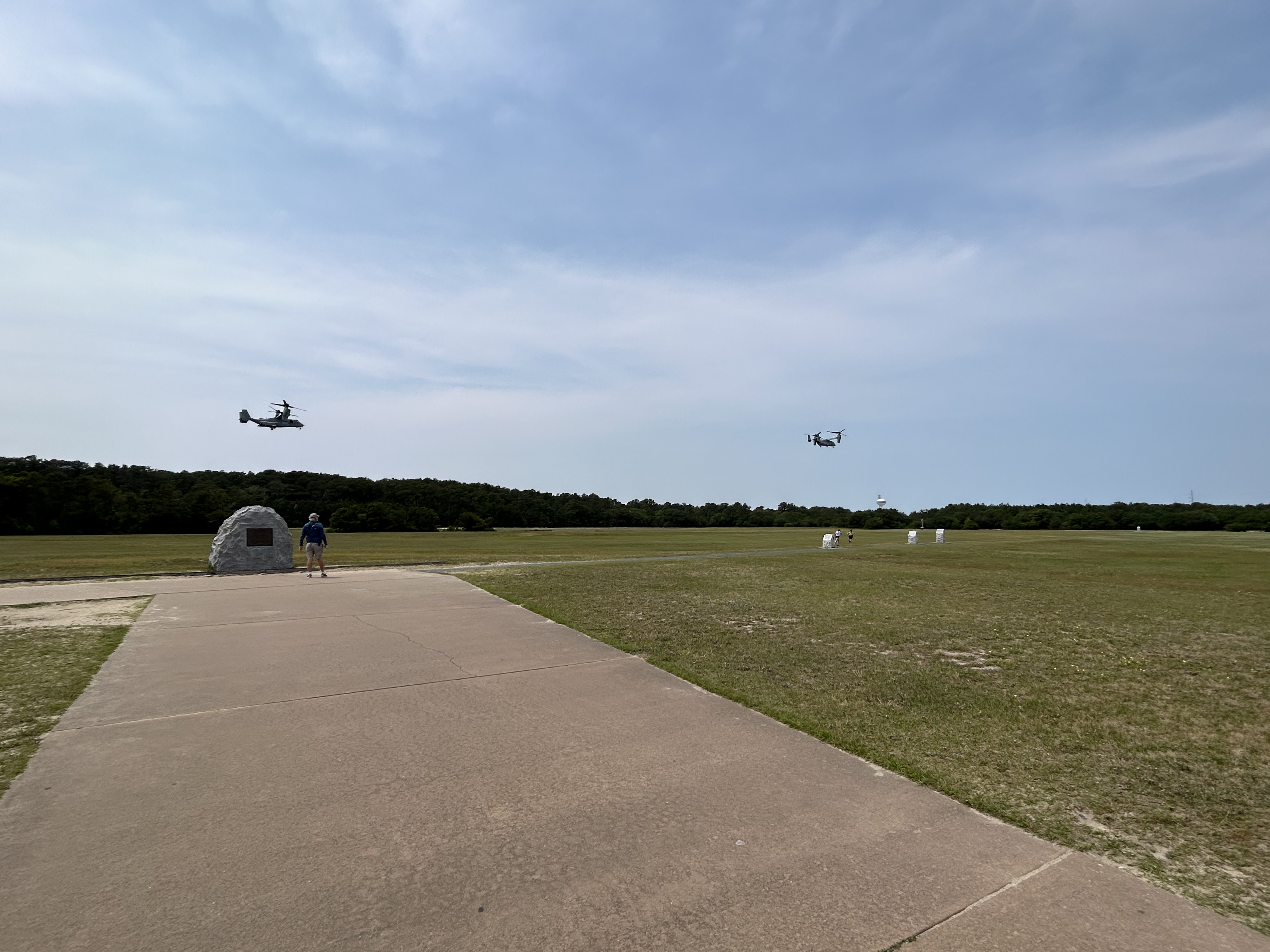
The boulder under the Osprey to the left marks the first flight takeoff, and the three stone markers under the right Osprey mark the first three landings. The fourth landing is marked by the white stone marker visible to the far right.

While the first flight happened here in North Carolina—at Kill Devil Hill near Kitty Hawk—due to favorable wind conditions and relatively soft sand, most of the work and final testing of a workable aircraft that could turn was done in Dayton. Inside the museum here you can see a full scale reproduction of the 1903 Flyer, and outside there’s a sculpture depicting the first flight. It’s a beautiful spot with a huge monument on the hill where they conducted gliding tests, and, yes, it’s still very windy.

James A Garfield National Historic Site

For some reason, the volunteers giving the tour did not appreciate my ‘Dad joke’ references to the cat from the comics (no relation). James Garfield was a veteran of Shiloh and Chickamauga and an effective General. He was also a large man, a skilled orator and quite intelligent, devising mathematical proofs, etc. At the 1880 Republican Convention, Garfield went to support John Sherman, of the Sherman Antitrust Act, but Sherman couldn’t win the nomination. After over 30 failed ballots, someone proposed Garfield, and he became the nominee. Garfield built a path from the railroad line at the back of his Ohio property to his front porch and invited all comers to hear him speak. This new ‘front porch’ campaign was a hit, and he won.

After only a few months in office, Garfield was fatally shot in the back by a failed applicant for a Civil Service job. It took months for him to die, and a rich friend raised a considerable amount of money to take care of his widow. So, the most significant policy which arose from his brief administration was to reform the Civil Service process, so that the President wouldn’t have to meet anyone who wanted a job and hand them out (often corruptly). They also granted pensions to the widows Garfield and Lincoln.

Garfield’s widow, now rich, added 20 rooms or so to her house and built a private Presidential Library upstairs, a first. The house is mostly filled with authentic items and is remarkably well restored. The room above is the best lit and shows the finery. The library no longer contains Garfield’s papers, but it contains many books, prints and busts of authors, and Garfield’s congressional desk. Based on his Congressional career, one could argue that Garfield would have been a good President, supporting African American suffrage, voting for Johnson’s impeachment, etc., but it’s neither clear nor a flawless record. We’ll never really know.

“I’m feeling down.
Down, down, down.
Down, dooby down-down.”

Garfield

Wolf Trap National Park for the Performing Arts

Honestly, the show was disappointing, but not every show is going to be like the Doobie Brothers’ Live At Wolf Trap. If you go, be sure to book your tickets months in advance to get seats to the most popular shows. Lots of folks arrived early to sit on the lawn in ‘general admission’ up above the seats, watching on big screens. I’d prefer just to hike the 2.5 mile trail through the Virginia woods, but I braved the crowds for the experience. And it was fun, so I shouldn’t complain that the artists were a bit out of tune and didn’t have much of importance to say. At least the expensive beer and crab cake sandwich tasted pretty good, so, except for my hearing loss, it was a good night.

Upper Delaware Scenic and Recreational River

Inside the Zane Grey museum in Lackawaxen PA, there are a couple of photos Grey took that make me extremely envious. One is him in 1920 sitting under Rainbow Bridge—which is a park site that I honestly can’t figure out how to visit—, and another is of his three masted schooner Fisherman in 1932, on one of his many adventures at sea. Grey introduced the world to the great American West, writing dozens of novels selling millions of copies in several languages along with movie and TV adaptations. I consider myself a bit of a traveler now, but many times I’ve reached a remote place, only to find that Grey beat me there by 100 years, on horseback or by boat. My grandfather and uncle inspired me with their travel stories, and I now have their journals of their trips out west with me to compare notes (thanks Nim!). I also have a decent collection of Zane Grey ebooks, although I read them mostly for the journey descriptions. Zane and his wife loved this place on the Delaware River, and I’m sure he’d have loved to see so many people taking their families out on small boats right off his front porch.

Eisenhower National Historic Site

Ike didn’t really like his “stuffy” living room above, but it contains some wonderful gifts from around the world, including Prague above the mantle, Korea, Iran and Grant’s fireplace from the White House. Ike preferred to chat with de Gaulle and Khrushchev in his enclosed porch. My favorite room is the den, which is more of a library, but it’s harder to photograph.

The house is well-preserved in 1950’s style, with almost all original artifacts, since the Eisenhowers lived here until it was given to the park service. Mamie’s home furnishings and decor recall her devotion to Ike, their family and all their guests. Much of the site is devoted to the farm & ranch—blue ribbon Angus cattle—, with various barns and related buildings, but there are a few less common features, such as a putting green, skeet range, helipad and Secret Service office.

The ranger didn’t know that Ike was a cheerleader, but she did explain what this place meant to Ike and why they chose it as their only real home as opposed to the dozens of places they lived temporarily. Ike trained the army’s WWI tank corps here in Gettysburg, and he loved to study the battlefield. That explains a lot.