I love this statue. Carver was born at the end of the Civil War and was kidnapped and orphaned by the Klan. His mother’s owners retrieved him and raised him here, where he studied the plants near the creek as a child. He was educated mainly in Kansas, despite racial barriers, and eventually became the first African American to graduate from his school. His manner was mild, but he demonstrated great determination in the face of poverty, adversity and prejudice.
Recognized for his extensive scientific knowledge of botany and for being a groundbreaking African American scientist, he was hired to teach at Booker T. Washington’s Tuskegee University. His goal was to help the least in society, so he worked on modernizing agricultural techniques used by African American farmers, even bringing a cart from the university out to the fields to teach, a technique copied by the US Department of Agriculture. He published many books and pamphlets, developed patented techniques and is best remembered for developing the lowly peanut into a highly profitable series of products. He testified to Congress about the peanut and scientific agricultural techniques and was widely recognized for his many accomplishments.
I know Carver is an inspirational figure admired for overcoming obstacles, but I can’t help but wonder how many others were denied even the limited opportunities he had. Slavery existed here for 244 years, with 10 million sent across the Atlantic and maybe another 10 million born into slavery here. None of them were properly educated. None had the freedom to pursue their dreams. And all died without being able to fully contribute their talents and ideas to improve the world. How many young, inquisitive minds were destroyed by slavery? How much human enlightenment was snuffed out to pick cotton? Carver was one of the first born after the Emancipation Proclamation was signed, and he spent his life making the world a better place for all of us. But I can’t help but mourn the incalculable loss of all the other people during those 244 years and after who could have contributed as well or even more.
Here’s the link to my visits to all the parks in Missouri.
Built in 1842 to defend the “permanent” frontier with Native American territory, the fort quickly fell behind events. Settlers were already moving west on the Santa Fe Trail. Within four years the actual frontier was being taken from Mexico, with cavalry “dragoons” riding a thousand miles west from here to fight in that war. The fort was abandoned in 1853 and the buildings auctioned. But the military withdrawal set the stage here for Bleeding Kansas, the conflict that presaged the Civil War. Turns out the military wasn’t needed here to keep peace between the settlers and the “warlike” Natives, but rather between the slavers and the abolitionists.
When the Supreme Court overturned the Missouri Compromise and the government passed the Kansas-Nebraska Act, the US government officially decided that it was best to just let the states decide on slavery by themselves. Here, the pro-slavery townspeople– and “border ruffians”–took over the fort to defend against militant abolitionists in the surrounding countryside who were determined to prevent the expansion of the moral abomination of slavery. Around 60 people were killed, including a pro-slavery former deputy marshal, whose widow is remembered for swearing revenge.
The US military returned to use the fort during the Civil War and defended it from guerrilla attacks. Both African American and Native American regiments were formed here. And after the war, soldiers were again sent west to defend the railroads against squatters who protested being cheated out of the land stolen from the natives.
While educational, I believe the park service has a responsibility to do more than simply illustrate the views of both sides. The Civil War was not “a controversy over states’ rights” nor was Bleeding Kansas merely “growing pains” as park exhibits say. The only states’ “right” being contested was the “right” to chain and breed people, on the basis of race, in perpetual ignorance and slavery, including women and children, forever. By any standard of human rights, that is not a right, but a profound moral crime. There is no legitimate justification of slavery. Perpetuating traitorous and racist views that there was any honor in fighting for slavery is dangerous to society and deeply offensive, to those held in bondage, to their descendants and to those who fought and died to end slavery in America.
Here’s the link for my visits to all parks in Kansas.
The home was actually Bess’s family’s, before becoming the vacation White House. Due to my inattention and Tesla’s quirky routing, I briefly visited Truman’s family farm, which is much less fancy, before getting to the center of Independence where Harry worked as a judge and could walk a couple blocks to Bess’s house. President Truman evidently enjoyed coming back to Missouri as often as possible, and I’m sure he would be pleased having so many folks visit.
Very little official business was conducted here. But if you’re looking for information on Truman’s Presidency, his library and related artifacts are managed separately by the National Archives a few blocks away.
Here’s the link for my visits to all parks in Missouri.
The volunteer here deftly explained to me why the NAACP chose an elementary school in Topeka Kansas as part of their legal battle against segregation. The NAACP had tried various cases in other states, where white schools like John Philip Sousa in DC were superior and where black schools like Hockessin #107c in Delaware were inferior, but here in Kansas, the two schools were almost identical in terms of facilities. In fact, the teachers in the black school were more qualified, due to lack of opportunities elsewhere. Because of the superficial “equality”, the NAACP was able to argue that segregation itself, no matter how “equal”, is unfair and damaging.
It’s not that Kansas was all or always fair-minded. Violent racist agitators in Kansas both predate the Civil War and still exist today. At the time, racist policies were implemented either broadly by law in states like South Carolina or locally and selectively in states like Kansas. Perhaps because Topeka is the state capital, the schools here were segregated with substantially equal funding.
The key to the case was the Clark Doll test, where black children often identified with and preferred to be like a white doll rather than a black doll. The evidence made it to the Supreme Court, where it was cited by Chief Justice Warren as revealing the permanent damage done by legal segregation. One of the original dolls used in the test is here.
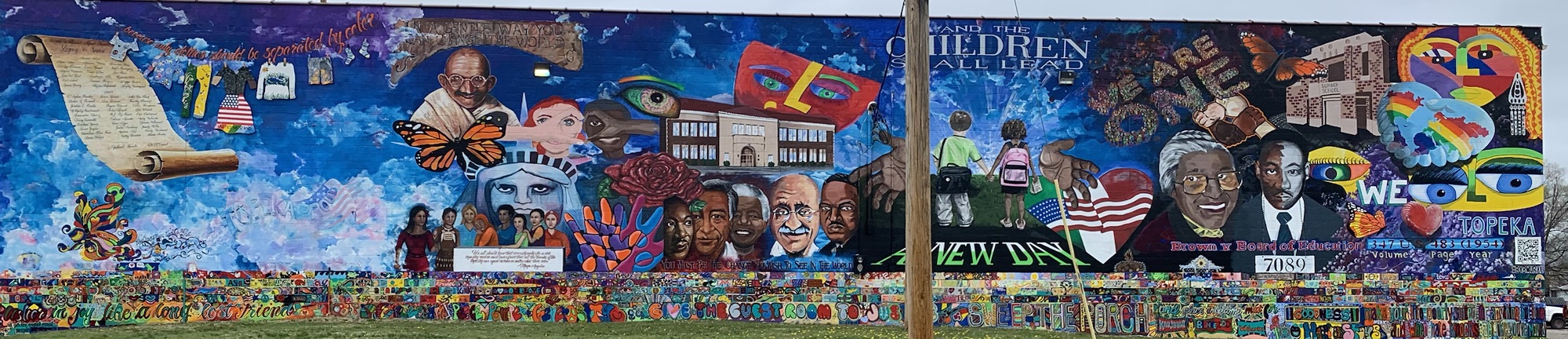
It is a privilege to be able to visit and feel connected to such an important site in the Civil Rights movement. The nation has many sites devoted to war, especially Civil War memorials, and I wish it had more sites devoted to the other kinds of fights we had for moral progress. The mural outside pictured above was done in 2018, and at the bottom local kids added their own colorful illustrations showing what Brown v. Board of Education means to them.
I grew up reading about the frontier spirit of rugged individual homesteaders who followed their manifest destiny, tamed the wilderness and settled the country by grit, determination and hard work. Most Americans can trace their roots back to folks like these, and this view traditionally defines what it means to be an American.
But I’ve learned a few things on my way here, so it’s time for some myth busting. First, the “untamed wilderness” was already occupied by Native Americans who built homes, farmed and lived off the land. Second, the settlers received serious government assistance in the form of the US military clearing the Native Americans off the land and giving it to them. Third, the homesteaders almost immediately ruined the environment by removing the topsoil, causing the dust bowl and mass migration to California. And finally, I only see little huge corporate agribusiness here now, not individual farms.
The park is impressive, with both a state of the art Heritage Center and an Education Center. The film and museum are “award-winning”, and much of the focus appears to be on teaching kids to be proud of their homesteading ancestry. Much of the money was donated by the local fossil fuel utility, so I’m not surprised that environmental issues such as the tallgrass prairie devastation, the dust bowl and the changing climate are not the focus. But what angered me was a slight-of-hand trick employed to tell the homesteading story.
The film & exhibits make it abundantly clear that the Native Americans once lived on the land before the homesteaders settled, and the unfair history is presented in a way that kids can’t leave without learning some basic facts. However, at the beginning of the film Native Americans are described as not believing in land ownership, in the middle they say all they want is for everyone to respect the land, and at the end one Native American speaks of how he loves his reservation. And the egalitarian aspects of the Homestead Act are used to justify it: blacks could homestead (although slavery held them back at the beginning), women also benefited, and European immigrants homesteaded.
I believe it’s wrong to lie to our kids, especially to make them feel better about something that was wrong to do. The Native Americans did own the land. And the homesteaders knew it, because the newspaper ads that urged them to go west clearly said “Indian Territory Open to Homesteaders” and “Grand Rush for the Indian Territory”. They knew it, because some moved into sod pit-dwellings built by Native Americans. They knew it when they copied Native American burn techniques to encourage new growth to feed cattle. And they knew it when they grew corn in the same fields as the Native Americans. What the Natives didn’t have were written real estate deeds or the ability to defeat the US military.
It’s simply dishonest to suggest that it was OK to take the land due to lack of ownership rights. It’s also wrong to imply that it was OK to take the land since it was under-utilized. Imagine someone comes into your home and tells you that they bought your land on the dark web using Bitcoin. Then they explain that it’s all legal in the new digital world and that you have to move out now since you don’t have a hexadecimal key to participate in the secret auction online. When you protest, they force you to leave with high tech weapons. Finally, to justify their actions, they say that they can house more people and grow more food on your lot. You would correctly say that you had been robbed, and you would correctly say that the explanation doesn’t justify the crime.
Frankly, in the 21st century, to be repeating old lies that the Native Americans wanted homesteaders to take their land because they would better use it is offensive. The US military forced the Native Americans off the land at gunpoint, by slaughtering bison, and by encouraging white settlers to move in. The homesteaders used the land in the same way as the Natives, farming, ranching, hunting and fishing. In some ways they were more advanced, and in other ways, such as topsoil removal, they were more destructive. It is also devious to try to defend the racist policy of Native American removal by saying that it benefited blacks, women and immigrants. Would you teach your son that it’s OK to beat up and steal another child’s lunch as long as he shared a little of it with other kids who were hungry?
Yes, there’s also a new fort, and no, I didn’t go there. The fort is a beautiful reconstruction made for the US Bicentennial. You might notice the fire damage around the edges. Just a few days earlier, a fire (under investigation) burned the fields and trees surrounding the fort. Fortunately, the fire department and rangers saved the fort and the animals. Even though I could still smell smoke, the ranger/ volunteer firewoman gave a full tour in period costume.
The Bents were merchants who traded buffalo bison hides and other goods on the Santa Fe trail. The fort was more of a commercial trading post than an active military base, but the lines were blurred. Kit Carson spent some of his early years around here hunting shooting bison. The US government used forts along the trail to protect the mail and to replace the Natives with white settlers.
Racism drove cultural hegemony. Before the arrival of Europeans, the Native Americans built homes, ate bison, hunted, fished, and grew mixed crops of corn, beans & squash. The superior settlers introduced a completely new way of using the land by building homes, eating beef, hunting, fishing and growing wheat. Oh wait, that’s exactly the same.
Click here to find my photos of all parks in Colorado.
While it is easy to see the impressive semi-circular pueblo ruins on the valley floor and peek in the various rooms along the canyon wall, Alcove House was open to those willing to hike a bit further and climb the series of steep ladders 140 feet up. I imagine it would have been much more difficult carrying supplies, children or elderly relatives up the ladders when the Native Americans were living here. There’s a creek running down the canyon from the large volcano which makes a pleasant place to consider the climb or to cool down on the hike back.
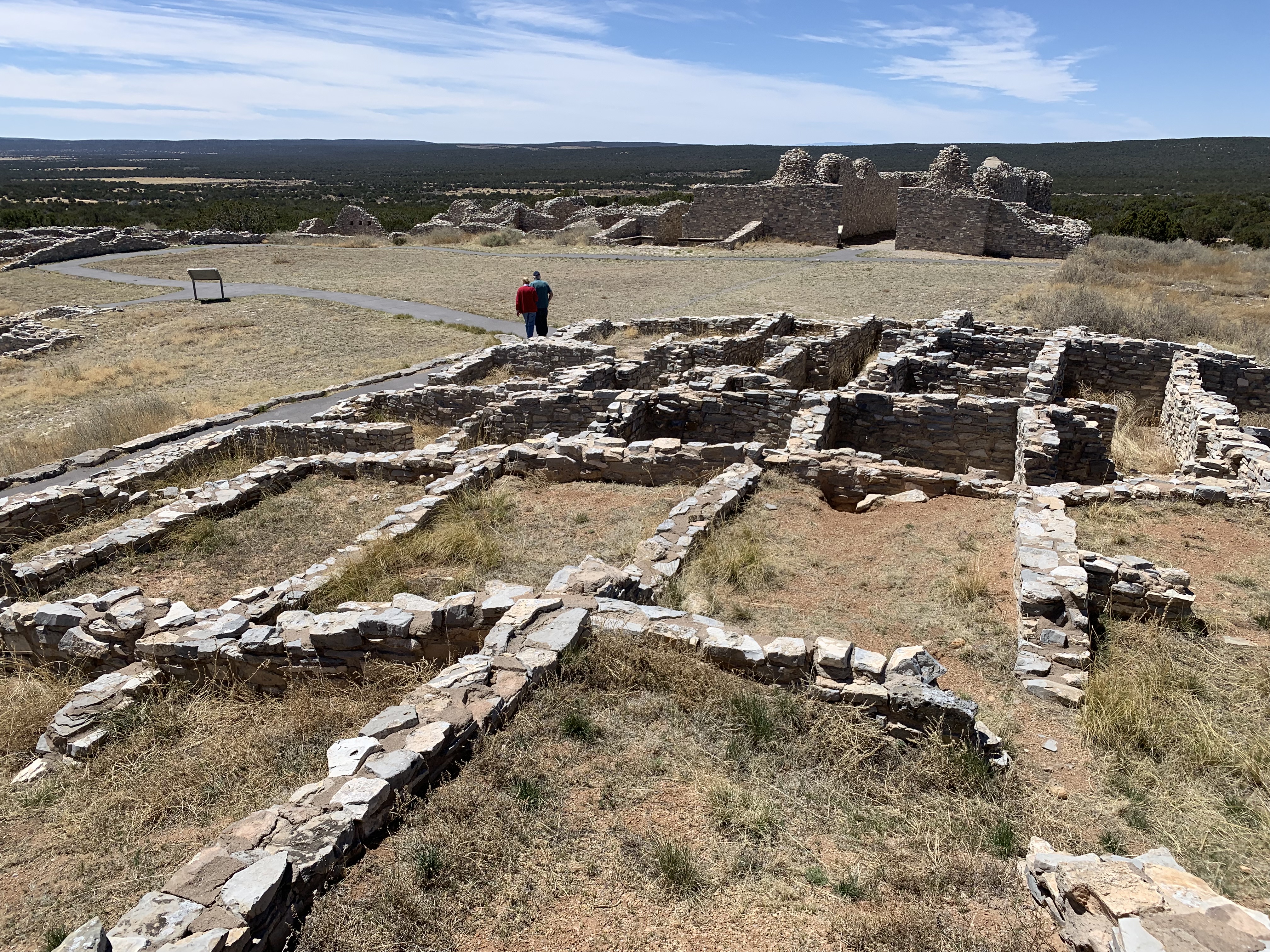
I chose to visit Gran Quivara, since it has the largest pueblo ruins of the three missions, although the churches are better preserved at the other monument sites. The original pueblo ruins are in the foreground. The Spanish claimed the land for the King and forced the people here to build two churches, first the low ruin to the left and then the taller structure in the back. Some accounts describe the relations between the natives here and the Spanish as friendly and positive. From what I can tell, it’s hardly a coincidence that the pueblo was abandoned a few years after they started constructing the larger church for the missionaries. The local people endured Spanish diseases, grew Spanish plants that were ill adapted to the drought-stricken area, and other native tribes mistreated or attacked them as collaborators. They were prohibited from practicing their own religion, including singing native songs or performing dances, due to the strict rules of the Spanish Inquisition. If I had to go through any of that, I would leave too.
This rock is interesting. Rock climbers would enjoy the many tall vertical crevices. There’s a spring with a pool in an alcove at the base. At the top, there’s a ruin with a good view of the surrounding valley. And all along the base there are carvings made centuries ago by travelers, from those who didn’t have a formal written language, to Spanish speakers who named this place ‘El Morro’ meaning ‘the hill’, to other pioneers.
This park unit has nine free campsites in a pleasant loop with toilets, tables and water (except during the winter). Since New Mexico offers many electric sites at their reasonably priced state campgrounds where I can charge my EV overnight, I generally try to stay there. Sometimes I stay at a private RV campground, and sometimes I stay at a hotel, especially when I really need a shower. The Tesla easily powers my 12v camping fridge. The least common denominator everywhere is a toilet and a trashcan. The model 3 is small, but I manage to sleep in it. Without a big rig to pull, I can easily park anywhere, and I don’t have to burn a gallon of fossil fuel every 10 miles.
This site, one of my favorites for native ruins, is also a UNESCO World Heritage Site. There are numerous pueblos located in the park, and the largest one pictured is actually missing a few rooms due to a rockslide from the cliff above. These great houses were several stories tall, including storerooms for trade and many ceremonial kivas. Due to the well preserved nature of the site, it’s easier to get a sense of the scale of human activity a thousand years or so ago. At other more degraded sites, you’re really looking at the small basement room foundations. Here, you can see that some of the rooms above were much larger with windows and wider passages. The road out here is miles of washboard dirt, which helps reduce human impact.
There’s an interesting display at the visitor center showing several of the other great builder civilizations around the world at the time Chaco thrived. For me the comparison that comes to mind is Rapa Nui, or Easter Island. They were also a civilization of great travelers and explorers who build large stone markers and then move on to other locations. Manmade ecological collapse contributed to the rapid population declines at these sites. Chaco no doubt boomed when it improved its agricultural yields by building a vast network of canals, but natural systems have natural limits that can break when pushed too far. Obviously, when the natural limits are pushed too far globally, the problem is that there will be nowhere to move that’s unaffected. And the crisis part of climate change is that we won’t have enough time to respond. For those unable to think more than a year or two into the future, it’s worth looking back over centuries since Chaco’s population collapsed due to over exploitation. We may think of ourselves as advanced, but we’re not (and won’t be) if we can’t avoid the coming climate catastrophe we created.






 Zero Carbon Travel