Like many folks, I grew up watching Westerns, so when I think of wagon trains of pioneers, I think of circling the wagons to defend against native attacks. But that’s another myth. More pioneers were killed by gun accidents than native raids. Pioneers traded peacefully with Native Americans as a rule. There was another school shooting recently, and the myth that guns make us safer is still being repeated today.
Of course, the main cause of death for the pioneers was cholera, so what actually protected them was coffee. Folks who drank “cowboy coffee” (strong enough to float a horseshoe) were saved by boiling water. I knew there was a reason I love espresso.
The park is beautiful, and many of our ancestors in the west walked (“prairie schooners” or wagons were for supplies) through the pass above. The rangers are both informative and engaging, and as always I learned more in a brief conversation than from any other source. Since I arrived early, I hiked up the Saddle Rock trail, but you can also drive up. The bluffs aren’t the highest or most brightly colored in the whole country, but they offer pleasant views of the historic trail.
Here’s the link to my visits to all parks in Nebraska.
A promised utopia for ex-slaves, this remarkable small town has also, like my last stop, preserved its cultural heritage. Named for both Nicodemus who asked Jesus the price of rebirth and for the old spiritual ”Wake Nicodemus” who asked to be awakened for the Jubilee, perhaps the best preserved and restored building is the AME Church above. But in the visitor center I met the living exhibits: the 5th, 6th and 7th generation descendants of those resilient settlers who survived in the remote prairie. They explained to me that while the town is extremely small today, every year in the last full week of July, many more descendants return for a reunion and keep the unbroken traditions thriving.
Here’s the link to my visits to all parks in Kansas.
Beautiful new park with many buildings dating back to 1785, and an active community of French cultural preservationists. There even seems to be a bit of friendly rivalry between the park service and the French living history museum folks. As the economy moved elsewhere, the town avoided development and kept their unique culture intact. There are three tours: a tavern, a French Don American (long story) governor’s house and a former slave’s house. Together they weave a fascinating story of a French settlement halfway between Quebec City and New Orleans.
Here’s the link to my visits to all parks in Missouri.
Grant was a quiet, thoughtful man who was sometimes taken advantage of by others, developed strong moral convictions and enjoyed travel. He was also the leader who saved the Union in battle and in his Presidency. This is one of my favorite presidential homes, next to Sagamore Hill.
While he served in the war with Mexico, he correctly deduced that it was “a wicked war” waged to expand slavery by taking territory from a neighbor in the midst of internal conflicts. After leaving the military to be with wife and kids, he somehow wound up owning a slave, most likely received from his father-in-law, and Grant freed him. His father-in-law kept his other slaves, until they escaped during the Civil War. Unlike some Union generals, Grant advanced African American units as key to victory.
I have now visited a number of his battlefields, but here at his (and his in-laws’) home his views are made clear. Grant clearly attributed the cause of the Civil War to slavery, and as President he fought hard for African American rights, establishing the precedent of sending in troops to protect African Americans being terrorized by racists including the KKK. Grant was often underestimated, even by historians, but in life he counter-attacked aggressively, and in history his core views have proven to be right.
Here’s the link to my visits to all parks in Missouri.
Local archaeologists started digging here under the overhang, but soon the Smithsonian took over, finding evidence of over ten thousand years of continuous use by Native Americans. There’s a particular style of stone spear point found here that old and named after the site. There’s a also a nature trail along the creek that flows from underground, with birds and lush vegetation.
I wonder how our country could have evolved more peacefully, with more respect of different cultures and more generous sharing of technology. If not expelled from this place, perhaps Native American guides could be teaching stories from their oral traditions here and could be conducting their own research, instead of having their culture irrevocably damaged and their societies misunderstood.
Isolation and homogenization slow the progress of new ideas and retard civilization. Many of the towns I drive through appear almost identical, with people wearing the same clothes from the same chain stores and eating at the same restaurants. A few corporations own the most popular national brands. The sameness isn’t strength; it’s weakness. Diversity and integration take more effort, but they pay off in vibrancy, new ideas, and healthier, more resilient communities. We impoverish ourselves by rejecting differences.
Here’s the link to my visits to all parks in Alabama.
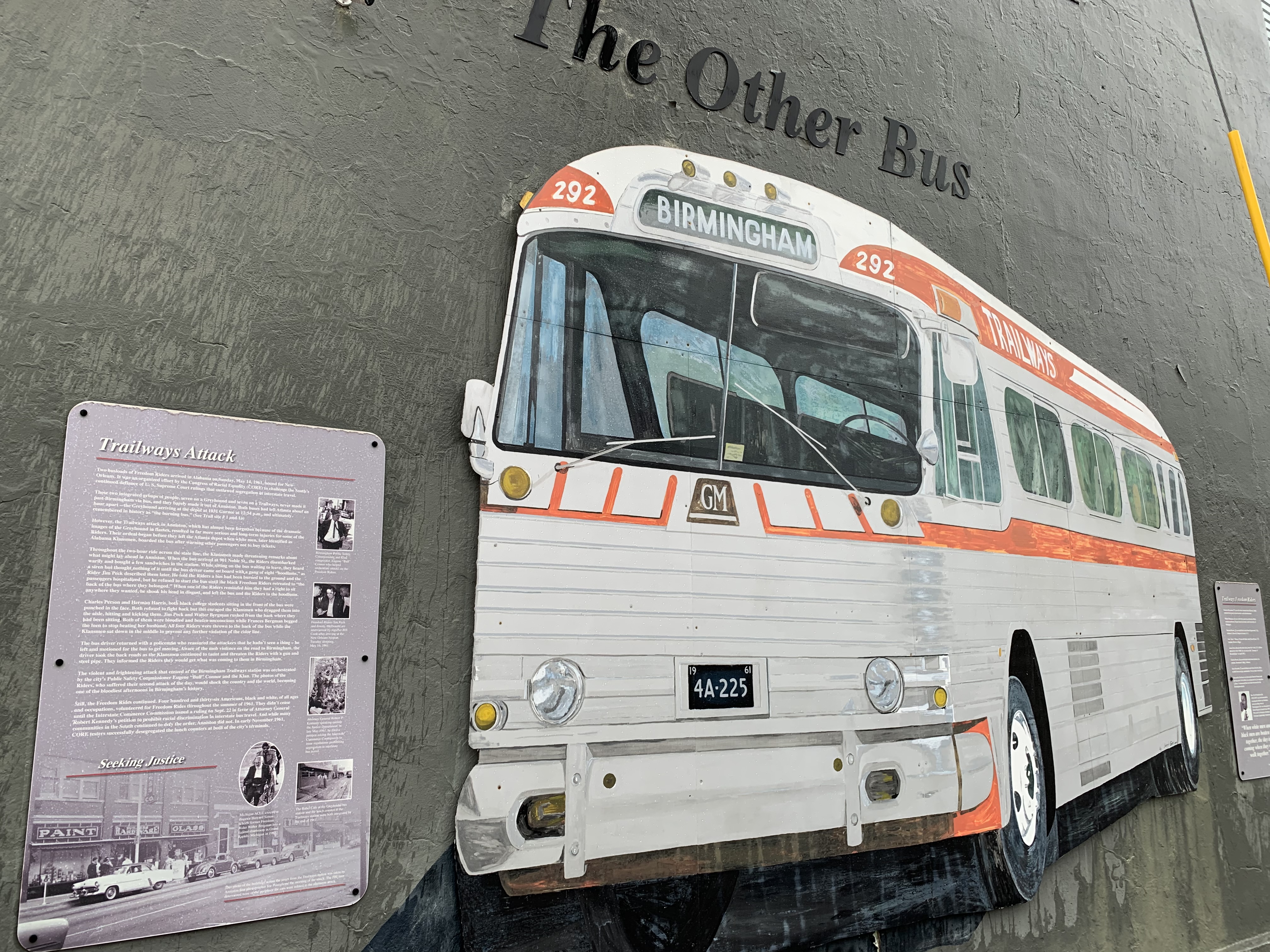
This is another underfunded Civil Rights site. The mural above is one of the few sights I found to see. As part of a systematic campaign to dismantle segregation, a small group of regular people rode buses between states in the south, where race mixing was not allowed under local laws. Since the federal government regulates interstate commerce and travel, they had jurisdiction. The activists exposed the racism, the NAACP lawyers brought cases to court, and eventually the Supreme Court outlawed segregation. Rosa Parks may have started the bus strikes, but it was the Court that integrated buses legally. The freedom riders were brutalized by the Klan, but their cause eventually won.
This may be the worst transition ever, but RV’s get about the same mileage as buses and some are even bus conversions. At a campsite near here, I was asked whether I was afraid of running out of electricity. We compared ”range anxiety” and realized that even with large fuel tanks, the rigs in the campground have less range than my long range model 3 Tesla’s 350 miles. Once loaded, they simply get such bad mileage that they have to go to gas stations more often than I need to charge.
Here’s the link to my visits to all parks in Alabama.
I had forgotten that it was a children’s march on Palm Sunday that was assaulted by dogs and water cannon. Under city ordinance, it was illegal for children of different races to play together. In my view, the longer a system of injustice is allowed to stand, the more deeply engrained it becomes. The Civil Rights Institute does a powerful job of setting the scene, where African Americans worked in the steel mills and mines and lived in the city behind a color line. People like Bull Connor and the mayor grew up believing that segregation was normal, right and beneficial. They didn’t play with African American children as kids, and as adults they attacked them, peacefully assembled, wearing Sunday clothes, in a park, outside the 16th St Baptist Church, singing songs. The children had learned from Dr King not to fear jail when doing no wrong, but the assault against them was brutal, and televised.
At the time, America was shocked and voiced outrage. This week children were slaughtered in yet another episode of gun violence. I wonder if we’re sufficiently outraged to change the system as those kids in Birmingham did.
“A man dies when he doesn’t stand up for injustice.”
Rev Dr Martin Luther King, Jr. in Selma
Here’s the link to my visits to all parks in Alabama.
[Updated after 3rd visit, including Oaks tour and Carver Museum.] I admit I was frustrated the first two times I drove here from California, unable to access either Booker T. Washington’s house or George Washington Carver’s Museum and finding incorrect information on the website and app. And I might have ranted about how other sites appear to be better funded. But all is now forgiven.
Like many emancipated slaves, Booker had no surname. When he showed up at school, he just said his last name was Washington. After walking across much of Virginia to go to school near Hampton Roads, he became a teacher at Hampton University, before being hired to run the Tuskegee Institute, now University. Ever hard-working, practical and focused on improvement, his students developed many valuable skills to support their families, including brick making. His students built his impressive mansion, The Oaks, across the street from Tuskegee University, using the design by our nation’s first African American architect, Robert Taylor, who trained at MIT as its first black student. Booker T., ever persuasive, recruited Taylor, who designed many buildings that are now part of both this national historic site and the university.
It is difficult to overestimate the importance Booker T. Washington had in advancing the lives of people who for centuries were not allowed to learn how to read. An advisor to US Presidents, world traveling speaker, practical educator, builder, mentor, and author, his practical focus drew criticism from WEB Du Bois and Frederick Douglass, who focused on ‘higher achievements’, but ultimately, they all worked towards the same goal of progress. All continue to inspire generations to learn, grow and excel. Inside the house on tour, I learned about Booker T’s wives, who also contributed to education. By necessity, black women have often had to assume a role as matriarch, when it was difficult or even impossible to keep families together.
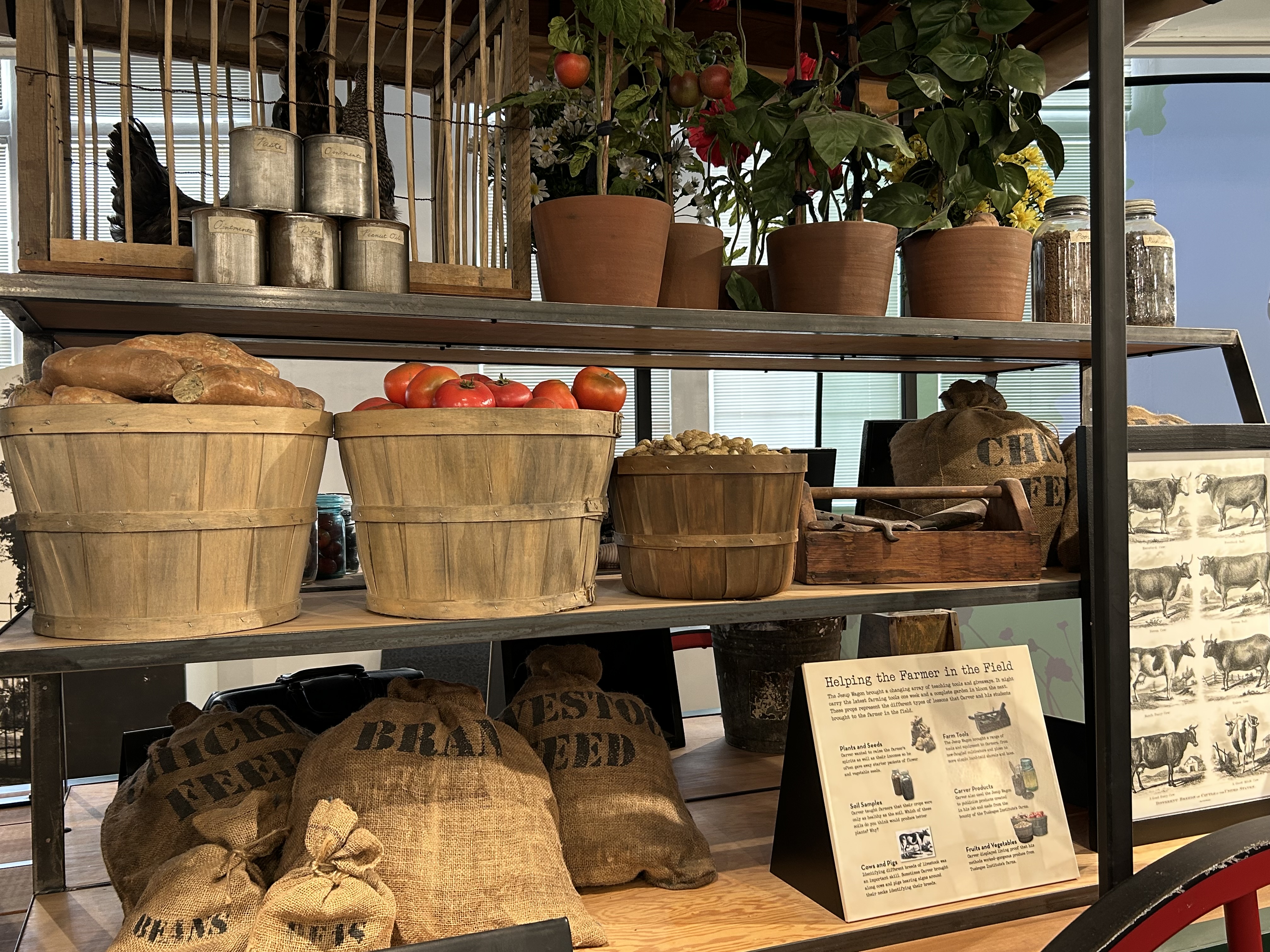
Booker T. Washington also hired George Washington Carver to teach and help improve the lives of African Americans, and the Carver’s museum on campus (see photo below) reveals his broad scientific interests beyond the peanut. Carver was an ecologist, who focused on profitable uses for peanuts in order to improve soil health, a forward-looking view that has only become more important over time. But following Washington’s practical focus, Carver spent much of his time in direct outreach to rural communities, bringing solutions and advice out in wagons.
I’m sure Washington could not have imagined that his institute would have been used by the US government to run a 40 year ”experiment” on black men, neither treating nor disclosing their diagnosis of syphilis. (See ”Miss Evers’ Boys” also set in Tuskegee & starring Laurence Fishburne). He might be pleased to know that there’s a private museum on campus dedicated to teaching the history of that infamous experiment as well as the genetic legacy of Henrietta Lacks. But doubtless Washington would have been out fundraising to develop the broader community of Tuskegee, which shows signs of economic neglect.
Here’s the link to my visits to all parks in Alabama.
Not far from the profoundly disturbing Andersonville site, is the very pleasant town of Plains, Georgia, where the Carters still reside. There’s a giant peanut, a store selling Billy Beer cans, the campaign depot and the delightful boyhood farm home of Jimmy Carter. The site and the town have a wholesome feeling that feels like stepping back in time. The farm still seemed active, with crops, goats, bees and mules (donkeys?), and everyone was very welcoming and friendly. The Carter compound is strictly guarded by the Secret Service and off limits, but I enjoyed fried peanuts and peanut flavored ice cream and peeking in store windows and chatting with the locals.
Young Jimmy’s playmates were mostly African American, so it was natural for him to oppose segregation and become an activist. He saw poverty just down the street, so his work with Habitat for Humanity was also natural for him. As President he negotiated the Camp David Peace Accords and later earned the Nobel Peace Prize for his Carter center. He did well by doing good, and he’s still making an effort at 97. We could all try to learn something from that.
Here’s the link to my visits to all parks in Georgia.
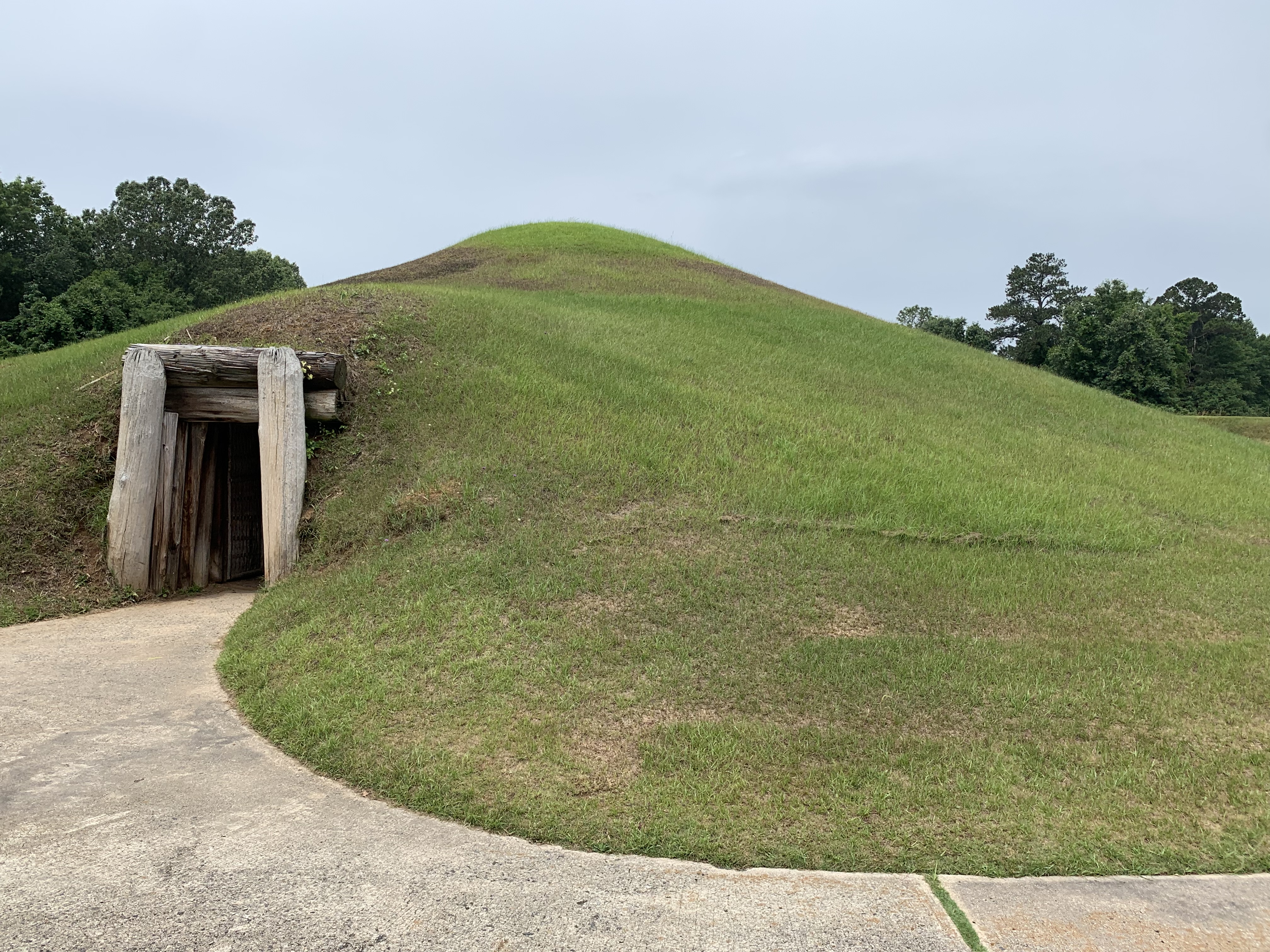
The large mounds here date back over 1,000 years, and include the reconstructed earth mound above, temples and funeral mounds of the ancestors of the Creek people. Despite tremendous challenges, the culture continues today, as seen in the Creek Nation Supreme Court Building in Ocmulgee Oklahoma, which is patterned after this mound. The ground inside dates to 1015, and appears similar to kiva I’ve seen in the west. During the Depression the Civilian Conservation Corps reconstructed the roof and built an Art Deco style visitor center. The entrance tunnel is low, carpeted and well ventilated, and it opens into a glassed-in viewing area. Despite not being half as old as Poverty Point, the mounds here also have bird symbols and other similarities. The Creek Nation farmed corn, squash, beans, pumpkin and tobacco here, fished and traded deer skins with the Spanish, French, British and Americans. They largely westernized and had multiple treaty rights to their lands, but they were nevertheless forced to abandon their homeland by Andrew Jackson.
Driving through the southeast, especially in rural areas, you see a great many churches. I’m no expert on the Bible, but I’m pretty sure the ”thou shalt not steal” is in there (Exodus 20:15). Almost all of the land was stolen from the Native Americans, yet I don’t often hear people expressing any regret for the sins of our ancestors, even in church. Obviously, it’s not God’s will that his commandment be broken. I’ve been to church services from coast to coast, and I’ve never heard a sermon about how we live on stolen property, how that was a sin and how we should try to make amends. Seems like that would be the proper Christian attitude. Of course, the church has been wrong on this issue for centuries, but reflecting on our sins and seeking forgiveness are supposed to be core values of Christianity. Why not start reflecting on this sin and our responsibilities today?
Here’s the link to my visits to all parks in Georgia.






 Zero Carbon Travel