Frederick Law Olmsted National Historic Site

Yet again, I arrived at a site only to realize that I had visited before, possibly even before they became a park unit. I also realized that I’ve been to many of his architectural landscape sites: the National Cathedral, the El Tovar Hotel, Arlington National Cemetery, the Roosevelt Memorial, the Biltmore Estate, the US Capitol Grounds, St Francis Woods, Redwood National Park, Boston Public Garden, the National Mall, Everglades National Park, Riverside Park (NYC), Central Park (NYC), Niagara Falls, Yosemite, UC Berkeley, Stanford, Columbia, Balboa Park, and a number of other sites, mostly in New England. And that’s just a tiny fraction of his work. You’ve probably visited more of his sites than you realize.

Olmsted was a self-educated big-picture guy. He presented a vision and hired experts to make it real. When I visited as a child, I felt small next to the hemlock outside his front door, cozy in his sunken garden, curious on his path into the woods, and free as I burst out on his lawn. What I learned today, is that those feelings were intentionally created with earth, rocks, trees, vines, bushes and lawns. I recognized hints of the Suzhou Gardens that Olmsted must have seen on his trip to Asia, and small design elements that he employed on a grander scale across our country. He said that “nature abhors a straight line”, and unlike the formal gardens of Europe, his designs organically blend nature together in a way that people enjoy instinctively. His home here is a good place to see what landscape he chose for his family, and the (mostly weekend) tours, both inside and outside are educational and inspirational.

“You may thus often see vast numbers of persons brought closely together, poor and rich, young and old… each individual adding by his mere presence to the pleasure of all others, all helping to the greater happiness of each.”

Frederick Law Olmsted, describing the importance of lawns and public spaces

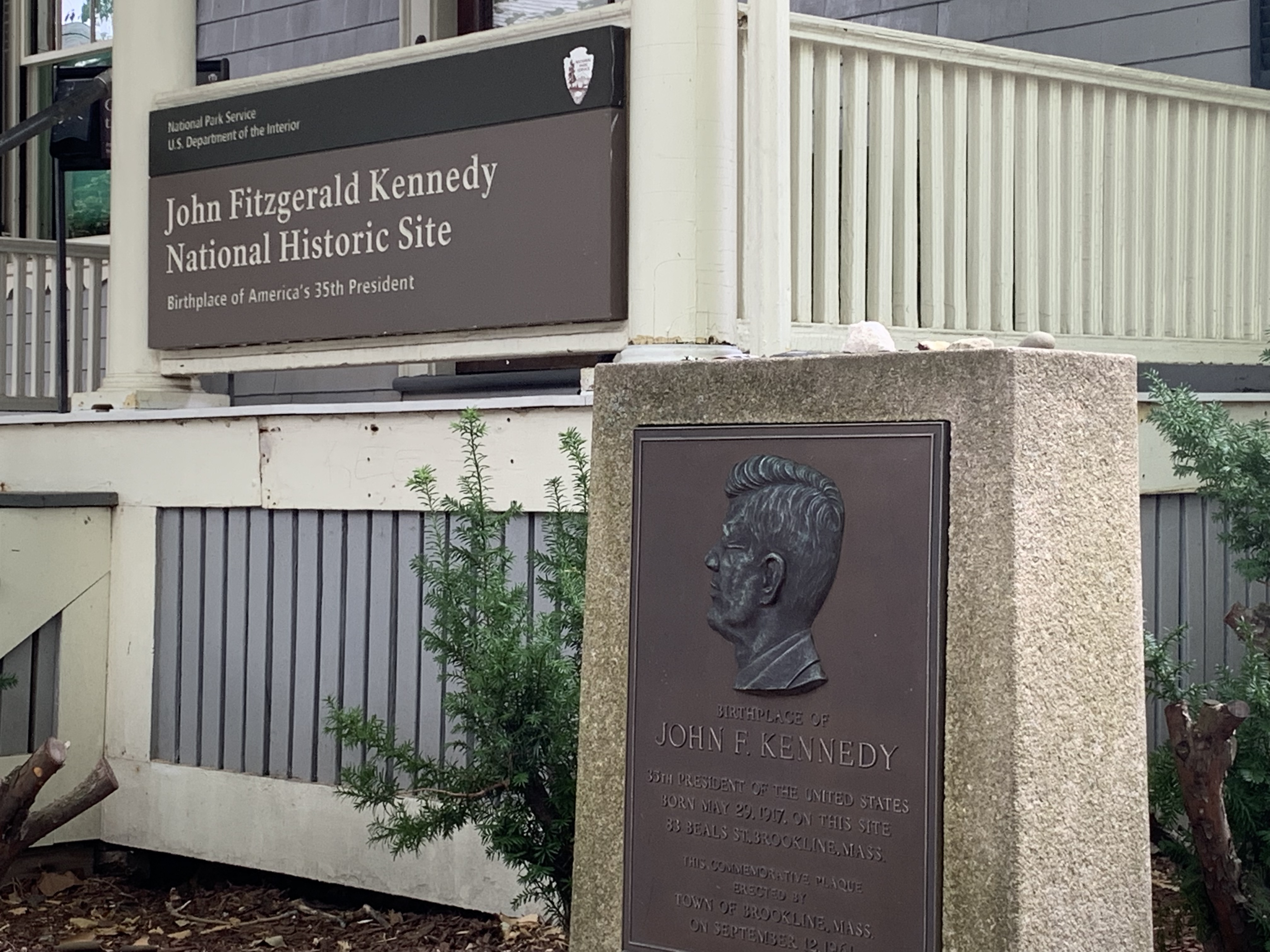
John Fitzgerald Kennedy National Historic Site

I first visited Brookline decades ago, so this was a trip down memory lane: the corned beef “king“, the narrow tree-lined side streets, and the signs of progressive political activism. The site is being renovated until sometime in 2023, but there’s a film and an audio tour online, a neighborhood walking tour, and even a special exhibit at the JFK Library, which is excellent. Rose, JFK’s mother, bought the home where she gave birth to JFK and donated it to the public. It’s quite a traditional home, that evokes the moral, social, political and intellectual upbringing that she and her husband provided their many children. Both sides of the family were prominent Irish Catholic leaders, with Rose’s father mayor and Joe Sr’s father an important part of FDR’s administration (he later resigned his ambassadorship after saying he supported American isolationism).

The legend of the family wealth is that Joe Sr was a bootlegger, but it’s more accurate to say that his family legally acquired liquor prior to Prohibition, sold it legally to close family friends during Prohibition, and then acquired the rights to be the first post-Prohibition US importer of Dewar’s scotch, Haig & Haig and Gordon’s Gin. Joe Sr was successful as a banker, film producer, investor and in his other ventures, he came from a prominent political family, and he helped raise some of America’s most famous public servants: JFK, RFK, Teddy K, and Eunice K Shriver. The rumors that suggest illegal activity are unfounded and likely were pushed by the family’s political enemies. He later divested from the alcohol business to avoid political trouble for his children.

Touro Synagogue National Historic Site

The oldest synagogue building in America, Touro is an enduring symbol of our freedom of religion. Fearful of the Inquisition, many Jews migrated to new world colonies not under Spanish or Portuguese control. The Torah pictured was a gift from a congregation in Amsterdam and is over 500 years old. Rhode Island was founded as a religious sanctuary by Roger Williams, with help from John Clarke and Anne Hutchinson, who was banished from the Puritan Massachusetts Bay Colony for having the audacity to argue that women could discuss and help interpret scripture. The synagogue occupies a prominent location in Newport, along with other faith centers, away from the political center to help show the separation of church and state. And, since it is still being used by the local congregation as a place of worship, the park receives no federal funding.

Several Presidents have visited, but the first was George Washington, who wrote a thank you letter expressing his view that beyond mere tolerance, religion is a natural American right shared equally, including full liberty of conscience for all, guaranteeing protection against fear. Today’s Christian Nationalists should be ashamed of their profoundly un-American views.

“All possess alike liberty of conscience…

for, happily, the Government of the United States, which gives to bigotry no sanction, to persecution no assistance…

every one shall sit in safety under his own vine and fig tree, and there shall be none to make him afraid.”

George Washington’s Letter to the Hebrew Congregation in Newport, Rhode Island

Boston African American National Historic Site

From a pulpit here in the African Meeting House (the oldest African-American church building), Frederick Douglass opened “a meeting to discuss the best method of abolishing slavery” in 1860. Maria Stewart, a free black woman, risked scandal and gave one of the first public speeches by any woman in America here to a racially-mixed crowd of men and women in 1833: “for it is not the color of the skin that makes the man or the woman, but the principle formed in the soul”. The north side of Beacon Hill was the center of a vibrant African-American community, the site of the first African-American school, the first African-American Masonic Temple, and a hotbed of abolitionist intellectuals. Harriet Tubman raised funds for the Underground Railroad here and networked with both abolitionists and early suffragettes in Boston.

While Faneuil Hall is famous for Patriot meetings before the Revolutionary War, it deserves equal renown for Abolitionist meetings before the Civil War, especially those dedicated to foiling the Fugitive Slave Act. Similarly, Boston was where the Massachusetts 54th and 55th African-American regiments formed before the battle at Fort Wagner (see the movie Glory). The Black Heritage Trail is fascinating, and includes the story of Sarah Roberts, a young black girl who wanted to go to the white school near her home. Her father’s lawsuit lost but led directly to the outlawing of segregated schools in Boston in 1855, a hundred years before Brown v Board. Racism continues, but the morality of equality is indisputable.

Frederick Douglass

Boston National Historical Park

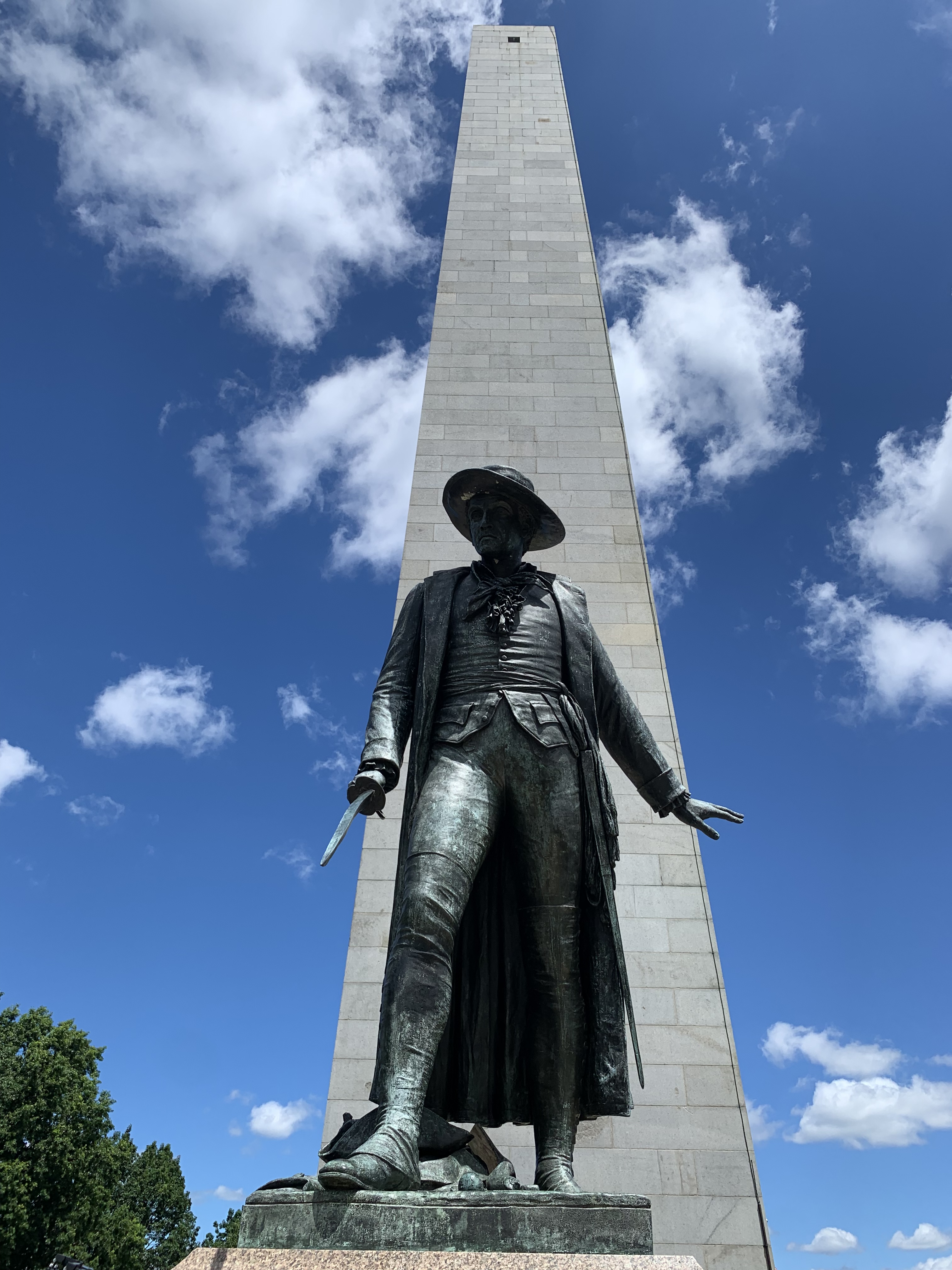
“Do not fire until you see the whites of their eyes.”

Colonel William Prescott, 1775

While the way to the top of the Bunker Hill Monument is currently closed, there is a live webcam. The monument is at the top of Breeds Hill, which the colonial soldiers defended against repeated attacks, before retreating to Bunker Hill. There’s a free museum facing Prescott’s statue across the street.

Boston has an embarrassment of historic sites in this park: the USS Constitution, Paul Revere’s house, the Old South Meeting House, the Old North Church, the Old State House, and Faneuil Hall. Each one is worth exploring to learn how we became independent, how we developed our democracy in town hall meetings, and how we debated our rights as Americans. Oh, and I’ve forgotten another historic ship (WWII), another historic battlefield (not open), another museum, a historic navy yard, living history exhibits, and other fascinating sites on the popular Freedom Trail.

Since the traffic and parking are even more horrendous than I remember, I definitely recommend taking the subway (electric and also historic) and walking. Many of the sites are clustered together, and the Rose Kennedy Greenway has beautiful art, flowers, and fountains along the way. Faneuil Hall is a great place to try local foods, and I recommend the thin cheesy Regina Pizzeria slices.

Saugus Iron Works National Historic Site

So far, none of the New England sites are new to me, and as soon as I got here, I remembered visiting as a kid. The visitor center is in an original building, while the blast furnace, casting shed, forge and blacksmith’s shop were reconstructed on their foundations. There was some work being done to get the park completely reopened this summer, but the museum and most buildings were open. It’s an impressive site, and you can see an egret in the river to the right.

As at Blackstone in Pawtucket Rhode Island, the site is on a water fall, and the local tribe (now dispersed) was known as the Pawtucket, meaning Falls. To the left above, you can see the spillway where the diverted water turned the giant mill wheels, powered the bellows for the forge and worked the heavy trip hammer to make iron bars, and while the river isn’t as deep here, the marshes were filled with iron ore. While Blackstone had America’s first cotton mills in 1790, the English settlers here in 1640 built the first iron mill. The Puritan Massachusetts Bay Colony owed much of its success (and all of its nails) to this mill. When the iron workers moved on for new opportunities, they built similar iron works where they settled.

Adams National Historical Park

“Because power corrupts,

society’s demands for moral authority and character

increase as the importance of the position increases.”

John Adams

The Old House above was John & Abigail Adams’ dream house where they raised their son, John Quincy Adams, and where future generations of Adams would live, garden, read, write and serve our country. The Adams were all educated well-beyond American standards. John felt that we suffer due to our fear of thinking, and that we must “dare to read, think, speak and write”. The larger quote hints at their high ethical standards as well. John defended the British officers involved in the Boston Massacre, because no matter how anti-British he was, he knew they deserved a proper legal defense (most were acquitted).

I hope folks are familiar with John & Abigail through various movies and series related to the Continental Congress, but his negotiations with Europe were also critical to our fledgling country, as was his Presidency. But I suspect few remember our 6th President, John Quincy Adams. He was criticized for supporting the opposition party’s embargo of Britain which hurt the financial interests of Massachusetts, for supporting infrastructure & education investments, supporting science, for refusing to sign fraudulent treaties stealing Native American land, for defending the slaves who escaped on the Amistad, and for trying to legislate the end of slavery. Like his father, he believed that country was more important than state or party, fearing that states’ rights folk would tear the country apart. While protesting the Mexican American War, he had a stroke and died in the US Capitol.

America has a problem with voters who will elect bad people to achieve selfish or immoral goals. While an individual might not steal Native American land, hold someone in bondage or pollute, there’s a moral dilution that occurs when electing a leader. The leader can simply say they are responding to the will of the people, and the people can elect the person who will commit evil on their behalf, without having to get their own hands dirty. Back in John Quincy Adams’ day it was Andrew Jackson, then pro-slavery leaders, and today one party is committed to taking no action on climate change and taking the country backwards in women’s rights & voting rights, among other issues. Electing a leader for intellect and morality who will do the right thing for the long run even when unpopular seems an impossible, quaint, bygone concept.

Blackstone River Valley National Historical Park

The river flows from northern Massachusetts into Rhode Island and has a natural waterfall not far from a navigable ocean ship channel. That made it a perfect location for an experimental mill, to see if the fledgling Americans could copy the British mill industry. Here Moses Brown, a Quaker and reformed transatlantic slave trader, gathered an English mill expert/ industrial spy, several inventors, blacksmiths, shipwrights and skilled craftsmen to build the first successful water-powered cotton-spinning machine in America. Here, America joined the Industrial Revolution.

The mill owners knew that the cotton came from slave-plantations and some later owners even invested in plantations while still claiming to be Abolitionists. (The Brown family founded the eponymous University here with slave trade money). The ranger at Slater’s Mill did an excellent job in describing this hypocrisy and the pros and cons of industrial capitalism, along with explaining the mechanics and the history of the mill company towns that grew up all along the valley, until electrification moved the mills south. Pollution from heavy dyes is still a problem as are the dams, but major clean ups have restored much of the riparian ecosystems, for birds, fish, plants, hikers, bikers and paddlers to enjoy. The entire area is interesting, with old shops, an Audobon park, and legacy industrial buildings.

Roger Williams National Memorial

Those ignorant people who claim that America was founded as a Christian nation need to visit this site in Rhode Island. Disgusted with the forced religious conformity in England (including burning heretics), Williams moves to Boston in 1631, where the Puritans had moved to escape persecution.

“… that no civil magistrate, no King, nor Caesar, have any power over the souls or consciences of their subjects, in the matters of God and the crown of Jesus …”

Roger Williams

Williams’ idea, that the government should not control citizens’ spiritual lives, made him flee the Massachusetts Bay Colony and live with the Native Americans, learning their languages and becoming an advocate for their rights and separate beliefs. Eventually, they deeded him land and he founded “Provident’s Plantation”, now Providence, and Rhode Island became a haven of religious tolerance, for Jews, Baptists, Quakers and even atheists. It is no accident that the country’s oldest synagogue is in Rhode Island. King Charles II granted a charter to Rhode Island, fulfilling Williams’ wish, that no one would be “molested, punished or called into question” for different beliefs in 1663 over 100 years before America became a country. Other colonies copied his charter’s separation of church and state and Jefferson enshrined the concept in our Constitution’s 1st Amendment.

“Congress shall make no law respecting an establishment of religion, or prohibiting the free exercise thereof.”

The First Amendment to the US Constitution

We live in a precarious time, where a single conservative Catholic sect, Opus Dei, has used its influence to place a majority of Justices on our Supreme Court, and that Supreme Court majority has limited an established right based on their particular religious objections to abortion, ruled in favor of Christian prayer at school events, and ruled in favor of using taxpayer funds for Christian schools. This country has avoided the religious and sectarian violence and oppression common elsewhere, by granting the right to freedom of conscience, and it is a frightening step backwards almost 500 years for the court to grant favored treatment to one religion. We have never been a Christian nation, and voters are wrong to vote for one.

New Bedford Whaling National Historical Park

Why am I showing a mural of the Massachusetts 54th instead of the blue whale or the model ship Lagoda from the Whaling Museum? Well, this park covers a lot of history, and most of the recruits for the famed 54th (see the movie Glory) joined here. They were here in part because the whaling industry had long employed people of all kinds, including free African Americans and escaped slaves, and because this was an important stop on the Underground Railroad. Before the Civil War, New Bedford was an abolitionist city, run by Quakers with people of color making up 7.5% of the population . A young Frederick Johnson escaped slavery and stayed in Nathan Johnson’s house here in 1838. To avoid confusion, he accepted the new name “Frederick Douglass”.

And the whaling history may be even more interesting. Today New Bedford is the largest scallop port, but from 1825 to 1925, its major commodity was whale oil, which once powered lamps across the country and had a hundred other uses. Besides the whaling museum, there’s the Seaman’s Bethel with memorials to those lost at sea, historic homes, living history, the Ernestina-Morrisey schooner along the fascinating wharf, fast ferries to the islands and many other interesting things to see and do. And, there are plenty of seafood places, including the Black Whale, which has both an excellent sit-down restaurant and a more casual dockside stand.