African Burial Ground National Monument

Yesterday I mused about the need ‘to learn from our past to prepare for the future’, without realizing that today I would be looking at a symbol that means exactly that, the West African Sankofa, which is carved above the doorway of return on the opposite end of the memorial structure above. The architect, Rodney Leon, has filled this space with symbols and symbolism, and it evokes the slave-ship hold, the middle passage, the diaspora centered on West Africa and the depth of the remains. When we choose to recognize our roots and learn from them, we can draw strength to be better.

When the burial ground was rediscovered in 1991 and when protests forced the government to change their plans, I was abroad and missed the news reports of the historic find and cultural repercussions. Fortunately, the story is well told in the museum in both the park film and in the exhibits. Government leaders were initially unable to see the pricelessness of the rediscovery due to the value of the land, and the African American community needed to speak out both for their ancestors and for all of us to force the government to respect the remains, preserve the site and honor the contributions of Africans to this city and to our society. The archaeological research, the history of those buried here and some African artifacts are all on display. Facing the emotionally moving subjects daily, the rangers help visitors understand the site’s importance, history and significance.

“You may bury me in the bottom of Manhattan.
I will rise. My people will get me.”

Maya Angelou

Stonewall National Monument

If General Sheridan returned to admire his statue, he would likely wonder why there were so many rainbow flags in his park. If he walked into the Stonewall Inn bar (to the left above), he would probably have more questions. But here on the 28th of June 1969, a police raid against the bar for illegally serving homosexuals sparked a riot against police oppression. Unlike earlier riots, a large crowd gathered and forced the police to retreat into the bar. The police called for backup, but the community brought even more protesters who linked arms and fought back. The bar was boarded up, but the protests became larger, as the LGBTQ+ community came out into the open in force to organize marches to Central Park that grew each year. Before Stonewall, some activists had begun staging “sip ins” at gay bars like Julius’ to protest the denial of civil rights and attempts to humiliate and prosecute people based on their sexual orientation. After Stonewall, laws began to change.

The bar itself is still serving drinks with pride, but the site is scheduled to become the headquarters & visitor center in 2024. There are other bars, nice shops and restaurants in the area, and it’s worth taking a stroll and maybe ordering a drink to raise a glass to the brave souls who fought police here. Despite being discriminated against by society and targeted by law enforcement, they demanded and won respect for their rights, bringing more freedom for everyone.

Castle Clinton National Monument

To prevent the British from taking New York (again) in 1812, a fort was built here on a man-made island (since filled in with the park above). As usual, the city reinvented the space several times, as an exhibition hall, an immigration center, an aquarium and as a national monument (where people also buy tickets to the Statue of Liberty & Ellis Island). The exhibit space is basically one room with displays showing the castle’s history, plus a few placards. The rangers are very helpful and knowledgeable, but unfortunately, nobody knew of a way to get to Liberty or Ellis Islands without burning carbon.

Federal Hall National Memorial

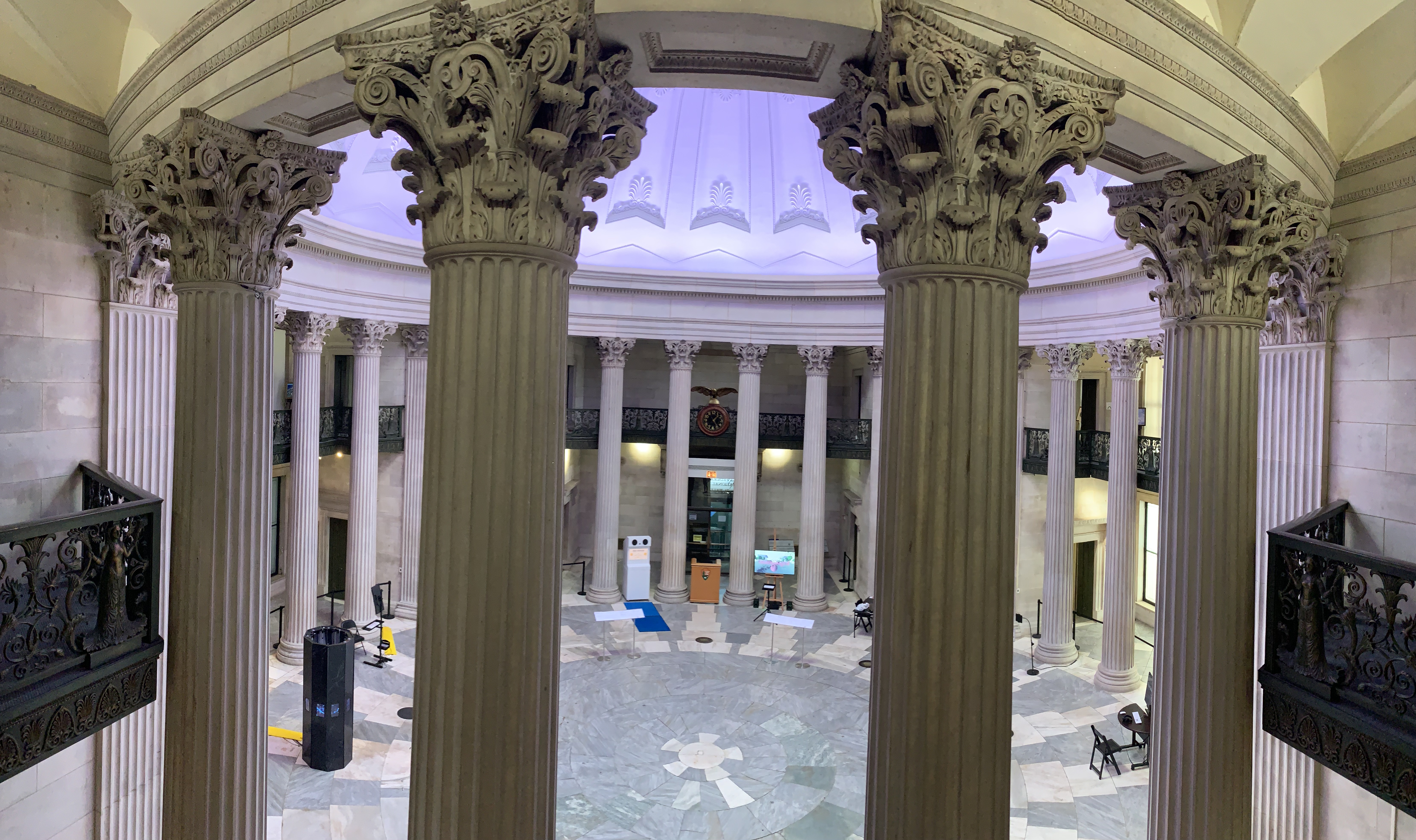
From the balcony outside, George Washington was sworn in as our first President in 1789. In 1790, Congress passed the Bill of Rights here, which was appropriate since the Zenger case that defined freedom of the press was tried here in 1735 and since the 1765 Stamp Act protests outside here defined freedom of assembly. The current version of Federal Hall was a Customs House in 1842 and later became a bullion depository for the US Treasury, which is appropriate given that it is around the corner from the NY Stock Exchange. New York City’s national park sites all seem to serve multiple purposes, as layers of history stack up in crowded urban spaces, but this quiet site offers a moment of respite to reflect on our past as we must prepare to face our future. I recommend eating at Fraunces Tavern nearby, since it predates our founding and is the oldest restaurant in New York City.

Lower East Side Tenement Museum National Historic Site

While I took the 1902 tour focusing on Jewish immigrants and the beef riots, the film in the museum was about two Joseph Moores, one black and one Irish, and explored the unequal outcomes dictated by law and society. I highly recommend both, as seldom does history provide so valuable a perspective on current issues such as the importance of activism in resisting inequality and injustice and as the long term impact of systemic racism.

The Levine family lived and worked in a three-room sweatshop tenement producing garments like those above (the one on the right is original), and their butcher’s family lived and worked in the basement. In the spring of 1902, the new scion of the Armour meatpacking firm of Chicago decided to hike the price of Kosher beef by 50%. He was trying to build an estate for his wife which would include a bowling alley, 20 marble fireplaces, fish ponds, a large herd of deer, and a greenhouse for growing oranges. (He inspired Upton Sinclair’s novel The Jungle). The Beef Trust had a monopoly on Kosher beef in New York City (at the time the largest Jewish city in the world), so they simply dictated the new price to all the butchers. The firm was renowned for low pay, strike-breaking, and hardball tactics to get whatever they wanted.

But they underestimated the Jewish housewives of the Lower East Side tenements. The women organized, boycotted, threw bricks through butcher shop windows, burned meat on their floors and even climbed down from the synagogue balconies to throw raw ground beef in the butchers’ faces. In a month, the price rise was reduced by 2/3rds, and a whole generation of suffragettes, union leaders and political activists was born. (In my first job, I worked with old women who had numbers tattooed on their arms, and they were not to be underestimated).

One of the historic Orchard St buildings is undergoing renovations, but all the tours, including the walking tours of the neighborhood are insightful. I recommend Katz’s deli or Russ & Daughters for a bite before or after your tour.

Hamilton Grange National Memorial

Since the musical, Hamilton’s home has been busier than ever. Built as a countryside retreat for his wife, Hamilton was killed in a duel only a couple of years later. But his wife and children lived here for many years, protecting his legacy and eventually donating his 18th century piano pictured above. The house itself has been moved a few blocks, twice, and the park service has only opened it for tours here in the past few years. The gardens are being regrown according to Hamilton’s old instructions, and the site is now located on the edge of a public park.

The town has grown up a bit since then. Historic Harlem is only a few blocks away, and I recommend dining at one of the old soul food restaurants with live music, if you have the time. I’m obviously in New York City, still traveling by EV, namely the Metropolitan Transit Authority’s NYC Subway.

“Who talks most about freedom and equality?

Is it not those who hold the bill of rights in one hand

and a whip for affrighted slaves in the other?” 

Alexander Hamilton

Weir Farm National Historical Park

When I say that I don’t like J. Alden Weir’s paintings, don’t misunderstand me. I was kicked out of my only art class at age 9 for drawing sketches of a battle including graphic illustrations of stick figures getting blown apart by WWII tanks & planes. I couldn’t tell you the difference between a tint or a tinge from a tincture. One of my favorite pieces of modern art remains the remains of an artist named Art, who, according to his will, was cremated and put on display. So, don’t judge Weir by my predilections.

Actually, I do like “On the Porch”, a Japanese inspired watercolor of two of his daughters painted here on his farm. But I don’t like “The Red Bridge”, where he contrasts a natural setting with a railroad bridge, and I find his landscapes to be too muted and subtle in color to hold my attention. Unlike some European impressionists, Weir didn’t typically paint laborers, preferring farm animals or his family (although he sold paintings to help the unemployed). In any case, tastes change, so creativity must overcome tastes.

Weir, the son of a West Point drawing instructor, helped found American Impressionism. Where his brother went to Hudson Valley, Julian went to Paris, where he overcame his initial horror of Impressionism to adopt some of the techniques. Soon he was back in the US, exhibiting impressionist paintings with his friends, Twachtman, Ryder, and others who organized a group of ten artists to promote the new style. His daughters grew up to be artists as well, and one married one of Brigham Young’s grandsons, Mahonri Young, whose studio is also on the Weir Farm.

While the tour of Weir’s house and studio is interesting, the magic of the place is in the artists who continue coming here to paint. Art colonies and communities constantly influence and depict each other, as when a student of Saint-Gaudens created a bronze relief of Weir. There’s an artist-in-residence, and a small army of artists of all levels who continue to see the new in the old barn, gardens, fields, forest, pond and porch. Some of their paintings are in bold, bright dramatic colors, which I like.

But honestly, real nature is subdued and muted in color. Light on leaves reflected in water is blurred. Roots and rocks on dirt trails near muddy banks are all shades of brown and gray. The real bear in the woods here isn’t kaleidoscopic. Nature is messy, mostly dully boring and awkwardly chaotic, with one tiny amphibian emerging from the algae to catch one’s eye on a stone before almost being trampled. Hmm, maybe I should go back and take another look at Weir’s landscapes.

Paterson Great Falls National Historical Park

While Blackstone was operational two years earlier, Paterson’s mills were churning out fabric a few years before Lowell. Where Lowell was focused on all things fabric, Paterson went through a variety of industries, including silk, revolvers, locomotives and even airplanes, including the Spirit of St Louis. Also, Lowell made clever use of a much smaller drop in elevation, using a large volume of water to drive many small engines. But the Great Falls at Paterson, which inspired Alexander Hamilton to found the town, had enough vertical drop to drive electric turbines (from Thomas Edison), which still run in the building on the left. As in the other mill towns, child labor was exploited and dyes poisoned the river. Here, young mill workers went on the “baby strike” for a shorter workweek, and cheaper competition eventually doomed many of the huge businesses. In the background at the top, there’s an old Negro League Baseball Stadium under reconstruction where a local high school star named Larry Doby played before he broke the color barrier in the American League just 3 months after Jackie Robinson. And it’s all part of this relatively new park, which has big plans for improvements.

Thomas Edison National Historical Park

Note well that the statue is carrying an illuminated electric lightbulb. From his work-study above to his inventions, patents, accolades, experiments, machine shops, laboratories, greenhouse, and especially to his garage, with it’s electric wall charger and multiple electric vehicles, Edison’s park is wondrous to explore. I did nothing in the proper order, ignored the scheduled tours, skipped the film, neglected to reserve a house tour, poked around, peeked in every corner and enjoyed it immensely.

In particular, I studied the evolution of his recording devices, from telegraph and phonograph to motion picture. I was very pleased to see that he took the time to invent a coffee maker (drip style, also makes tea). I noted that his wife drove him around in their electric car. And it was interesting to learn how his higher quality proprietary records lost out to cheap vinyl recordings, in part due to his unpopular taste in music. So much more than merely the inventor of the light bulb.

“I’ve not failed. I’ve just found 10,000 ways that won’t work.”

Thomas Edison

Hopewell Furnace National Historic Site

Among the sheep in this bucolic valley is the most complete early ironworks industrial site in America (unrelated to Hopewell Culture). Over 130 years after English settlers built the Saugus Iron Works, a more elaborate and higher volume factory was built here in 1771. Cannon and shot used at Yorktown and in our early Navy were forged here. Inside the red roofed cast house is a giant stone furnace, fed down the chimney by a constant stream of charcoal, limestone and iron ore through the grey wood building above. For over 100 years, the giant water wheel (which still turns today) blasted air into the crucible to pour iron ingots into the floor inside.

Upon arrival, I recalled visiting here at age 12, a number of years ago, on a school trip to Philadelphia and DC. One of my teachers still volunteers at a military park nearby. Each step in the process can be seen here, basically unchanged, from wood pile, to charcoal, worker housing and eventually to pig iron, ready for sale. Many great forests were felled for America to rise to the top of the iron and steel industry, but I notice that the owners kept many of their own fine old trees for shade and beauty. Now that we can harness nearly infinite clean, non-destructive power from the sun, I hope we make progress restoring nature.