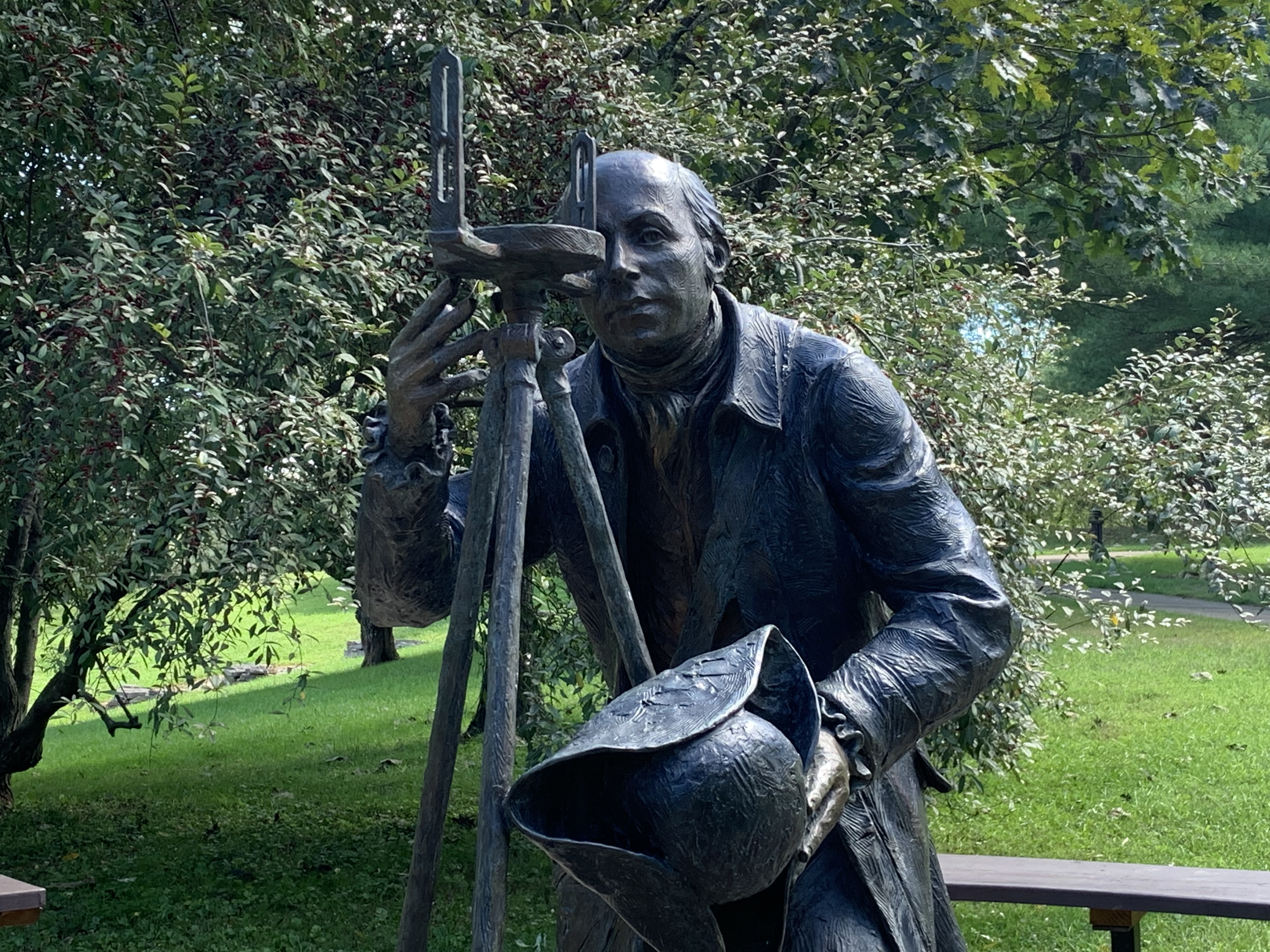
The National Road, now US 40, was our first federal highway. Washington started it when he cut a road up to Fort Necessity, and he later bought property there for a tavern. But the surveyor above, Albert Gallatin, is known as the road’s father. He met Washington and suggested a straighter route, and Washington agreed, encouraging the young man to work on it.
Swiss born Gallatin bought 400 acres here on the hill near the Monongahela River and soon became Senator. Gallatin tried to moderate the local Whiskey Rebellion, but Washington still sent in troops. After criticizing Hamilton’s financial plans, Jefferson made him Secretary of the Treasury, where he reduced the national debt and finance the Louisiana Purchase, Lewis & Clark and the National Road. Gallatin and Lafayette were friends and helped bring French pressure to help settle the multi-year War of 1812 at Ghent.
Gallatin’s bucolic country estate, 10 miles of forested trails and well maintained mansion behind the statue is well worth a stop along the historic highway.
Here’s the link to my visits to all parks in Pennsylvania.
Since each park is unique, I would never be able to say which is my favorite. But this one is.
Here, at the confluence of the Shenandoah and Potomac Rivers, in 1859 the abolitionist John Brown led 18 men to capture the armory, arsenal, and rifle factory here, killing three men, freeing slaves and taking the town’s leaders captive, before being captured by Col. Robert E. Lee and martyred after a brief trial, becoming the first person executed for treason in America. Brown believed he was right, did not intend for anyone to die and argued at trial that “had I interfered on behalf of the rich, the powerful… or any of that class… this court would have deemed it an act worthy of reward.”
Native Americans lost this land to European settlers during the 16th and 17th centuries. Washington explored the area for his canal project and recommended an armory be built here. The armory supplied Lewis & Clark’s expedition, and the arsenal supplied weapons for the Civil War. During which the town changed hands eight times including the destruction of the arsenal, the capture of 12,500 Union soldiers by Stonewall Jackson and the critical resistance to the confederate army marching on DC. Major Delaney, the only African American field officer in that war, came from here, alongside many USCT recruits. Frederick Douglass and W.E.B. DuBois organized and lectured here, where the Freedman’s School and Storer College educated the descendants of slaves.
Thomas Jefferson stood on a rocky overlook and said “this scene is worth a voyage across the Atlantic.” The mountains, rocky cliffs, rivers, swamps, and floodplains here support diverse wildlife, including three species of hawk, a harrier and the bald eagle. There are over 20 miles of hiking trails in the park, including part of the Appalachian Trail (park & hike). And the tavern in town serves a draft amber ale called Almost Heaven.
“Almost heaven, West Virginia Blue Ridge Mountains, Shenandoah River”
John Denver
Here’s the link to my visits to all parks in West Virginia.
The highlight of the canal has to be the tavern, lock and boat in Maryland across from the Great Falls Park in Virginia. It’s only a short walk here to a view of the falls from the ecologically important Olmsted Island, which was preserved by the son of the famous landscape architect. There are limited boat rides on Saturdays until mid October. Williamsport has a much more elaborate and functioning canal boat exhibit, but their rides are currently suspended. If time allows, I would like to come back next year to bike along the multi-state canal route.
Here’s the link to my visits to all parks in Maryland.
I bet LBJ would joke that this monolith is a middle finger salute to DC. But the grove is a tribute by his wife to his environmental legacy, recognizing LBJ’s unsurpassed legislative achievements in one term: the Wilderness Act, the Clean Water and Clean Air Acts, the National Historic Preservation Act, the Endangered Species Act, and the Wild and Scenic Rivers Act. While meant to reflect nature and his Texas roots, the monolith looks unfinished, like the work ahead of us to save our climate.
“Injustice anywhere is a threat to justice everywhere. We are caught in an inescapable network of mutuality, tied in a single garment of destiny. Whatever affects one directly, affects all indirectly.”
letter from a Birmingham jail
“Darkness cannot drive out darkness, only light can do that. Hate cannot drive out hate, only love can do that.”
Strength to Love
“I believe that unarmed truth and unconditional love will have the final word in reality. This is why right, temporarily defeated, is stronger than evil triumphant.”
Nobel Peace Prize acceptance speech
Here’s the link to the MLK NHP in Georgia. And here’s the link to my visits to all parks in the District of Columbia.
Ike was a farm boy, raised by Mennonite pacifists, who chose military school because tuition was free. His only outstanding role at West Point was leading the cheerleading squad. But the military valued his leadership skills, and George Marshall picked him to plan the European war effort, form the allies into an effective team and lead them to victory in North Africa, Southern Italy, D-Day, and Germany.
A popular President, Ike expanded the social safety net, created the interstate highway system (thanks), started NASA, spied on the Soviets, and sent troops into Little Rock Central High School. When leaving office, he warned about the “unwarranted influence [of] the military-industrial complex”.
“Only an alert and knowledgeable citizenry can compel the proper meshing of the huge industrial and military machinery of defense with our peaceful methods and goals.”
“It is true of the Nation, as of the individual, that the greatest doer must also be a great dreamer.”
Teddy Roosevelt
On the re-wilded island in the Potomac River amid a couple miles of wildlife trails, there’s a statue of Teddy Roosevelt along with a few granite inscriptions of his thoughts and exhortations on youth, manhood, nature and the state. Nature is slowly reclaiming the plaza’s landscaping, and nobody was there on a drizzly weekday morning. So I felt like I had stumbled across a forgotten sacred space in the forest. Once, a man of great vision, recognizing the importance of wilderness to our spirit and future, fought to protect nature from being wasted by myopic man. He challenged us to overcome our misfortunes, “find delight in the hardy life of the open”, and do our duty to preserve our natural resources for the next generation. Let us not forget him. Let us honor his vision.
“There are no words that can tell of the hidden spirit of the wilderness, that can reveal its mystery, its melancholy and its charm”
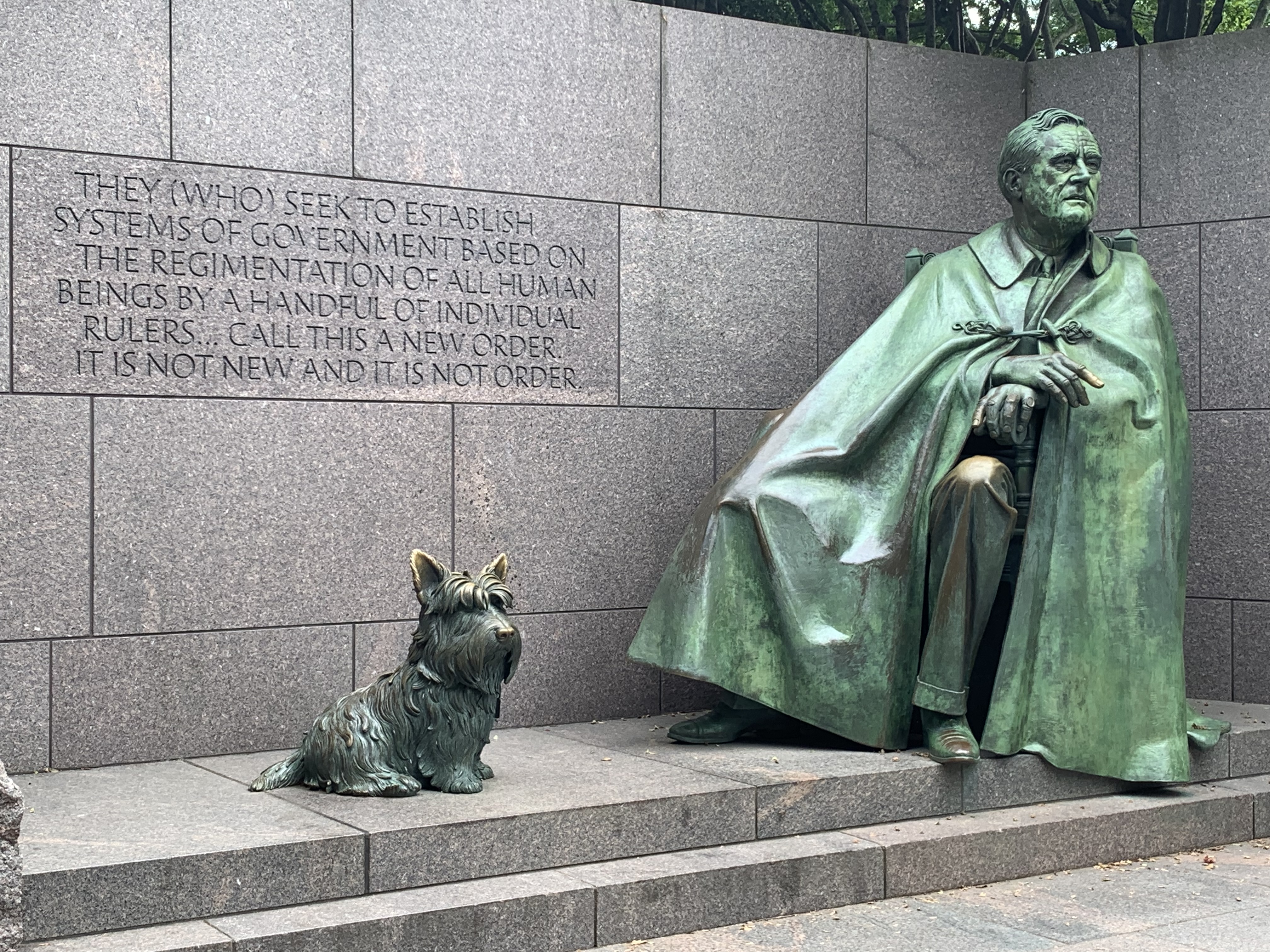
“We have faith that future generations will know here, in the middle of the twentieth century, there came a time when men of good will found a way to unite, and produce, and fight to destroy the forces of ignorance, and intolerance, and slavery, and war.”
FDR in 1943
Wander through the FDR memorial amid the waterfalls and trees, reading his words and reflecting on his extraordinary life, and feel the impact his leadership had upon the world. He struggled against being defined by polio, against the Great Depression, to bring a new deal to Americans, through WWII and for peace, until his wife Eleanor took up his torch at the UN. In speaking plainly with people FDR became the lightning rod that harnessed the energy of everyone’s dashed dreams and fearful hopes to make the world better. The desperation of the times brought Americans “a rendezvous with destiny” and required more of FDR than any other President: putting 1/4 of the country back to work, creating a new social contract with a safety net, becoming “the great arsenal of Democracy”, and fighting for a dream of world peace.
“Unless the peace that follows recognizes that the whole world is one neighborhood and does justice to the whole human race, the germs of another world war will remain as a constant threat to mankind.”
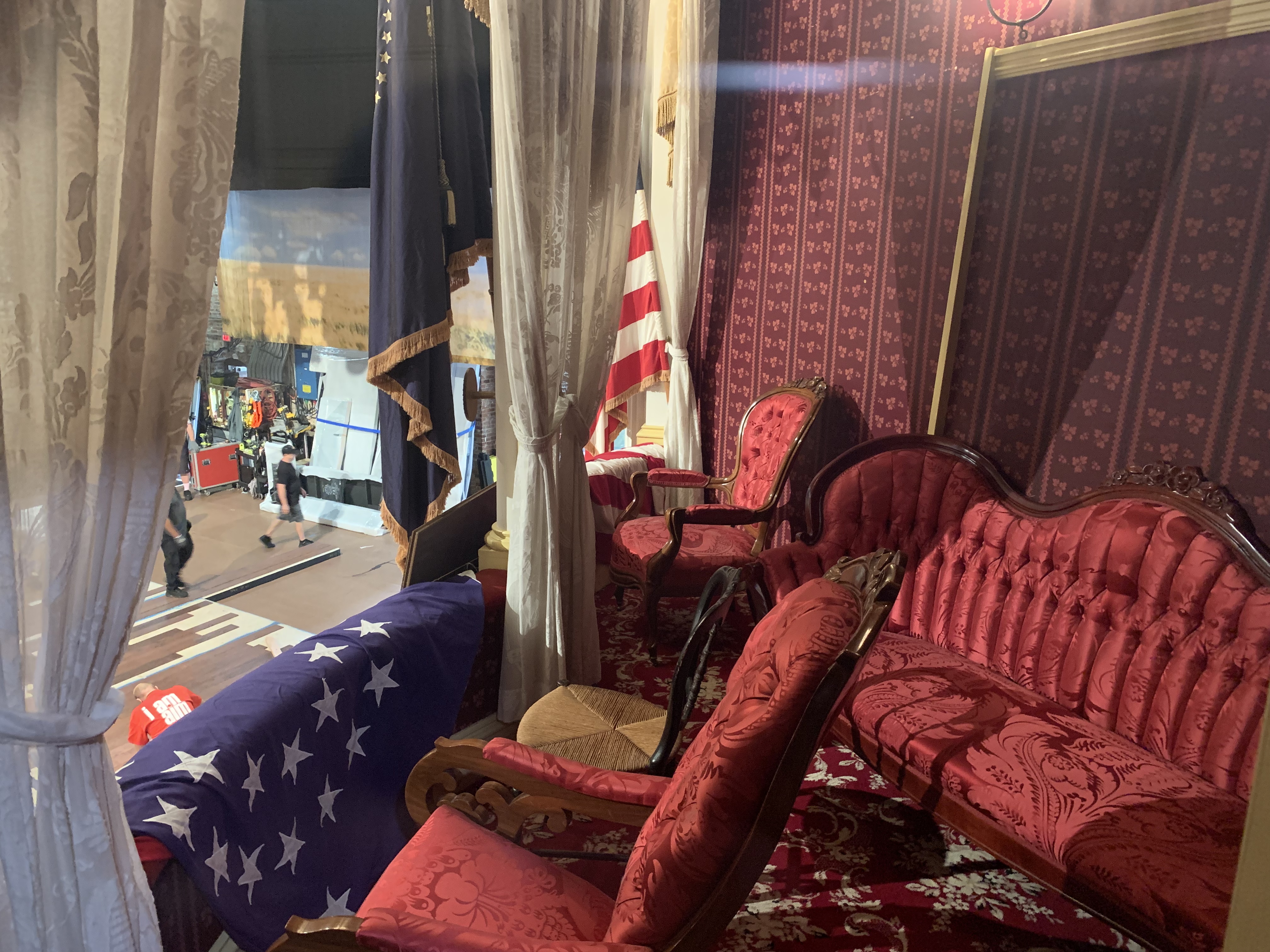
“By God, that will be the last speech that he will ever make!”
John Wilkes Booth
A Shakespearean actor, infuriated by a Lincoln speech about voting rights for African Americans, after learning where the President would be, shot him.
Arlington House is “a riddle, wrapped in a mystery, inside an enigma, but perhaps there is a key.” The key is slavery. The house belonged to the descendants of George Washington’s stepson, John P. Custis, and Robert E. Lee married John’s granddaughter. Lee was a veteran (Mexico) and West Point grad who put down John Brown’s abolitionist rebellion at Harper’s Ferry. Abraham Lincoln offered him command of the Union Army, but here Lee declined and chose treason.
While it would have been better if Lee had chosen morally, it was no surprise to his slaves here. When John Custis’ son G. W. P. Custis died, his will ordered his slaves freed, except that Lee didn’t free them and cracked down instead. Some slaves resisted, escaped, were caught, jailed and lashed.
Lee fought to dissolve the Union to preserve slavery and against those who fought to preserve the Union without slavery. The country split in half right near here, with Maryland staying with DC and the traitors set up their HQ nearby in Virginia. When Lee evacuated, his slaves were finally freed, and one, Selina Gray, personally handed the keys to the cellar over to the Union General in order to preserve George Washington’s personal relics (including his war tent now on display in the Museum of the American Revolution in Philadelphia).
Periodically, slavery-supporting “lost cause mythology” believers try to rehabilitate Lee’s reputation. After the war, Lee supported disarmament and peaceful reconciliation, but that doesn’t excuse either his own slave owning or his treason on behalf of slave owners. Still, there have been periodic political attempts to elevate Lee, especially in times when white nationalism is in vogue or politicians feel that “reconciling his legacy” would be worth a few votes. This house, previously known as the Custis-Lee House, became known as “Arlington House, The Robert E. Lee Memorial”, but there’s legislation pending to remove his name again.
The site is educational, especially the slave quarters exhibits with audio. There’s a metro stop in front of Arlington National Cemetery, and it’s a healthy walk from there, through security, past the idling gas-polluting buses, past the Military Women’s Memorial and up the hill on a path between the graves to the park site. Be sure to visit the Tomb of the Unknown Soldier and watch the Sentinels of the Old Guard change the Tomb Guard every hour every day. The Old Guard is the name General Winfield Scott gave to the 3rd U.S. Infantry Regiment, and only their most elite volunteers may serve as Sentinels.
“You have made the greatest mistake of your life, but I feared it would be so.”
General Scott’s response to Lee on his refusal to fight for the US
Here’s the link to my visits to all parks in Virginia.



 Zero Carbon Travel