Keweenaw National Historical Park

Reports of a two ton boulder of pure copper lying in a river bank on the Keweenaw peninsula of the upper peninsula of Michigan were dismissed as tall tales, until proven by a geologist in 1840. The boulder wound up at the Smithsonian Natural History Museum, a huge mining boom rush erupted, and the closest port town was named after the geologist, Houghton. Most of the small mines failed, but eventually a large consolidated firm found and mined the largest pure copper lode in the world.

Technically the copper was “rediscovered” (or stolen) as the Native Americans here had been mining it for at least 7,000 years and traded it as far as Effigy Mounds, Hopewell, and other prehistoric sites around the country—so don’t accept the common misconception that Europeans introduced metal work to this continent. However, European immigrants did expand the mines here to an astounding scale. The deepest part of the Quincy Mine above is over 9,000 feet below ground, which is over 6 times deeper than the Empire State Building is high, with huge rooms left behind after the copper seam was excavated (see photo), and 92 levels mostly flooded after the mine closed in 1945 due to competition from western mines.

The huge equipment includes many rare and once record-breaking pieces of industrial machinery, and the Quincy Mine tour is fascinating and essential to understand miners’ lives. Be sure to get a big Cornish Pasty at Roys in Houghton. There are some museums and a visitor center in Calumet, including a magnificent old theater with lovely murals, but since most of those tours are only in the afternoon, it may be smarter to tour the mine in the morning. There are a couple dozen interesting sites on the Keweenaw peninsula, but for me the most haunting exhibit was the description of the Italian Hall disaster at Christmas in 1913.

While capitalists are allowed to organize freely under the law, labor was not. Thousands of copper miners went on strike, and the mine owners hired ruthless, violent strikebreakers. Someone—an anti-unionist according to eight witness who later testified to Congress—yelled ‘fire’ into a crowded Christmas party on the second floor of the Italian Hall in Calumet. There was no fire, but 59 children and 14 adults died. Woody Guthrie explained what happened below.

“The copper boss’ thugs stuck their heads in the door,
One of them yelled and he screamed, “there’s a fire”
A lady she hollered, “there’s no such a thing.
Keep on with your party, there’s no such thing.”

A few people rushed and it was only a few,
“It’s just the thugs and the scabs fooling you, “
A man grabbed his daughter and carried her down,
But the thugs held the door and he could not get out.

And then others followed, a hundred or more,
But most everybody remained on the floor,
The gun thugs they laughed at their murderous joke,
While the children were smothered on the stairs by the door.”
“1913 Massacre” by Woody Guthrie

Clara Barton National Historic Site

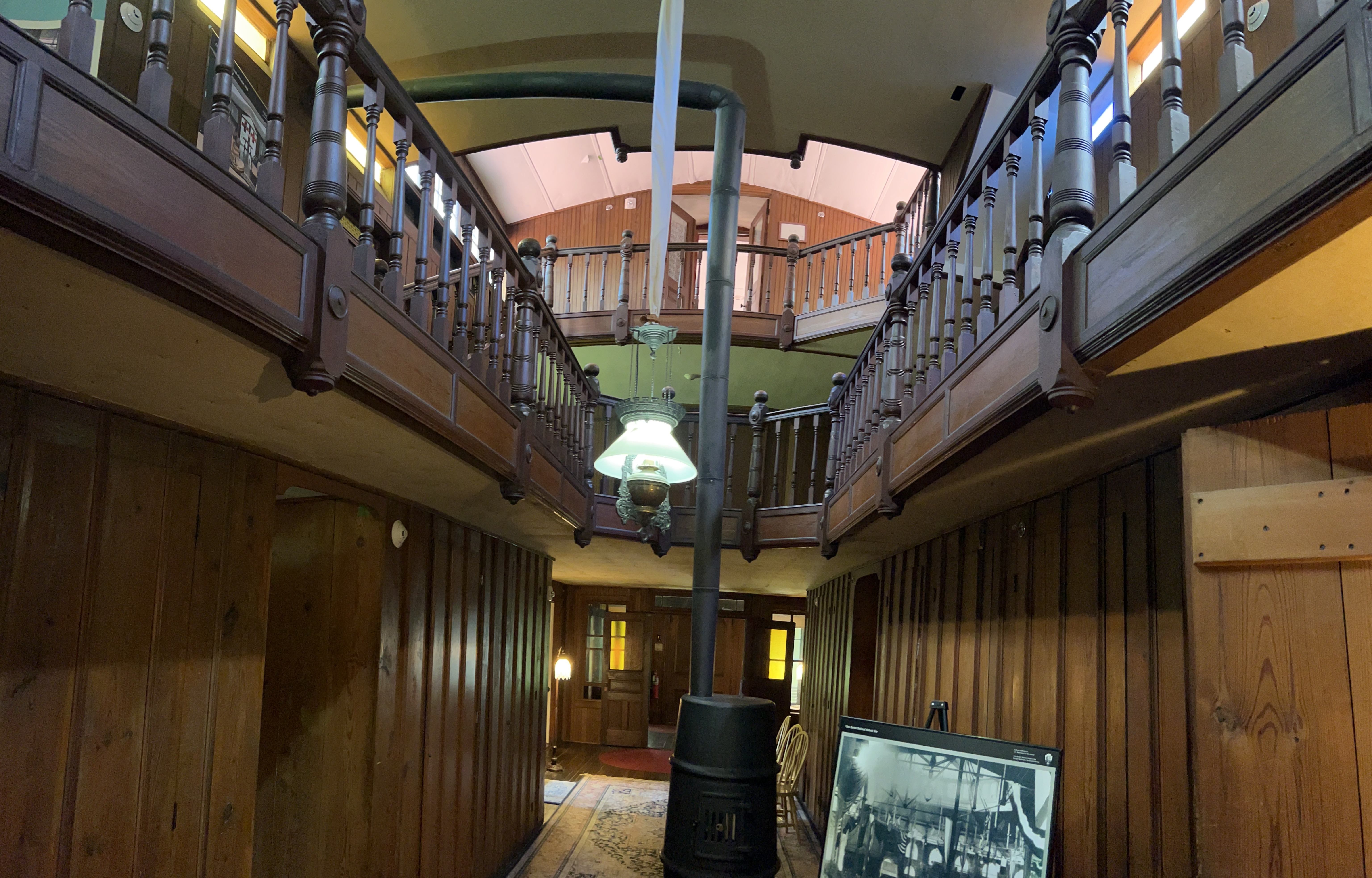
The Maryland home was donated by wealthy business partners who wanted to attract people to their lands along the Potomac, and it was built to meet Clara’s specifications. She was all business. The lamp is hung by bandage cloth, and the walls are all supply closets with blankets, food and emergency items. The design is similar to the early Red Cross disaster buildings first used at Johnstown. The top floor windows have Red Cross images so that travelers can see it from the road at night. And the staff had both offices and rooms to live and work. The home is currently empty in preparation for a major restoration, but there are large photos to see what each room looked like furnished.

A week after the Civil War broke out, a contingent of the 6th Massachusetts was attacked in Baltimore while on their way to defend the Capital. Clara Barton tended them in the Senate Chamber with her household materials, and she recognized many as her former students. She asked them to tell their parents to send relief supplies to her, so that she could support the Union’s war effort and care for the wounded. She followed the sounds of battle and pre-positioned wagons of supplies as close to the fighting as possible.

There’s a monument to her in the middle of the bloodiest site at Antietam, where she extracted a bullet from a soldier’s face. She became known as the ‘Angel of the Battlefield’. She followed the fighting for years from Manassas to Spotsylvania, she petitioned Lincoln to help prisoners of war, and she went to Andersonville to walk the thousands of graves identifying ‘missing’ soldiers. Sent to Europe to recuperate, she went to Switzerland to work on getting the US to sign the Geneva Convention and join the International Red Cross. Her tactic was to reframe the Red Cross as also providing disaster relief, and not solely as a war organization, and she prevailed on both. She started First Aid kits and training programs. Her missing soldiers department grew into an important bureau of the Defense Department.

Clara Barton was directly responsible for saving many thousands of lives, and her initiatives save millions. She devoted her life to making this country and the world better and safer. But she never had the right to vote.

Port Chicago Naval Magazine National Memorial

At 10:15 pm on 17 July 1944, 320 people were vaporized in a munitions explosion while loading two ships simultaneously. The blast registered 3.4 on the Richter scale, disintegrated the docks above, blew one ship into small pieces, threw other ships hundreds of yards away, and injured people on the other side of Suisun Bay above. Most of the victims were young African Americans, and the Navy blamed the poorly trained black workers rather than the white officers in charge. When 50 survivors refused to return to work, they were sentenced to 8 to 15 years in prison and others were threatened with firing squad for mutiny. Despite the efforts of Thurgood Marshall to defend them and focus the blame on the Navy’s negligence, the ‘mutineers’ spent the rest of the war in prison, and the story was lost to history until a Cal professor named Robert Allen found a pamphlet, interviewed a dozen survivors and wrote a book in 1989.

The story is powerful, and the ranger and volunteer did an excellent job of painting a detailed picture of racism, dereliction of duty (among the officers who bet on load rates), the lies that the enlisted workers were told (that the bombs were inert), and the trial. Photographs, oral accounts and actually visiting the spot where it happened, including touring the revetments where munitions were transferred from boxcars and out to the docks, bring the impact home. The volunteer, Diana, noted that the Navy suffered an even more deadly munitions loading accident less than 4 months later, when the USS Mt Hood exploded in New Guinea on 10 November 1944, obviously not learning the lessons of Port Chicago. The ranger, Eric, made a persuasive case that the negligence and racism uncovered and protested, while officially unpunished, likely prompted the Navy to be the first branch of the military to desegregate completely in February 1946, two years before the other branches.

This park unit is dedicated to preventing this unjust tragedy from being forgotten. Tours must be reserved at least two weeks in advance for Thursday through Saturday when the Army, who took over the base, allows visitors. Although the tour met at the Muir home, I was able to drive my EV to the site above. Fortunately, the park service is working on improving access by building a visitor center nearby.

Johnstown Flood National Memorial

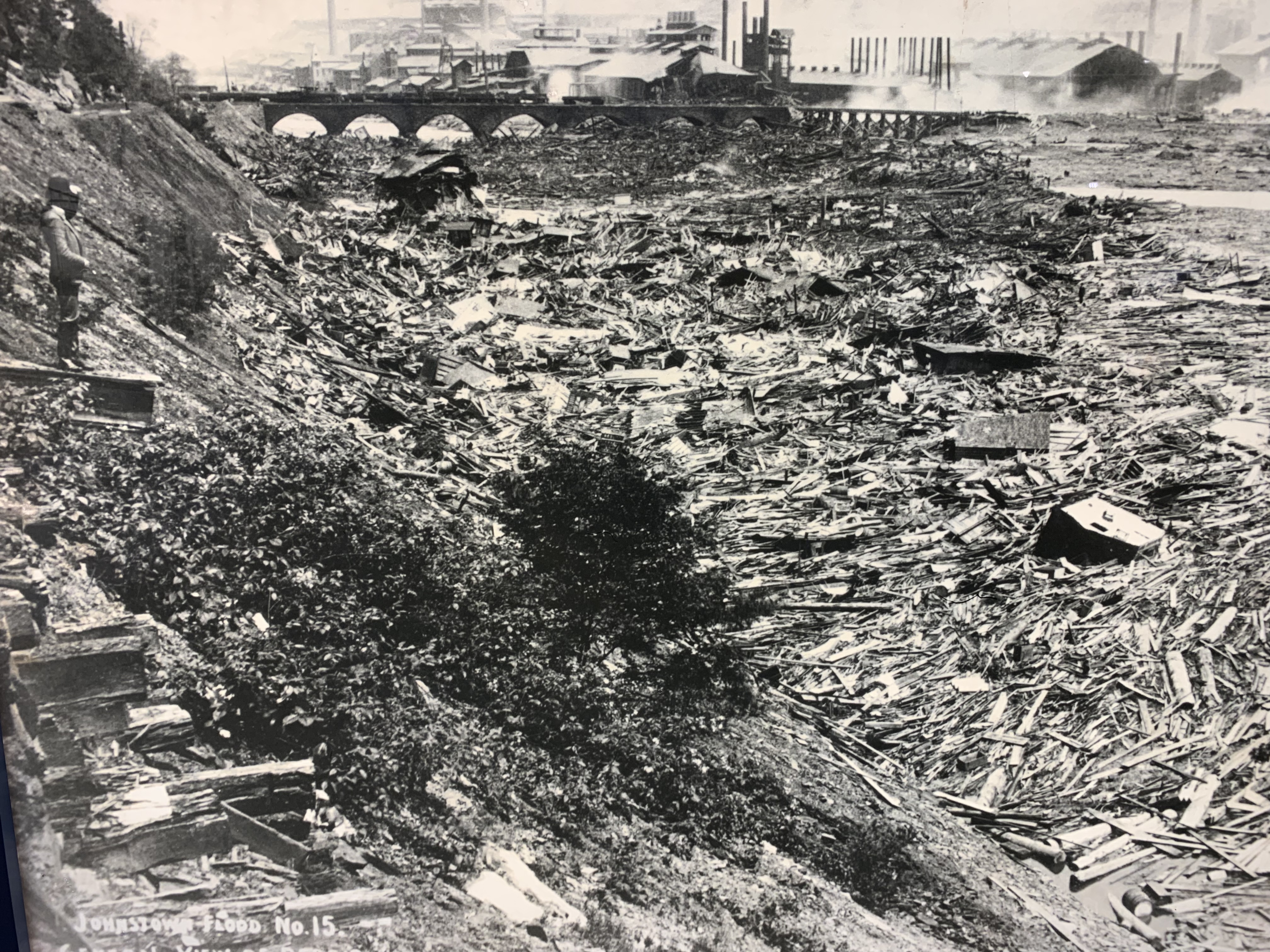
150 years ago, a few of the wealthiest men in the world (Carnegie, Mellon, Frick, et al.) enjoyed relaxing in their fishing & hunting club on the shores of their huge private lake. The lake was held back by raising a dam, but the industrialists ignored recommendations for spillways to avoid overflowing. In the smoky valley below, their workers lived in the fast growing industrial city of Johnstown. The rains came, the waters rose, warnings were issued too late and the dam failed. Over 2,200 people died in Johnstown and the neighboring towns.

As with the Climate Crisis today, people just went about their business and assumed their bosses would not carelessly risk their lives. By the time they realized the danger they were in, it was too late.

Flight 93 National Memorial

Rather than let the 9/11 terrorists use their plane against us, the passengers chose to fight back, preventing another attack on DC and becoming heroes in the war on terror. They are profiled in the visitor center exhibits, regular Americans who did not deserve to be killed by Al Qaeda.

I’m old enough to remember the events, but after my visit today, I felt the need to look up some details about what happened afterward. Turns out that Al Qaeda is still out there (although under new leadership after Seal Team 6 killed Bin Laden in 2011). Al Zawahiri was rumored to have died of natural causes in 2020, before finally being killed in a drone strike in August 2022. Iran and Syria have provided safe havens, and many of the senior members are reportedly Egyptian.

Remembering what happened that day is important for us and for future generations, and it is also important that we continue to bring justice to those responsible.

Oklahoma City National Memorial

Each of the chairs is etched with a name of one of the 168 victims of the bombing here on 19 April, 1995. The smaller chairs are for each of the 19 children killed.

The memorial is designed to achieve closure for this traumatic event, for the families, survivors and responders. The reflecting pool spans the 1 minute interval at 9:02 am ‘between innocence and healing’. There’s a statue of Jesus weeping with his back turned away. There’s a grand old elm that survived. And there’s graffiti, sprayed by a CSI bomb specialist working in the rubble, promising to seek Justice for the victims and for God.

For me, the decision not to delve into the cause of the bombing makes closure impossible. Neither the victims nor God could be satisfied that 27 years later our country is still under assault by violent anti-government white supremacists. The $15 museum (closed Sunday mornings) describes the investigation and trial (2nd floor), but the main film is on “personal responsibility” (GW Bush’s campaign theme).

The truth is that McVeigh (executed) and Nichols (life) were anti-semitic, white supremacists who believed that attacking the government and killing civilians is justified. They were heinous criminals, not patriots. Yet their hateful, militant and deadly beliefs have continued to grow into a powerful political movement that still threatens our democracy.

The memorial offers a powerful opportunity to teach people about overcoming bigotry, about non-violence and about true patriotism. The focus should be on the strengths of our democracy, including “liberty and justice for all” and our right to “peaceably assemble, and to petition the Government for a redress of grievances”. Instead, each memory is placed in a glass case, platitudes abound, Christianity is affirmed, extremism ignored, and our nation is left unable to come to terms with the issues that caused the bombing.