Natchez Trace Parkway

The “trace” or trail from Natchez to Nashville is now a parkway, under strict protection of the park service which limits development. The National Scenic Trail, also a park unit, has miles of hiking & equestrian trails along the way. I’ve more or less driven the length now, with lots of side trips to nearby sights, and the dense spring foliage is beautiful, soothing and seems endless.
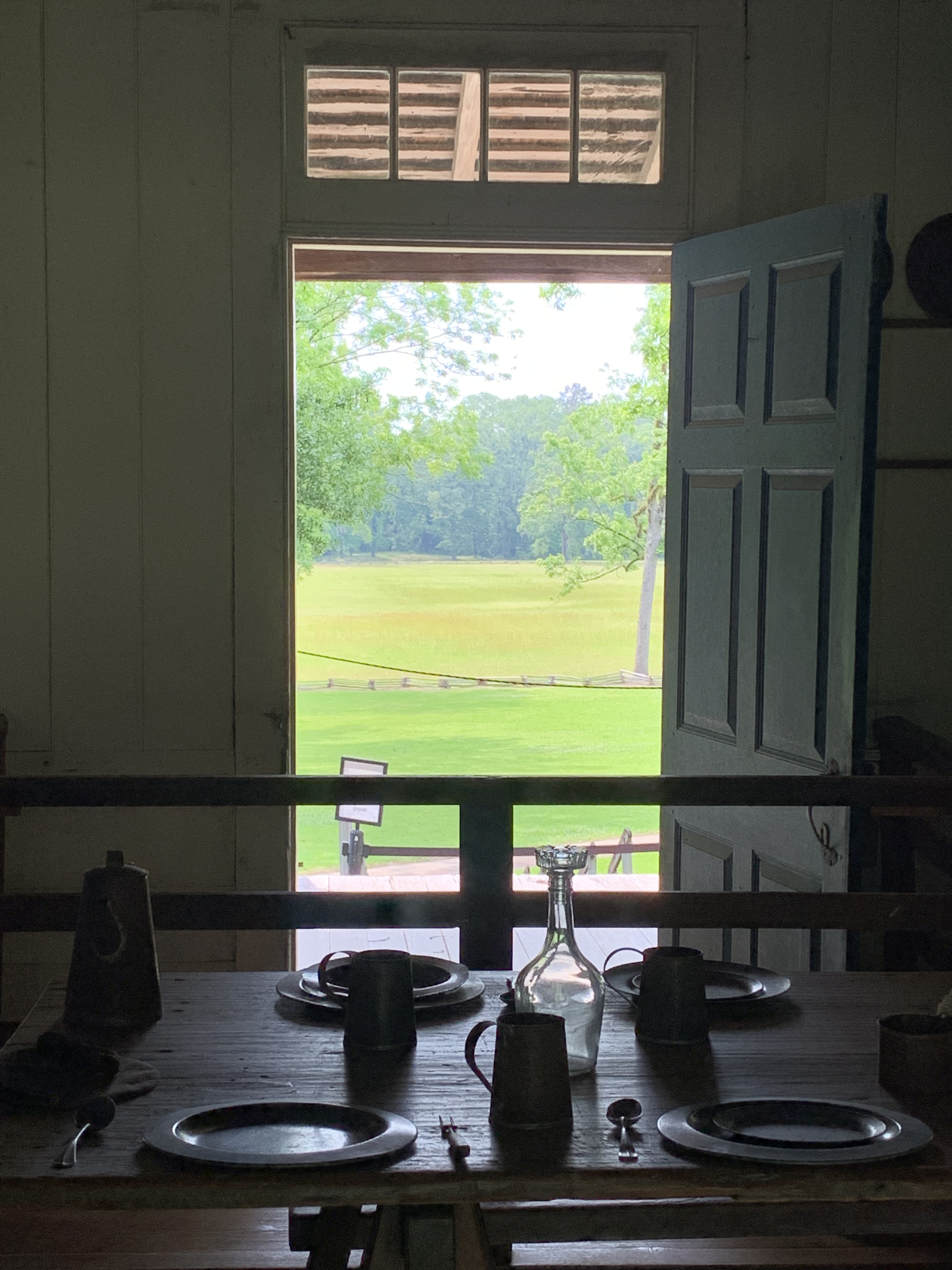
The first stop traditionally is at Mount Locust pictured above, and the route was typically used northbound, returning by boat. The trail is far older than our country, as French fur traders followed Native American trading routes that had been used for thousands of years. After the steamship was invented, most people stopped walking, which put an end to the proprietor’s lucrative business of selling whiskey, food and basic shelter at the ”stand” or simple roadside inn.

We tend to see history as inevitable, and don’t often think about what might or should have been different. But the people back then were constantly trying to learn, make changes and adapt. The land in the photo belonged to Native Americans, then was claimed by England, then by America, then worked by slaves who turned sharecroppers, and is now run by the park service. At each transition there was loss and opportunity. Only fortunate and adaptable people made it through turbulent changes. Injustice was resolved by war. No success or failure was inevitable. In hindsight, better choices could and should have been made.

I need to believe that we’re capable of learning, making changes and adapting. Dramatic change is inevitable, common behaviors suddenly become unthinkable, and those who can’t change usually suffer most. The extent of damage from the climate crisis has not yet been determined. Not all the coming extinctions are inevitable. The actions we take today make a difference to our future. We must stop burning carbon now, no matter how inconvenient, and we must prepare for the coming challenges.

Natchez National Historical Park

Natchez was the second largest slave market in the US (after New Orleans), but almost nothing remains. From here, many were walked to plantations up the Natchez Trace. The park service recently acquired part of the ”Forks of the Road” slave market for an interpretive site, which includes the actual slave chains pictured above. The hand in the photo is of a woman who is planting flowers to beautify the site. She explained to me that she feels compelled to do something due to the profoundly disturbing history of tens of thousands of humans sold into bondage for generations. When she first arrived here, she had trouble sleeping, and she imagines the voices of the enslaved calling out for help.
She asked me if I thought that strange, and I said it was by far the best perspective I had heard today.

I had just finished touring the Melrose mansion in the park, and all the glamour of the place left me feeling quite ill. The home of a Pennsylvanian lawyer turned plantation owner, it has all the ostentatious luxury that money could buy, with slaves next to the barn, above the laundry and dairy, and in the basement, all trained to come running at the sound of a bell. And 350 slaves working on plantations out of sight. I had to ask about those 350 slaves who actually brought in the cotton, since the placards only described a few house slaves, “laughing” and enjoying their “leisure”. The other visitors had seen the TV shows and movies filmed in the well-preserved mansion, and they seemed impressed by the lifestyles of the rich and morally reprehensible.

I could only hear the bells ringing years ago, and later, I too heard the voices.

Cane River Creole National Historical Park

There was a storm coming when I took this photo of the Overseer’s House on Oakland Plantation which may help convey the dark, menacing sense of the place. I visited Magnolia Plantation years ago with my kids, and I remember the slave huts. This plantation illustrates a later period when most farms employed day laborers, but here they still had tenant farmers. The ranger euphemistically explained that they were technically “day laborers who just happened to live on the plantation”. The sign on the iron gate dates Oakland to 1821, but that’s just when the cotton plantation was renamed. The French first used slaves to plant cotton here in the 1790’s.

This tragically moving site has poor signage, marking several places you can’t park but no entry sign for the actual parking lot around back. So I ended up driving around more than expected, and I noticed some African Americans living in run-down shacks right down the street from large new plantation-style homes complete with landscaped grounds, wrap-around porches and white colonnades. I think it shows an abysmal lack of sensitivity to or remorse over the centuries of mistreatment of slaves and laborers to intentionally choose to live in a plantation style house here, especially before investing in decent housing for the descendants of the victims.

Little Rock Central High School National Historic Site

Okay, the photo is crooked. But in a way, that’s appropriate. As the ranger Randy explained, “there’s more than you know” here. Turns out, the school board took all the public school funds, gave them to the all white school, and told the African American community to build their own school on their own. So that’s why this is considered one of the finest looking schools in the country, because of racism and theft.

The Supreme Court may have ordered schools to desegregate, but many local school districts did everything they could to resist. As ranger Randy said, “you need to ask why there were only nine”, referring to the Little Rock Nine. In fact, there were many more than nine African American students in the district, but the school board put all kinds of restrictions on who could get in to the white school: you needed a 3.8 GPA, you weren’t allowed to participate in any extra-curricular activities, and you could neither report nor retaliate to bullying. They specifically designed the rules to reduce the number of black students to a small few who they could force into quitting.

The mob arrived first. The nine were told to arrive later and meet nearby. Well, all except for Elizabeth Eckford, who didn’t have a phone. She went right up to the door, surrounded by a hateful and threatening mob and was met by the National Guard. She expected the soldiers to protect her and let her pass, but they had been ordered by the governor to block any of the nine black students from entering. Confused and alone, she walked back to the bus stop and waited, enduring constant torment from the racist mob.

The case goes to Federal court, which disallows the Guard from blocking the students. The police try to defend the nine, but there’s a riot. Finally, Eisenhower nationalizes the Arkansas National Guard and sends in the 101st Airborne to escort the students inside more than three weeks after school began. The students endure physical and verbal abuse daily all year. The governor closes all the schools. The voters approve it. The Federal court declares that unconstitutional. And eventually, black students make it through to graduation.

Perhaps the racists thought that it would be easier to intimidate the smart kids, but they fully understood what was happening, why it was important that they didn’t give up and why they still shouldn’t give up.

George Washington Carver National Monument

I love this statue. Carver was born at the end of the Civil War and was kidnapped and orphaned by the Klan. His mother’s owners retrieved him and raised him here, where he studied the plants near the creek as a child. He was educated mainly in Kansas, despite racial barriers, and eventually became the first African American to graduate from his school. His manner was mild, but he demonstrated great determination in the face of poverty, adversity and prejudice.

Recognized for his extensive scientific knowledge of botany and for being a groundbreaking African American scientist, he was hired to teach at Booker T. Washington’s Tuskegee University. His goal was to help the least in society, so he worked on modernizing agricultural techniques used by African American farmers, even bringing a cart from the university out to the fields to teach, a technique copied by the US Department of Agriculture. He published many books and pamphlets, developed patented techniques and is best remembered for developing the lowly peanut into a highly profitable series of products. He testified to Congress about the peanut and scientific agricultural techniques and was widely recognized for his many accomplishments.

I know Carver is an inspirational figure admired for overcoming obstacles, but I can’t help but wonder how many others were denied even the limited opportunities he had. Slavery existed here for 244 years, with 10 million sent across the Atlantic and maybe another 10 million born into slavery here. None of them were properly educated. None had the freedom to pursue their dreams. And all died without being able to fully contribute their talents and ideas to improve the world. How many young, inquisitive minds were destroyed by slavery? How much human enlightenment was snuffed out to pick cotton? Carver was one of the first born after the Emancipation Proclamation was signed, and he spent his life making the world a better place for all of us. But I can’t help but mourn the incalculable loss of all the other people during those 244 years and after who could have contributed as well or even more.

Fort Scott National Historic Site

Built in 1842 to defend the “permanent” frontier with Native American territory, the fort quickly fell behind events. Settlers were already moving west on the Santa Fe Trail. Within four years the actual frontier was being taken from Mexico, with cavalry “dragoons” riding a thousand miles west from here to fight in that war. The fort was abandoned in 1853 and the buildings auctioned. But the military withdrawal set the stage here for Bleeding Kansas, the conflict that presaged the Civil War. Turns out the military wasn’t needed here to keep peace between the settlers and the “warlike” Natives, but rather between the slavers and the abolitionists.

When the Supreme Court overturned the Missouri Compromise and the government passed the Kansas-Nebraska Act, the US government officially decided that it was best to just let the states decide on slavery by themselves. Here, the pro-slavery townspeople– and “border ruffians”–took over the fort to defend against militant abolitionists in the surrounding countryside who were determined to prevent the expansion of the moral abomination of slavery. Around 60 people were killed, including a pro-slavery former deputy marshal, whose widow is remembered for swearing revenge.

The US military returned to use the fort during the Civil War and defended it from guerrilla attacks. Both African American and Native American regiments were formed here. And after the war, soldiers were again sent west to defend the railroads against squatters who protested being cheated out of the land stolen from the natives.

While educational, I believe the park service has a responsibility to do more than simply illustrate the views of both sides. The Civil War was not “a controversy over states’ rights” nor was Bleeding Kansas merely “growing pains” as park exhibits say. The only states’ “right” being contested was the “right” to chain and breed people, on the basis of race, in perpetual ignorance and slavery, including women and children, forever. By any standard of human rights, that is not a right, but a profound moral crime. There is no legitimate justification of slavery. Perpetuating traitorous and racist views that there was any honor in fighting for slavery is dangerous to society and deeply offensive, to those held in bondage, to their descendants and to those who fought and died to end slavery in America.

Brown v. Board of Education National Historical Park

The volunteer here deftly explained to me why the NAACP chose an elementary school in Topeka Kansas as part of their legal battle against segregation. The NAACP had tried various cases in other states, where white schools like John Philip Sousa in DC were superior and where black schools like Hockessin #107c in Delaware were inferior, but here in Kansas, the two schools were almost identical in terms of facilities. In fact, the teachers in the black school were more qualified, due to lack of opportunities elsewhere. Because of the superficial “equality”, the NAACP was able to argue that segregation itself, no matter how “equal”, is unfair and damaging.

It’s not that Kansas was all or always fair-minded. Violent racist agitators in Kansas both predate the Civil War and still exist today. At the time, racist policies were implemented either broadly by law in states like South Carolina or locally and selectively in states like Kansas. Perhaps because Topeka is the state capital, the schools here were segregated with substantially equal funding.

The key to the case was the Clark Doll test, where black children often identified with and preferred to be like a white doll rather than a black doll. The evidence made it to the Supreme Court, where it was cited by Chief Justice Warren as revealing the permanent damage done by legal segregation. One of the original dolls used in the test is here.

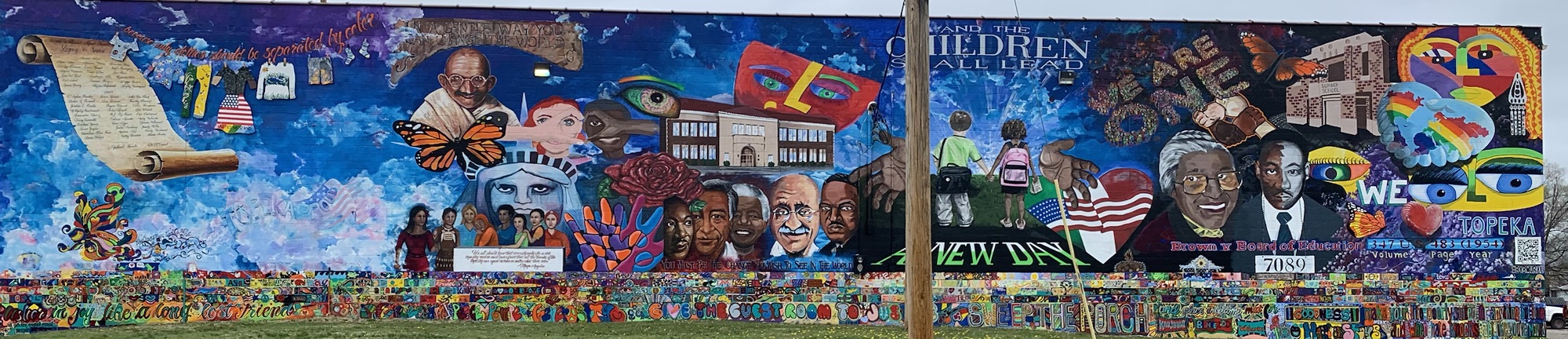
It is a privilege to be able to visit and feel connected to such an important site in the Civil Rights movement. The nation has many sites devoted to war, especially Civil War memorials, and I wish it had more sites devoted to the other kinds of fights we had for moral progress. The mural outside pictured above was done in 2018, and at the bottom local kids added their own colorful illustrations showing what Brown v. Board of Education means to them.

César E. Chávez National Monument

I returned here today to see the exhibits, as they were closed when I visited last year. The black & white photos of the Delano grape strike and Chávez’s hunger strike remarks are particularly moving. Pesticides were not regulated at all then, and labor was denied rights by growers. Chávez’s national boycott of grapes helped change both.

Today, growers drain rivers, lakes, wetlands and water tables, even as the western half of the country suffers in drought. In Kern County, where the Monument is, the Kern River no longer flows to the Kern Lake, due to diversion for agriculture. In order to sell more produce, growers are ruining the environment for fish, animals and people. Climate change and some farming practices also exacerbate Valley Fever, a deadly fungal infection spreading in California & Arizona.

Agriculture is a trillion dollar industry in the US, with $150 billion in exports. But Big Ag prefers to blame Democrats, rather than face the fundamental challenge of the climate crisis. Big Ag needs to convert farm equipment to electric, and they need to stop using fossil fuel to ship their produce around the world. They also need to cooperate to restore wetlands to sequester carbon.

César Chávez devoted his life to raise awareness and lead civil disobedience to make change. He acknowledged that in the struggle against the rich and powerful, poor people only have their lives “and the justice of our cause” on their side. Today, we need more people to be just as devoted to stop the climate crisis.

Wisteria, photographed in my previous visit in 2021.

Click to see my photos of all national park units in California, or click to read an updated site visit here.