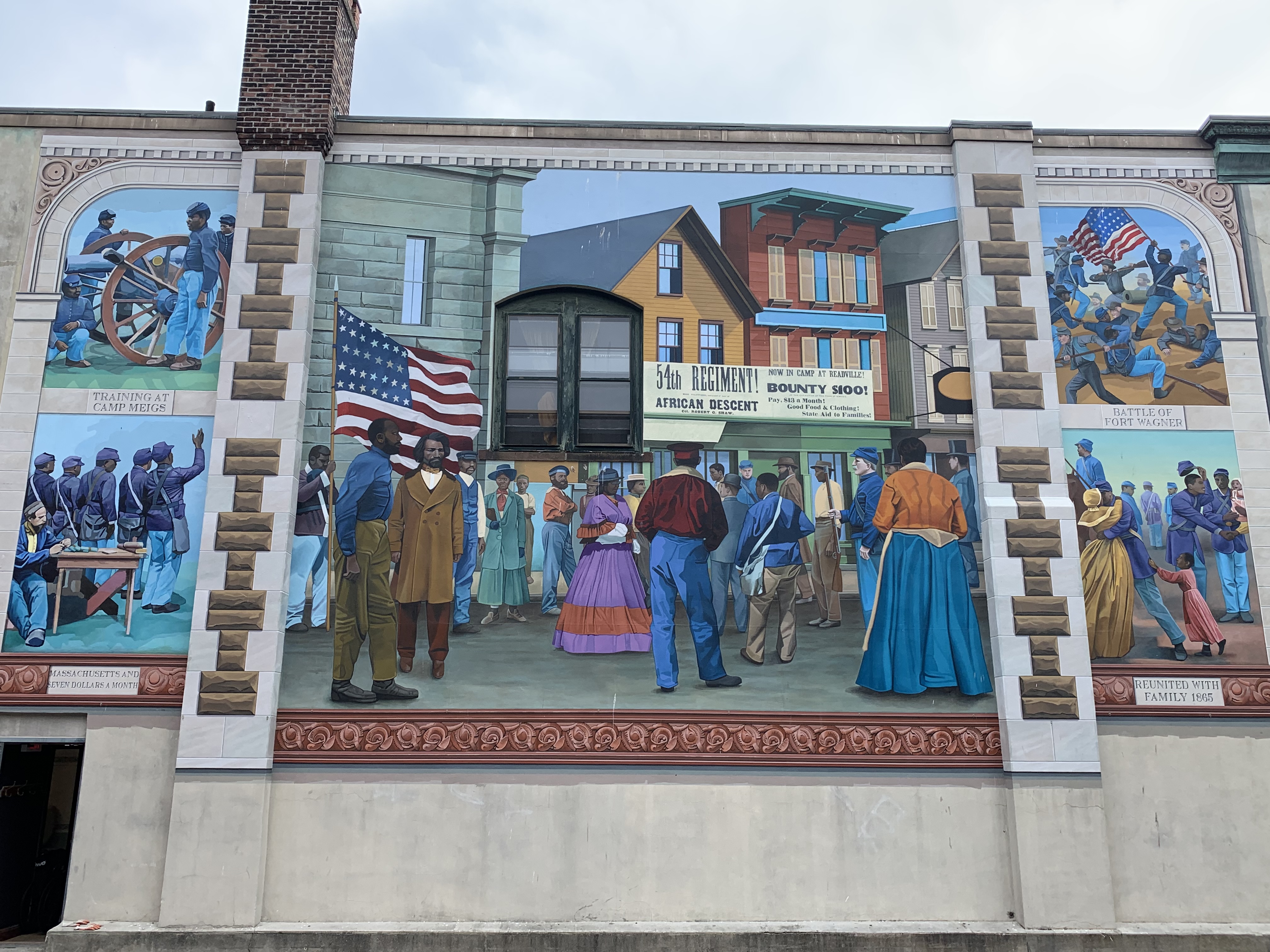
Why am I showing a mural of the Massachusetts 54th instead of the blue whale or the model ship Lagoda from the Whaling Museum? Well, this park covers a lot of history, and most of the recruits for the famed 54th (see the movie Glory) joined here. They were here in part because the whaling industry had long employed people of all kinds, including free African Americans and escaped slaves, and because this was an important stop on the Underground Railroad. Before the Civil War, New Bedford was an abolitionist city, run by Quakers with people of color making up 7.5% of the population . A young Frederick Johnson escaped slavery and stayed in Nathan Johnson’s house here in 1838. To avoid confusion, he accepted the new name “Frederick Douglass”.
And the whaling history may be even more interesting. Today New Bedford is the largest scallop port, but from 1825 to 1925, its major commodity was whale oil, which once powered lamps across the country and had a hundred other uses. Besides the whaling museum, there’s the Seaman’s Bethel with memorials to those lost at sea, historic homes, living history, the Ernestina-Morrisey schooner along the fascinating wharf, fast ferries to the islands and many other interesting things to see and do. And, there are plenty of seafood places, including the Black Whale, which has both an excellent sit-down restaurant and a more casual dockside stand.
This park is the lynchpin of the nation. If it were removed, the whole country would fall apart.
OK, maybe not, but it is an important spot. The domed courthouse above heard the infamous Dred Scott case, which was used by the Supreme Court to take the country backwards, deny people their basic rights and help spark the Civil War. (How times change). The arch represents a gateway to western expansion, facilitated by Jefferson’s Louisiana Purchase in 1803 and subsequently explored by Lewis & Clark from here.
Many factors came together for the territory to wind up as ~12 US states. France traded with the Native Americans who lived there, and all along the rivers there were French communities, from Pittsburgh to St Louis and from Quebec to New Orleans. Shortly before we became independent, Britain declared war on France, used their ships to take Quebec and blockaded Spain from their colonies, and in exchange for peace, they took Canada and Florida, while France kept Haiti and Spain wound up with the Louisiana territory.
That peace treaty didn’t last long. The British heavily taxed the colonists to pay for that war (bad idea), the US declared independence (and won), the slaves in Haiti revolted (and won), Spain secretly gave Louisiana back to France, and France & Spain were preparing to invade England (and lose). Amidst this chaos, Napoleon wanted cash more than colonies that he couldn’t control, and Jefferson wanted to secure the Mississippi and expand our new country. Both sides approached each other to make a deal.
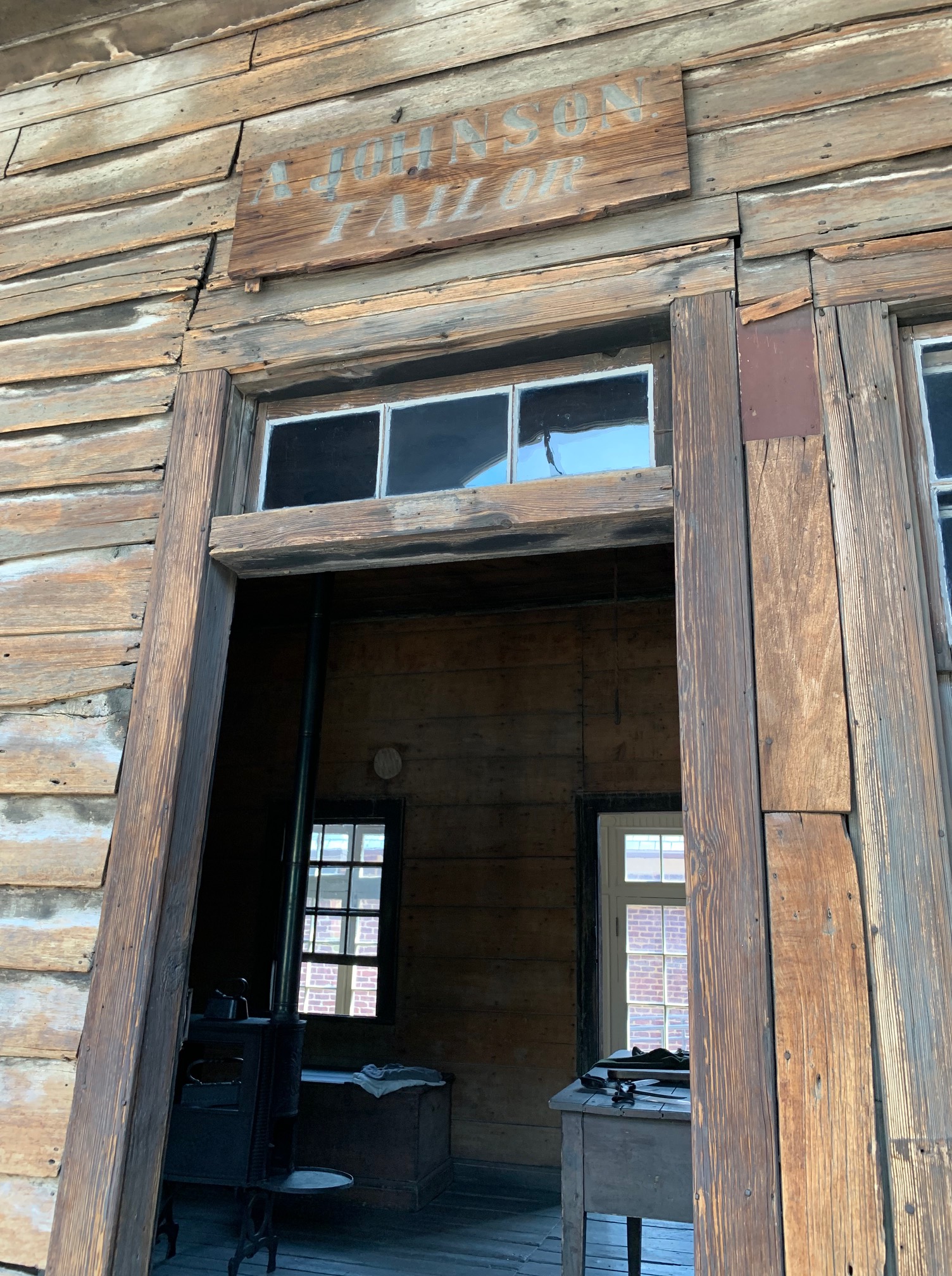
Somebody has gone to a great deal of effort to rehabilitate disgraced President Andrew Johnson. The hagiographic film is narrated by the late Tennessee Senator (and actor) Fred Thompson. The exhibits extol Johnson’s fidelity to the Constitution against the “radical” views in Congress that African Americans should be granted full citizenship rights. This may be the worst site for informing people about history in the park service.
In fact, Johnson was an inveterate racist, a slave-owner who got a special exemption from Lincoln’s Emancipation Proclamation to extend slavery in Tennessee. After Lincoln’s demise, Johnson reversed Reconstruction and vetoed the Civil Rights Act, paving the way for a campaign of terror by the KKK (also from Tennessee in 1865) and the collapse of all efforts to let freed slaves participate fully in elections. He was impeached (148-27), but escaped conviction by one vote. Johnson’s presidency was such a threat to the nation that Grant was pressured to run “in order to save the Union again”. A long-time historical favorite of racists, modern historians generally rank Johnson among the worst presidents. Nowhere at this historic site could I find any acknowledgement that it was morally wrong and anti-democratic to deny freed slaves the right to vote.
Johnson was a poorly-educated tailor who had the good fortune to be married by a relative of Abraham Lincoln.
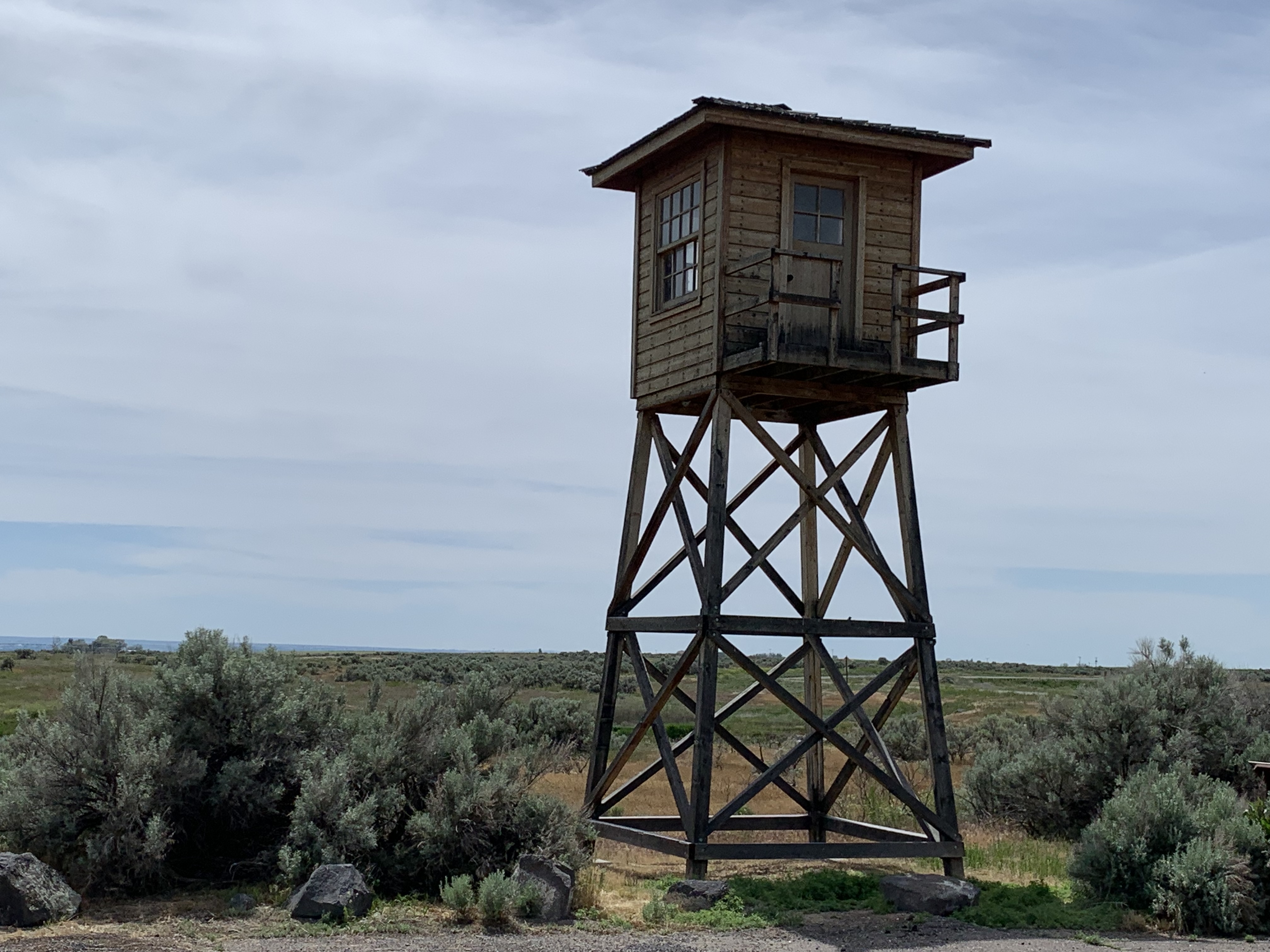
Named for the Dakota Sioux word for a spring, this concentration camp is along an irrigation canal, where the Japanese-American prisoners built a swimming hole and tried to fish. The sincere efforts to try to improve their confinement somehow make the circumstances even sadder. Thousands of Americans were cut off from their homes, neighbors and country, due to their national origin and race. Most German and Italian Americans were not incarcerated during WWII. Neither were most Japanese-Americans in Hawaii. Most of those kept here were from the Pacific Northwest and had lived in the US for a generation or more. Many also found their property had been stolen when they tried to go home. Under Carter and Reagan the survivors were paid $20,000 compensation for “race prejudice, war hysteria and a failure of political leadership”.
A promised utopia for ex-slaves, this remarkable small town has also, like my last stop, preserved its cultural heritage. Named for both Nicodemus who asked Jesus the price of rebirth and for the old spiritual ”Wake Nicodemus” who asked to be awakened for the Jubilee, perhaps the best preserved and restored building is the AME Church above. But in the visitor center I met the living exhibits: the 5th, 6th and 7th generation descendants of those resilient settlers who survived in the remote prairie. They explained to me that while the town is extremely small today, every year in the last full week of July, many more descendants return for a reunion and keep the unbroken traditions thriving.
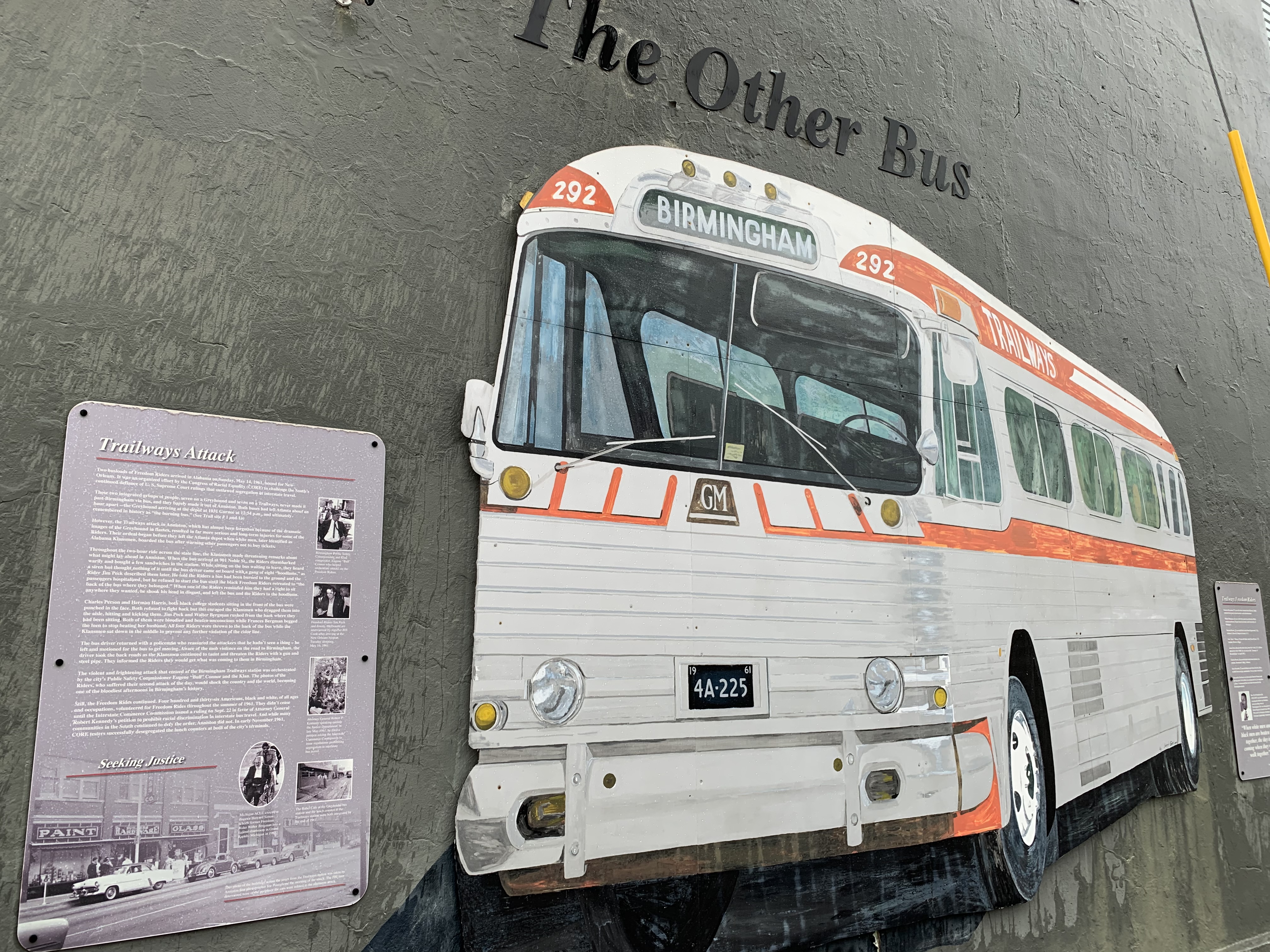
This is another underfunded Civil Rights site. The mural above is one of the few sights I found to see. As part of a systematic campaign to dismantle segregation, a small group of regular people rode buses between states in the south, where race mixing was not allowed under local laws. Since the federal government regulates interstate commerce and travel, they had jurisdiction. The activists exposed the racism, the NAACP lawyers brought cases to court, and eventually the Supreme Court outlawed segregation. Rosa Parks may have started the bus strikes, but it was the Court that integrated buses legally. The freedom riders were brutalized by the Klan, but their cause eventually won.
This may be the worst transition ever, but RV’s get about the same mileage as buses and some are even bus conversions. At a campsite near here, I was asked whether I was afraid of running out of electricity. We compared ”range anxiety” and realized that even with large fuel tanks, the rigs in the campground have less range than my long range model 3 Tesla’s 350 miles. Once loaded, they simply get such bad mileage that they have to go to gas stations more often than I need to charge.
I had forgotten that it was a children’s march on Palm Sunday that was assaulted by dogs and water cannon. Under city ordinance, it was illegal for children of different races to play together. In my view, the longer a system of injustice is allowed to stand, the more deeply engrained it becomes. The Civil Rights Institute does a powerful job of setting the scene, where African Americans worked in the steel mills and mines and lived in the city behind a color line. People like Bull Connor and the mayor grew up believing that segregation was normal, right and beneficial. They didn’t play with African American children as kids, and as adults they attacked them, peacefully assembled, wearing Sunday clothes, in a park, outside the 16th St Baptist Church, singing songs. The children had learned from Dr King not to fear jail when doing no wrong, but the assault against them was brutal, and televised.
At the time, America was shocked and voiced outrage. This week children were slaughtered in yet another episode of gun violence. I wonder if we’re sufficiently outraged to change the system as those kids in Birmingham did.
“A man dies when he doesn’t stand up for injustice.”
[Updated after 3rd visit, including Oaks tour and Carver Museum.] I admit I was frustrated the first two times I drove here from California, unable to access either Booker T. Washington’s house or George Washington Carver’s Museum and finding incorrect information on the website and app. And I might have ranted about how other sites appear to be better funded. But all is now forgiven.
Like many emancipated slaves, Booker had no surname. When he showed up at school, he just said his last name was Washington. After walking across much of Virginia to go to school near Hampton Roads, he became a teacher at Hampton University, before being hired to run the Tuskegee Institute, now University. Ever hard-working, practical and focused on improvement, his students developed many valuable skills to support their families, including brick making. His students built his impressive mansion, The Oaks, across the street from Tuskegee University, using the design by our nation’s first African American architect, Robert Taylor, who trained at MIT as its first black student. Booker T., ever persuasive, recruited Taylor, who designed many buildings that are now part of both this national historic site and the university.
It is difficult to overestimate the importance Booker T. Washington had in advancing the lives of people who for centuries were not allowed to learn how to read. An advisor to US Presidents, world traveling speaker, practical educator, builder, mentor, and author, his practical focus drew criticism from WEB Du Bois and Frederick Douglass, who focused on ‘higher achievements’, but ultimately, they all worked towards the same goal of progress. All continue to inspire generations to learn, grow and excel. Inside the house on tour, I learned about Booker T’s wives, who also contributed to education. By necessity, black women have often had to assume a role as matriarch, when it was difficult or even impossible to keep families together.
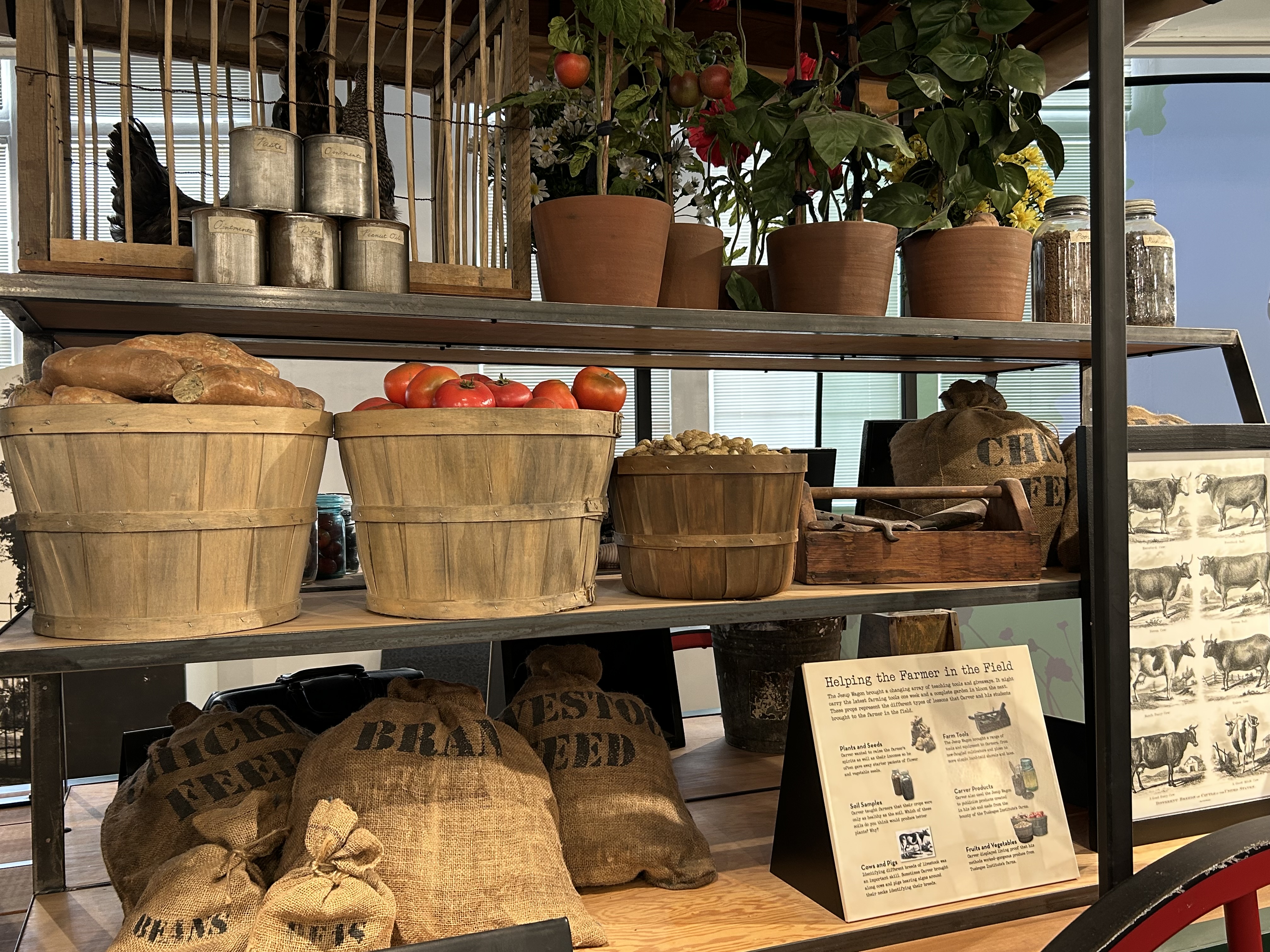
Booker T. Washington also hired George Washington Carver to teach and help improve the lives of African Americans, and the Carver’s museum on campus (see photo below) reveals his broad scientific interests beyond the peanut. Carver was an ecologist, who focused on profitable uses for peanuts in order to improve soil health, a forward-looking view that has only become more important over time. But following Washington’s practical focus, Carver spent much of his time in direct outreach to rural communities, bringing solutions and advice out in wagons.
I’m sure Washington could not have imagined that his institute would have been used by the US government to run a 40 year ”experiment” on black men, neither treating nor disclosing their diagnosis of syphilis. (See ”Miss Evers’ Boys” also set in Tuskegee & starring Laurence Fishburne). He might be pleased to know that there’s a private museum on campus dedicated to teaching the history of that infamous experiment as well as the genetic legacy of Henrietta Lacks. But doubtless Washington would have been out fundraising to develop the broader community of Tuskegee, which shows signs of economic neglect.
Every year winning poems are chosen from children around the world for visitors to admire along with the roses. The sentiments are moving testimonials to his life, ideals and inspiration, expressed with the moral clarity and unbridled hope of children. This is my favorite Civil Rights site.
The short films & exhibits in the visitor center capture Dr King’s life as the heart and soul of the Civil Rights movement, as well as his wish that we continue. His birthplace, church, center for non-violence and grave are overwhelming, but I was struck by how the community continues to gather here daily for many different events and causes. His passion for justice and righteousness inspire action every day.
Today I’m inspired by one of his thoughts in his letter from a Birmingham jail, about how difficult it is to be told to wait after enduring centuries of suffering. Earth has suffered centuries of pollution, and always the message to environmentalists is to wait. Wait for new technologies, wait for laws, people and society to change, and wait until the polluters have made more money, and then, maybe…. But now we have no more time to wait. We’re moving quickly to catastrophe, wasting precious time on inaction, and extinguishing species without pause. Unless we act to stop burning fossil fuels now, we condemn much life on earth to end.
Their home is currently closed to the public. It’s in a residential neighborhood, and the park service is figuring out how to reopen it. The normal setting underscores the shocking assassination of civil rights leader Medgar Evers in June of 1963. They had prepared for a drive by attack (note the door is on the side), but not for a waiting sniper. Two all white juries failed to convict his assassin who sat on the local ”White Citizens Council”, but in 1994 a conviction was won. Myrlie continues to fight for civil rights, and Medgar, a Normandy veteran, is buried at Arlington National Cemetery.






 Zero Carbon Travel