Constitution Gardens

DC is confusing, park-wise. First of all, parks usually have a type (monument, memorial, etc.) but not this one. Second, there are overlapping layers. Constitution Gardens originally referred to a large area, including the National Mall, but now both parks are part of the National Mall and Memorial Parks, which is a grouping but not a park unit. In 1982 the area with a pond next to the Vietnam Veterans Memorial, was established as this park unit in tribute to the Constitution, and it’s signature feature (above) is the semicircle of stones on Signers Island. Which is nice, but, third, these are not signers of the Constitution but rather of the Declaration of Independence.

I know that, because I’m from Concord, Massachusetts and my father was a history major. So I went to the Massachusetts contingent where I saw five names I recognized. John Hancock, John and Sam Adams (yes, the beer guy was a real patriot) didn’t attend the convention. Robert Paine (unrelated to the guy who wrote Common Sense) wasn’t a delegate, and Elbridge Gerry (for whom Gerrymandering is named) was there as a delegate but didn’t sign the Constitution. Only 39 of the 55 delegates actually signed. The important thing was that they had enough votes to pass it and send to the states to ratify.

But, the garden-variety misnomer not withstanding, the signers of the Declaration of Independence did risk their lives, fortunes and sacred honor by signing that document. Their signatures on paper, here captured in stone, meant Treason against the King, punishable by death. 56 brave patriots, including Thomas Jefferson, Benjamin Franklin, Robert Morris, Thomas Stone and the others remembered in this garden signed, and we owe them all our thanks.

General Grant National Memorial

As General, U.S. Grant won the Civil War, and as President, he saved the Union. He created the Justice Department, supported the 15th Amendment and fought the Ku Klux Klan. Over a million people gathered to watch his funeral procession in 1885, and his mausoleum became one of the top tourist destinations in the nation.

Racists like President Johnson were determined to resist letting African Americans vote, and Grant agreed to run for President in large part to protect those rights. This divide of bigotry, which festered after the Civil War, continues to divide our country. After Grant’s death, the descendants of traitors promulgated the big lie (known as the Lost Cause) that the confederates were honorable, benevolent to slaves, and were the moral victors of the Civil War. To do so, they maligned Grant as a drunk, ignoring his reform efforts and associating him with corrupt officials. The campaign was effective, and Grant was often ranked among the worst Presidents.

Grant’s Indian policy illustrates the problem. Grant appointed the first Native American to be Commissioner of Indian Affairs, and Grant pledged “proper treatment of the original occupants of this land—the Indians.” Supporting peaceful reconciliation, his administration allowed many Quakers and Episcopalians to “help” the natives, instead of continuing genocide. Grant was a firm believer in the separation of church and state, but the religious people believed that converting the Natives was the best way to help them and thus erased so much of their culture. And many people still wanted to take Native American land, so well-intended land policies were similarly corrupted.

Like most of the park rangers I’ve spoken with, I’m a fan of Grant. We believe he was, generally for his time, on the right side of history and does not deserve the vitriol he received in life and death from those on the wrong side of history. I wish he had better understood the depths of and had proposed better solutions against systemic racism, but he was an ally of the Americans who were denied their rights by many white Americans. The struggle to secure the voting rights of African Americans and to restore justice to Native American communities continues over 150 years later. Grant recognized both his own failures of judgement and the moral sins of our nation. But Grant also said victory goes to those who keep fighting.

“Nations, like individuals, are punished for their transgressions.”

Ulysses S. Grant

St. Paul’s Church National Historic Site

The New York Royal Governor Crosby’s allies tried to disenfranchise the Quakers by requiring them to swear an oath on the Bible, which violates their beliefs. In response, the colonial assembly voted in favor of religious freedom and protecting voting rights. The press coverage so annoyed the Governor, that he had the publisher arrested and tried at Federal Hall. But the publisher (Zenger) was acquitted in the case, resulting in expansion of freedom of the press.

The original church here was established by the British to impose the Church of England on the heretical Puritans and Quakers and others who lived here, including people like Anne Hutchinson, who fled both Boston and Rhode Island to avoid harassment over her belief that women could interpret scripture too. (The Hutchinson River Parkway is named after her). As the revolution approached, the people here split into factions of loyalists and patriots, and the graveyard contains families who fought on both sides, as well as Hessian mercenaries, slaves and free African Americans. There was some fighting nearby at Pell’s Point which helped Washington retreat to White Plains, and the church was used as a military hospital.

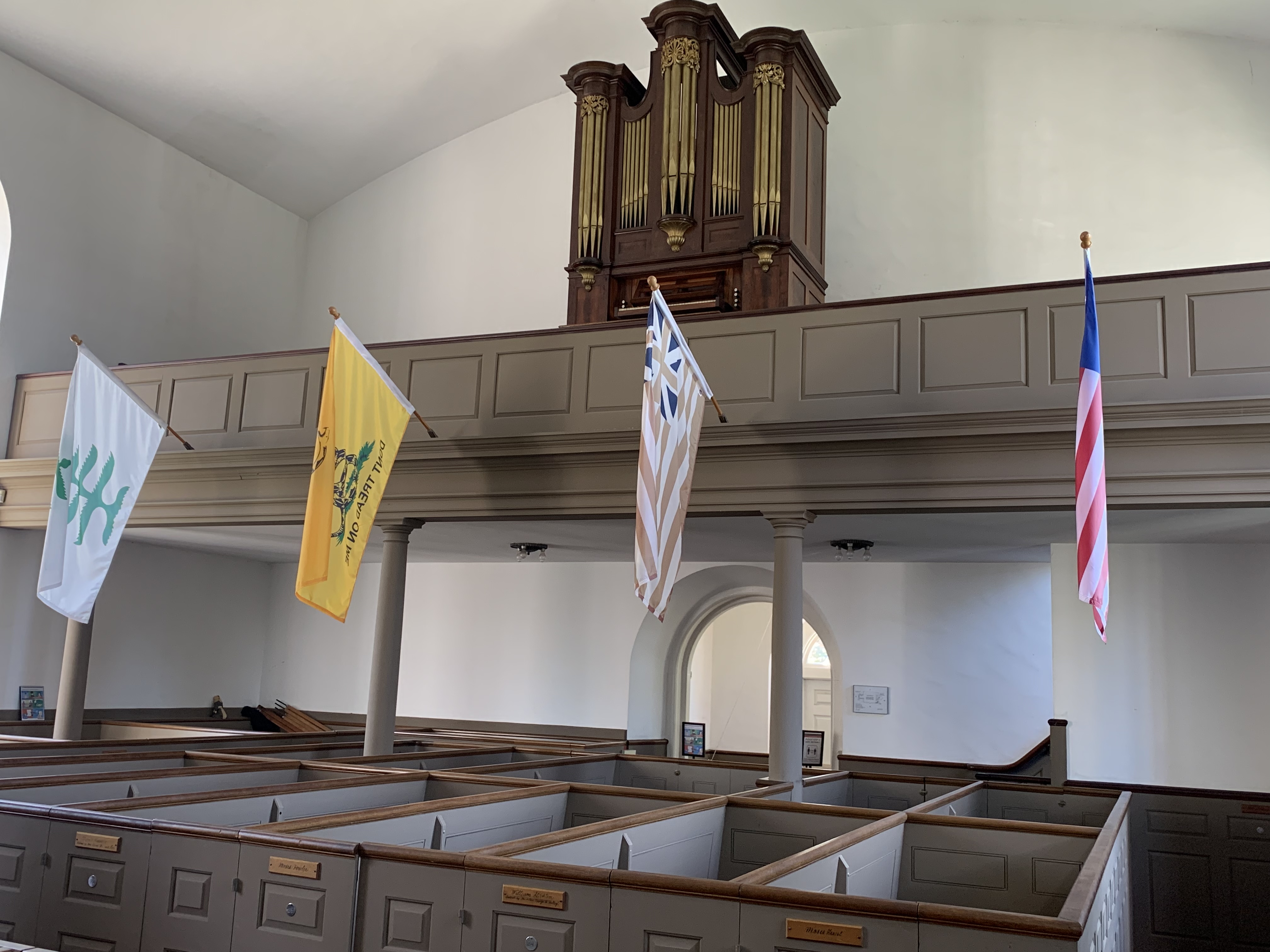
In addition to the fine old organ, family box-pews and flags pictured above, there’s also a bell cast in London in 1758 and a stained glass window. Much of the restoration work was done around WWII with fundraising led by FDR’s mother. But the surrounding neighborhood at the northeast border of the Bronx is now heavily industrial, not residential. (I walked from the Eastchester-Dyer Av station). The Episcopal church, which is related with yet independent from the Anglican Church, was deconsecrated around 1978 and is cooperatively managed with the parks service as a (secular) national historic site. Take some time to walk around the evocative colonial and early American graveyard.

African Burial Ground National Monument

Yesterday I mused about the need ‘to learn from our past to prepare for the future’, without realizing that today I would be looking at a symbol that means exactly that, the West African Sankofa, which is carved above the doorway of return on the opposite end of the memorial structure above. The architect, Rodney Leon, has filled this space with symbols and symbolism, and it evokes the slave-ship hold, the middle passage, the diaspora centered on West Africa and the depth of the remains. When we choose to recognize our roots and learn from them, we can draw strength to be better.

When the burial ground was rediscovered in 1991 and when protests forced the government to change their plans, I was abroad and missed the news reports of the historic find and cultural repercussions. Fortunately, the story is well told in the museum in both the park film and in the exhibits. Government leaders were initially unable to see the pricelessness of the rediscovery due to the value of the land, and the African American community needed to speak out both for their ancestors and for all of us to force the government to respect the remains, preserve the site and honor the contributions of Africans to this city and to our society. The archaeological research, the history of those buried here and some African artifacts are all on display. Facing the emotionally moving subjects daily, the rangers help visitors understand the site’s importance, history and significance.

“You may bury me in the bottom of Manhattan.
I will rise. My people will get me.”

Maya Angelou

Stonewall National Monument

If General Sheridan returned to admire his statue, he would likely wonder why there were so many rainbow flags in his park. If he walked into the Stonewall Inn bar (to the left above), he would probably have more questions. But here on the 28th of June 1969, a police raid against the bar for illegally serving homosexuals sparked a riot against police oppression. Unlike earlier riots, a large crowd gathered and forced the police to retreat into the bar. The police called for backup, but the community brought even more protesters who linked arms and fought back. The bar was boarded up, but the protests became larger, as the LGBTQ+ community came out into the open in force to organize marches to Central Park that grew each year. Before Stonewall, some activists had begun staging “sip ins” at gay bars like Julius’ to protest the denial of civil rights and attempts to humiliate and prosecute people based on their sexual orientation. After Stonewall, laws began to change.

The bar itself is still serving drinks with pride, but the site is scheduled to become the headquarters & visitor center in 2024. There are other bars, nice shops and restaurants in the area, and it’s worth taking a stroll and maybe ordering a drink to raise a glass to the brave souls who fought police here. Despite being discriminated against by society and targeted by law enforcement, they demanded and won respect for their rights, bringing more freedom for everyone.

Lowell National Historical Park

Some of the old factories are empty ruins, and many have been remodeled into chic housing or modern offices. Lowell followed on the success of the cotton spinning mills of the Blackstone River Valley, but many times larger in scale: all stages of production automated from spinning to cloth, cotton & wool, printed patterns & carpets, powered by two rivers, two layers of canals running 6 miles through the city, 10 multistory mill complexes, and 10,000 mill workers. 19th century visitors from Europe were astounded to see England’s Industrial Revolution expanded on American shores. Today, visitors walk the canals (or take a park tour boat or trolley), see the power looms in action, and take in the exhibits & public art in this university town. While there are paid parking spaces all around the historic district, the visitor center will validate free parking in the neighboring structure.

Since the factories sold “Lowell” brand cheap cloth to the plantations for slave clothing, this was not a city that attracted many ex-slaves for work. The owners who profited from their slave-labor suppliers did not support abolition, but many workers did. There was an active Underground Railroad site under the Second Universalist Church, attended by many workers and led for many years by a staunch critic of slavery. The minister also supported the “mill girls” who organized strikes and agitated for their rights 90 years before women won the right to vote. Many suffragettes began their struggle in Lowell’s mills.

Lowell also teaches important environmental lessons. The forests were cut down and burned to bake bricks, the river was polluted with heavy metal dyes and untreated sewage, and the air was polluted with coal to power the steam engines that replaced the greener hydropower. By 1970, the Merrimack River was declared a “non-river”, since it was essentially slow-moving toxic sludge. Lowell was not a pleasant place to live, and many good jobs had moved elsewhere. Citizens voted to clean up the environment, and gradually the environment has improved. The river is now passably clean, and there are green spaces amid the old industrial sites (see photo above). In the long run, polluting for profit is terribly destructive and often irreversible. We need to make better decisions to stop carbon pollution now, or we will regret our lazy, thoughtless inaction later.

Touro Synagogue National Historic Site

The oldest synagogue building in America, Touro is an enduring symbol of our freedom of religion. Fearful of the Inquisition, many Jews migrated to new world colonies not under Spanish or Portuguese control. The Torah pictured was a gift from a congregation in Amsterdam and is over 500 years old. Rhode Island was founded as a religious sanctuary by Roger Williams, with help from John Clarke and Anne Hutchinson, who was banished from the Puritan Massachusetts Bay Colony for having the audacity to argue that women could discuss and help interpret scripture. The synagogue occupies a prominent location in Newport, along with other faith centers, away from the political center to help show the separation of church and state. And, since it is still being used by the local congregation as a place of worship, the park receives no federal funding.

Several Presidents have visited, but the first was George Washington, who wrote a thank you letter expressing his view that beyond mere tolerance, religion is a natural American right shared equally, including full liberty of conscience for all, guaranteeing protection against fear. Today’s Christian Nationalists should be ashamed of their profoundly un-American views.

“All possess alike liberty of conscience…

for, happily, the Government of the United States, which gives to bigotry no sanction, to persecution no assistance…

every one shall sit in safety under his own vine and fig tree, and there shall be none to make him afraid.”

George Washington’s Letter to the Hebrew Congregation in Newport, Rhode Island

Boston African American National Historic Site

From a pulpit here in the African Meeting House (the oldest African-American church building), Frederick Douglass opened “a meeting to discuss the best method of abolishing slavery” in 1860. Maria Stewart, a free black woman, risked scandal and gave one of the first public speeches by any woman in America here to a racially-mixed crowd of men and women in 1833: “for it is not the color of the skin that makes the man or the woman, but the principle formed in the soul”. The north side of Beacon Hill was the center of a vibrant African-American community, the site of the first African-American school, the first African-American Masonic Temple, and a hotbed of abolitionist intellectuals. Harriet Tubman raised funds for the Underground Railroad here and networked with both abolitionists and early suffragettes in Boston.

While Faneuil Hall is famous for Patriot meetings before the Revolutionary War, it deserves equal renown for Abolitionist meetings before the Civil War, especially those dedicated to foiling the Fugitive Slave Act. Similarly, Boston was where the Massachusetts 54th and 55th African-American regiments formed before the battle at Fort Wagner (see the movie Glory). The Black Heritage Trail is fascinating, and includes the story of Sarah Roberts, a young black girl who wanted to go to the white school near her home. Her father’s lawsuit lost but led directly to the outlawing of segregated schools in Boston in 1855, a hundred years before Brown v Board. Racism continues, but the morality of equality is indisputable.

Frederick Douglass

Boston National Historical Park

“Do not fire until you see the whites of their eyes.”

Colonel William Prescott, 1775

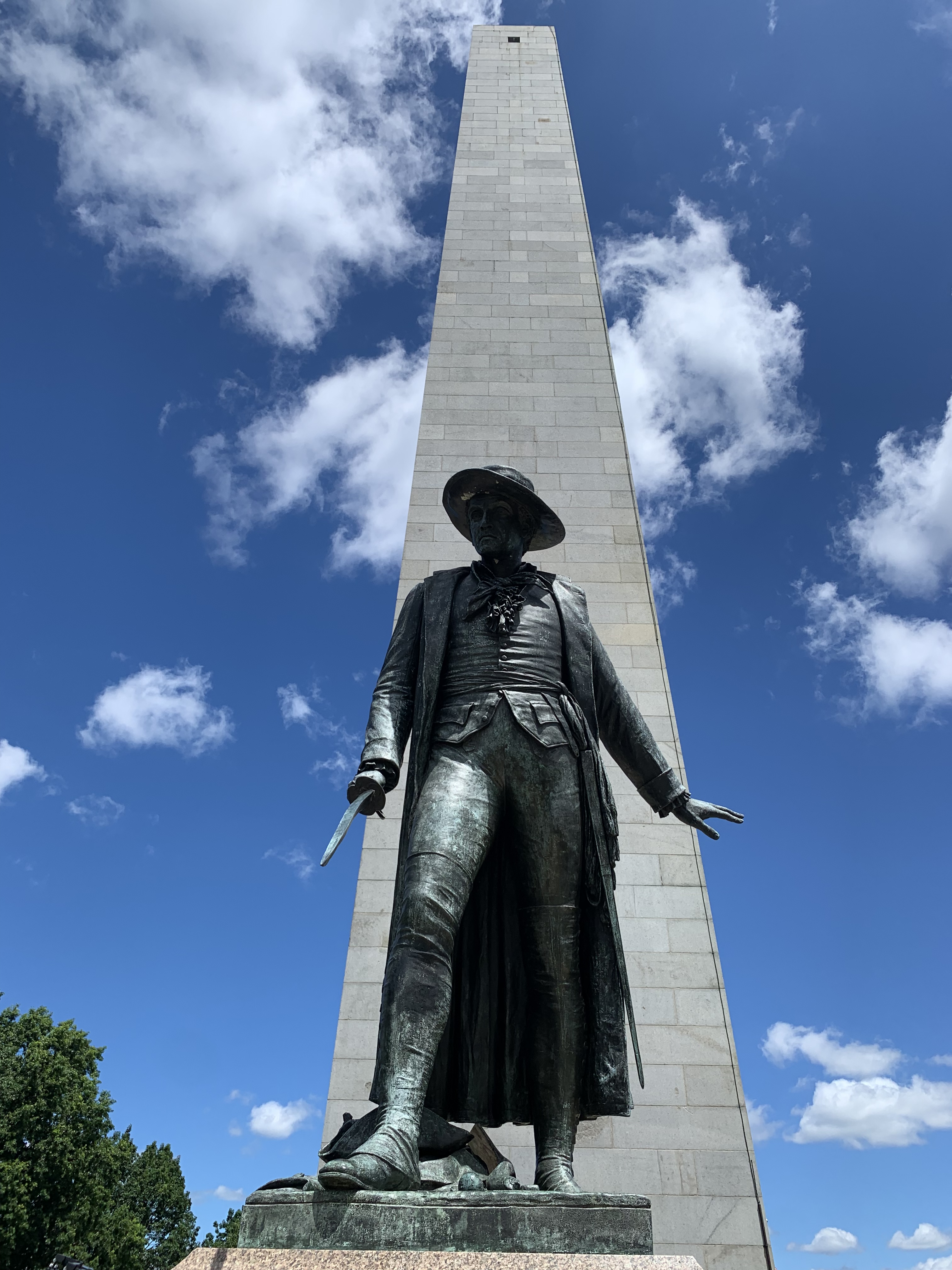
While the way to the top of the Bunker Hill Monument is currently closed, there is a live webcam. The monument is at the top of Breeds Hill, which the colonial soldiers defended against repeated attacks, before retreating to Bunker Hill. There’s a free museum facing Prescott’s statue across the street.

Boston has an embarrassment of historic sites in this park: the USS Constitution, Paul Revere’s house, the Old South Meeting House, the Old North Church, the Old State House, and Faneuil Hall. Each one is worth exploring to learn how we became independent, how we developed our democracy in town hall meetings, and how we debated our rights as Americans. Oh, and I’ve forgotten another historic ship (WWII), another historic battlefield (not open), another museum, a historic navy yard, living history exhibits, and other fascinating sites on the popular Freedom Trail.

Since the traffic and parking are even more horrendous than I remember, I definitely recommend taking the subway (electric and also historic) and walking. Many of the sites are clustered together, and the Rose Kennedy Greenway has beautiful art, flowers, and fountains along the way. Faneuil Hall is a great place to try local foods, and I recommend the thin cheesy Regina Pizzeria slices.

Roger Williams National Memorial

Those ignorant people who claim that America was founded as a Christian nation need to visit this site in Rhode Island. Disgusted with the forced religious conformity in England (including burning heretics), Williams moves to Boston in 1631, where the Puritans had moved to escape persecution.

“… that no civil magistrate, no King, nor Caesar, have any power over the souls or consciences of their subjects, in the matters of God and the crown of Jesus …”

Roger Williams

Williams’ idea, that the government should not control citizens’ spiritual lives, made him flee the Massachusetts Bay Colony and live with the Native Americans, learning their languages and becoming an advocate for their rights and separate beliefs. Eventually, they deeded him land and he founded “Provident’s Plantation”, now Providence, and Rhode Island became a haven of religious tolerance, for Jews, Baptists, Quakers and even atheists. It is no accident that the country’s oldest synagogue is in Rhode Island. King Charles II granted a charter to Rhode Island, fulfilling Williams’ wish, that no one would be “molested, punished or called into question” for different beliefs in 1663 over 100 years before America became a country. Other colonies copied his charter’s separation of church and state and Jefferson enshrined the concept in our Constitution’s 1st Amendment.

“Congress shall make no law respecting an establishment of religion, or prohibiting the free exercise thereof.”

The First Amendment to the US Constitution

We live in a precarious time, where a single conservative Catholic sect, Opus Dei, has used its influence to place a majority of Justices on our Supreme Court, and that Supreme Court majority has limited an established right based on their particular religious objections to abortion, ruled in favor of Christian prayer at school events, and ruled in favor of using taxpayer funds for Christian schools. This country has avoided the religious and sectarian violence and oppression common elsewhere, by granting the right to freedom of conscience, and it is a frightening step backwards almost 500 years for the court to grant favored treatment to one religion. We have never been a Christian nation, and voters are wrong to vote for one.