Acadian Village

One of the finest historic sites in the country is Maine’s Acadian Village in the Acadian Culture area of Saint John Valley in the northern tip of the state, open from mid June to mid September 12-5pm. Over a dozen buildings were donated and moved here overlooking the river that marks the border with Canada. Due to a penchant for large families, the Catholic agricultural community grew quickly, and many descendants trace their roots back to the rough hewn wooden buildings gathered here. Nearby towns also preserve their Acadian heritage, and the area has a partnership with the national park service.

What makes the place special is that you can walk in each building, including an art gallery, a church, a dentist office, a barber shop and a one room schoolhouse, and, unlike, many historic sites, you can go upstairs too. The tour guide had called in sick, but I was happy to have the place to myself for a while. Many of the exhibits have tags explaining the provenance of each item, and I was able to open a trapdoor to see how water was collected by wooden pipes. Every room seems furnished with authentic pieces evoking the lives and stories of inhabitants long ago.

I have a very old memory of hiking along a railroad bed to an old station in a French speaking village up here, so I believe this area is a revisit for me. But now I come with knowledge of the Acadian or ‘Cajun’ diaspora from Nova Scotia to Louisiana and many other areas, having eaten buckwheat cakes in Quebec, and having danced to Zydeco in the Bayous down south. Evangeline, Longfellow’s epic poem about the 18th century expulsion of the Acadians, strikes me more deeply now that I have grown children. I also have a greater appreciation for the meticulous love required to assemble such a beautifully moving collection of memorabilia from a unique culture that still thrives today, albeit out of sight of those who deny our non-English heritage.

”Silently, one by one, in the infinite meadows of heaven,
Blossomed the lovely stars, the forget-me-nots of the angels.”

From Henry Wadsworth Longfellow’s Evangeline: A Tale of Acadie

New Jersey Coastal Heritage Trail Route

Before coming here, I wasn’t sure if this was an affiliate, a heritage area or a trail, but I thought a road trip along the NJ coast between Cape May and Sandy Hook, worthwhile. Cape May above is a lovely old town with Victorian style, boats and beaches. The Pine Barrens near Great Egg Harbor extend for miles. There are wildlife refuges, lighthouses, and historic sites, especially around the Battle of Monmouth, where Washington’s troops eked out a victory after training in Valley Forge. Locals freely admit that Seaside Heights is tacky, but much of the Jersey shore is both classy and trendy, especially in areas like Asbury Park. Technically, it turns out that this is a lapsed trail, that once partnered with the park service and was considered for heritage area status, which explains why it still appears as an obscure NPS site in a few places, but it is no longer authorized under the national park service. However, I’m glad my mistake and my curiosity about this area drove me here, and I enjoyed exploring this fascinating stretch of historic coast.

Pilgrims v. Puritans

Recently I returned with my kids and my Mom (above right) to Duxbury in Massachusetts, where she grew up. Duxbury is a pretty seaside town with a large harbor on the north end of Plymouth Bay, reflecting the long history of our seafaring roots. When the Pilgrims arrived on the Mayflower in 1620, they first landed in Provincetown on the tip of Cape Cod, skirmished with the natives and then moved to Plymouth. The military commander, Miles Standish, settled in Duxbury, and his statue stands there atop a large viewing tower on Captain’s Hill. Longfellow wrote a romantic poem about a love triangle between Standish, the cooper John Alden and a recently orphaned teen named Priscilla Mullins. John and Priscilla Alden lived on the homestead above, which is still owned by their many descendants as a National Historic Landmark.

The Aldens were Pilgrims, not Puritans. The Pilgrims had separated from the Church of England, while the Puritans did not. Just before arriving in Plymouth to form a new colony, while awaiting royal permission, the Pilgrims and others aboard wrote an independent contract, the Mayflower Compact of 1620, which was the first self-governing document by British settlers in the now USA, although the British colony of Jamestowne was founded first. The Puritans arrived around 1630, settling in Boston and Salem. Contrary to the ‘mind your own business’ ethos of the Pilgrims, the Puritans were so strict that many left their colony for religious freedom. Such historic differences may seem inconsequential now, but freedom versus loyalty to England would become a big issue in Concord in 1775. And still today, there are conflicts between those who would impose their strict religious beliefs and those who prefer more freedom to make our own choices.

Driving back over the bridge from the beach, we got a glimpse of Miles Standish looking out over the harbor once famed for ship building and a large merchant fleet, before we went to dinner at a haunted restaurant, built before the Revolution. Moments like these improve our perspective, remembering the breathtaking leap of faith our ancestors took to settle here. While not part of the NPS, I recommend visiting the reconstructed living history museum in Plymouth, now called Plimoth Patuxet Museums, as well as other historic sites in the area like Alden House in Duxbury where we enjoyed an excellent tour.

Biosphere 2

From 1991 to 1993, eight people lived in this huge sealed greenhouse or giant terrarium in Arizona, growing their own food and attempting to live without outside intervention. Built at a cost of some $250 million, the complex includes the artificial ocean above, multiple tropical growing zones, industrial HVAC, and even a unique, massive ‘lung’ to equalize air pressure at different temperatures. Results were mixed, but there are important lessons to be learned.

Humans like to believe we can control our environment and that we have conquered nature. The truth is that we don’t completely understand nature, and when we try to control it, there are unintended consequences.

The most serious problem was a gradual reduction in oxygen, which threatened to kill the participants by around day 500 and required emergency intervention. Despite all the plants, overall, the system produced too much carbon dioxide. Also, the participants complained of constant hunger, unable to eat enough calories per day, which made it difficult to complete their extensive daily chores. Many plants and pollinators did not survive, but stowaways like cockroaches thrived. Still, they survived for two full years. Others later managed shorter stints, but bickering and mismanagement soon ended fully sealed living experiments.

From 1995 to 2003, Columbia University managed the site and completed groundbreaking research here scientifically proving up to 90% declines in oceanic coral due to artificially high levels of atmospheric carbon dioxide. Unfortunately, the coral later died when the site went back on the market, although there are plans to try to reintroduce it. Today the site is run by Arizona State University, which offers both a general self-guided tour and specialized guided tours, in addition to hosting students and researchers. When fully funded, the semi-tropical desert forests are very well controlled and measured, enabling many scientific experiments on micro ecosystems to be carried out under laboratory conditions. Tracers can be added to water and carbon dioxide, so researchers can figure out exactly what plants are doing in different conditions. Unfortunately, the whole complex is extremely energy intensive, and it is run on diesel and natural gas, which both contribute carbon pollution to exacerbate the climate crisis.

Some believe that technology will allow us to adapt to the worst effects of climate change. The truth is that we need to spend our time, energy and money trying to protect Biosphere 1 (Earth) from carbon pollution. This massive, extremely expensive, carefully engineered and scientifically researched project could barely take care of eight people for two years. That’s neither an efficient nor effective use of resources, but it quickly illustrates how difficult it is to scale environmental technologies to the point that they are practical. How big of a terrarium would we need to feed eight billion people? Far better to take care of the Earth, while we still have hope.

Tombstone

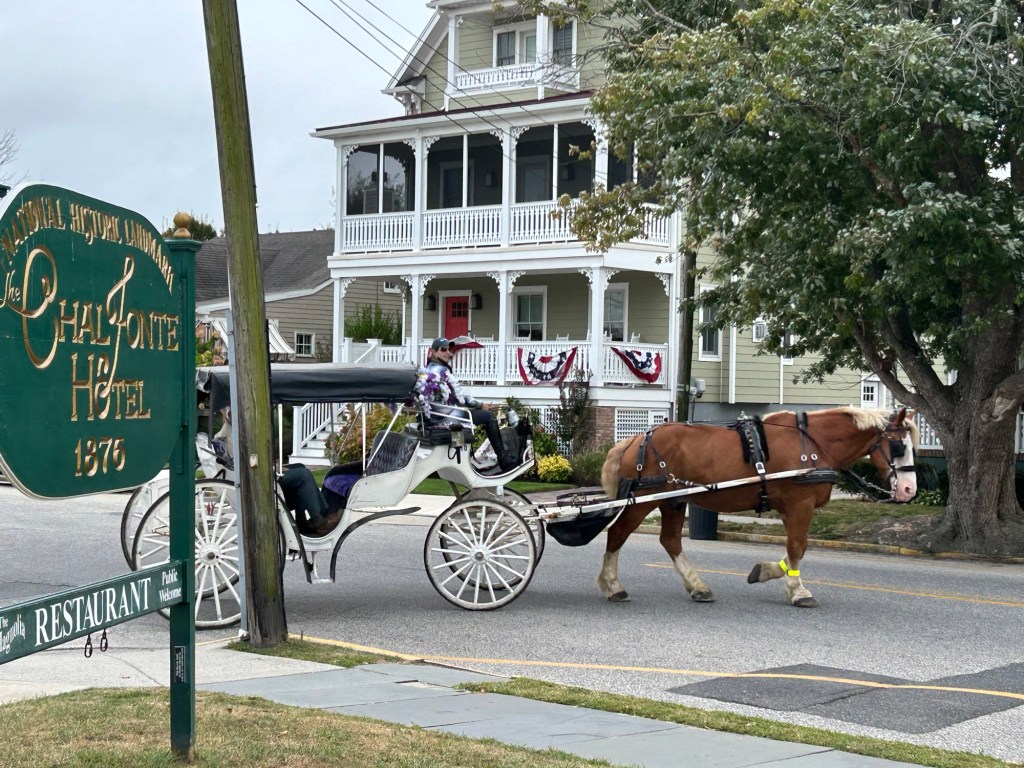
While not a national park site, I just had to stop to see the legendary Gunfight at OK Corral. The shootout was so quick I only got this photo of the aftermath. This Arizona town—named after a silver claim wrongly thought hopeless—is not far from a Butterfield Stage stop, and it has restored horse-drawn stagecoaches that take folks around the historic center of town. Boot Hill cemetery is another famous site here, but there are loads of historic saloons, re-enactments, museums, shops and more. The “world’s largest rose tree” is in a courtyard near the courthouse, and it’s amazing how large plants can get if we let them grow. Nellie Cashman ran a string of successful businesses here before moving on to the Klondike. Three Mexican Revolutionaries were convicted in the old county courthouse here, along with the Bisbee Massacre gang. And Geronimo had his famous photo taken by the photographer who had a studio above.

As mass shootings go now, I doubt this one from 1881 would make the news today. Today’s mass shooters kill more in one day than any old west gunslinger did in their lives.

Rohwer

The last American concentration camp to close was Rohwer, Arkansas, deep in the delta near the Arkansas Post. There’s an echo of history, since that site is part of the Trail of Tears, when another group of Americans were forcibly removed from their homes unconstitutionally and sent to live in government reservations. The vast camp soon returned to farmland, so little remains besides the cemetery above. Several of the graves mark infants and elderly inmates. The monument to the right is to the 442nd Regimental Combat team, the most highly decorated unit in US military history. They served in Europe, while their families were imprisoned. 

The neighboring town of McGehee maintains the excellent WWII Japanese American Internment Museum about both Rohwer and Jerome. The sculptor Ruth Asawa was imprisoned here. Another inmate at Rohwer was a 5 year old boy named George Takei, who later played Lt. Sulu on the original Star Trek. 

“And it became normal for me to go to school in a black tar-paper barrack
and begin the school day with a pledge of allegiance to the flag.
I could see the barbed wire fence and the sentry tower
right outside my schoolhouse window
as I recited the words,
‘with liberty and justice for all’.”

George Takei, speech at the museum on 16 April 2018

Jerome

Jerome was the last American concentration camp to open and the first to close, as it was converted into a POW camp for Germans. The military acquired the land as a result of a tax default, and over 8,000 Americans of Japanese descent were incarcerated here in the southeast corner of Arkansas, deep in the Mississippi Bayou. The Governor of Arkansas insisted that none of the prisoners be allowed to remain in his legally segregated state after the war and that all of the guards be white. When it closed, the prisoners here were mostly transferred to the other camp in Arkansas, with some sent to Amache, Gila River and Heart Mountain; ‘trouble makers’ who protested had already been sent to Tule Lake. Besides the monument above, there is a deteriorating old smokestack from the infirmary visible in the distance to the right. Nothing else remains, and the land is now a working farm. 

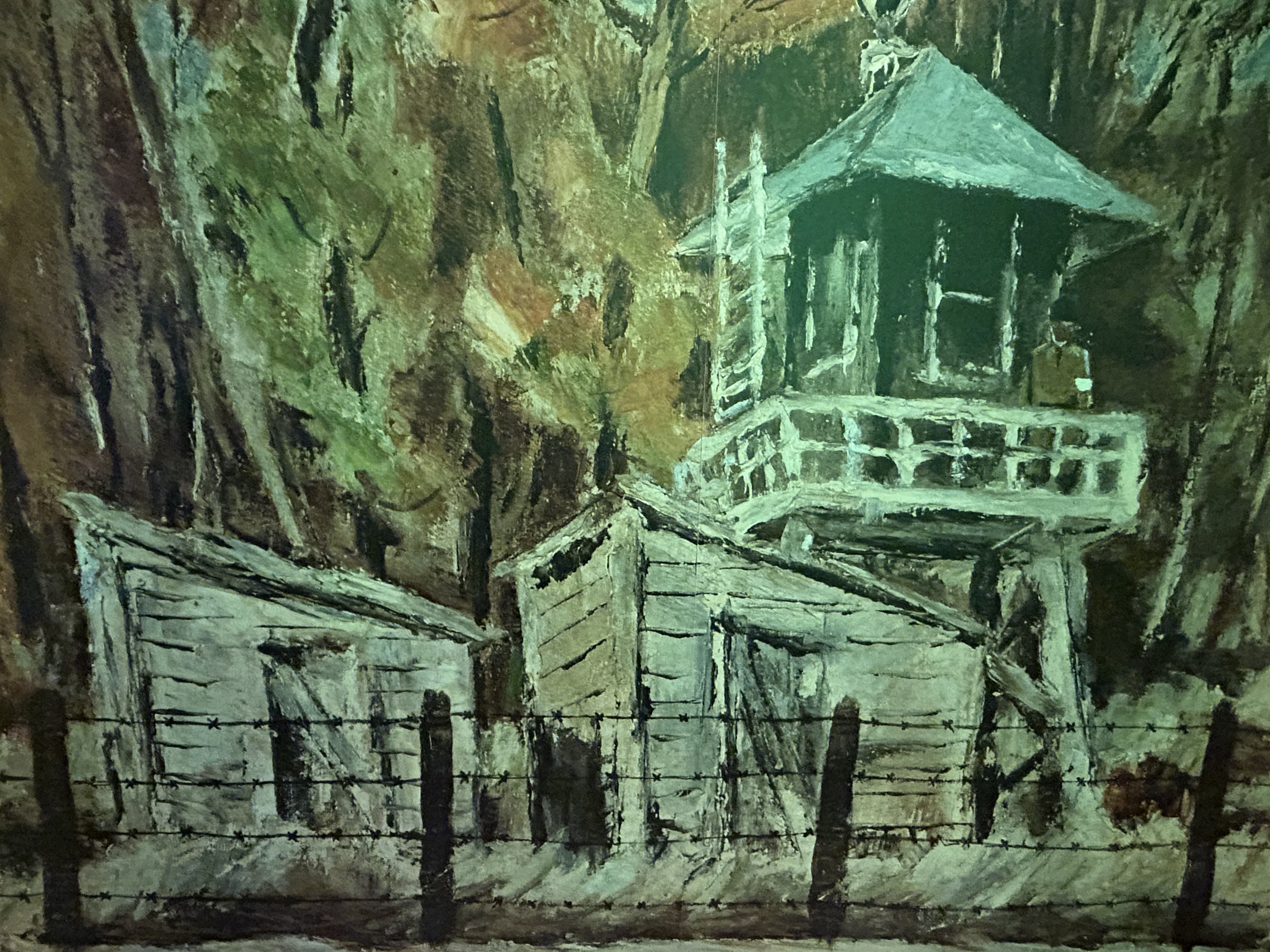
Nothing except a shameful unconstitutional history, a duty to be better Americans, and memories. Below is detail from a painting by Henry Sugimoto showing how he remembered his time at Jerome. The painting is on display with many other exhibits at the WWII Japanese American Internment Museum in McGehee about 20 miles north. The museum is excellent, open Thursday to Saturday, and is the result of talented, caring and dedicated townspeople working to preserve this important history without federal funding. 

Gila River

Despite not being on the West Coast, the US military evicted all American citizens from the southern part of Arizona during WWII as potential ‘navy base saboteurs’, if they had Japanese ancestry. The military’s arbitrary exclusion zone ran through Phoenix, so if you lived on the south side of the city, you wound up incarcerated while your family on the north side kept their homes.

Like Poston, most Japanese-Americans were taken from their homes in Southern California. The barracks in the background of the photo above comprised a small part of camp 2 or Butte Camp at Gila. The Gila River Tribal Community protested, but the military appropriated over 17,000 acres of their land anyway and concentrated roughly 15,000 people here according to their ethnicity. 

The tribal community had been struggling since the Gila River was diverted by white settlers beginning in the 1880s. In 1934, archaeologists dug up their ancestral burial grounds, and after they dug again in 1964, the government also created a national park site. Now that site is closed and the tribes don’t allow visitors there. 

Survivors of internment built a monument on the ‘internment camp’ site, but someone shot it up with a machine gun a few years back, and unless you’re family, you can’t visit the site now. Given all the tragedies and harm done here under the American flag, seems like folks might benefit from a government funded educational center explaining the history and the importance of respecting Constitutional rights. 

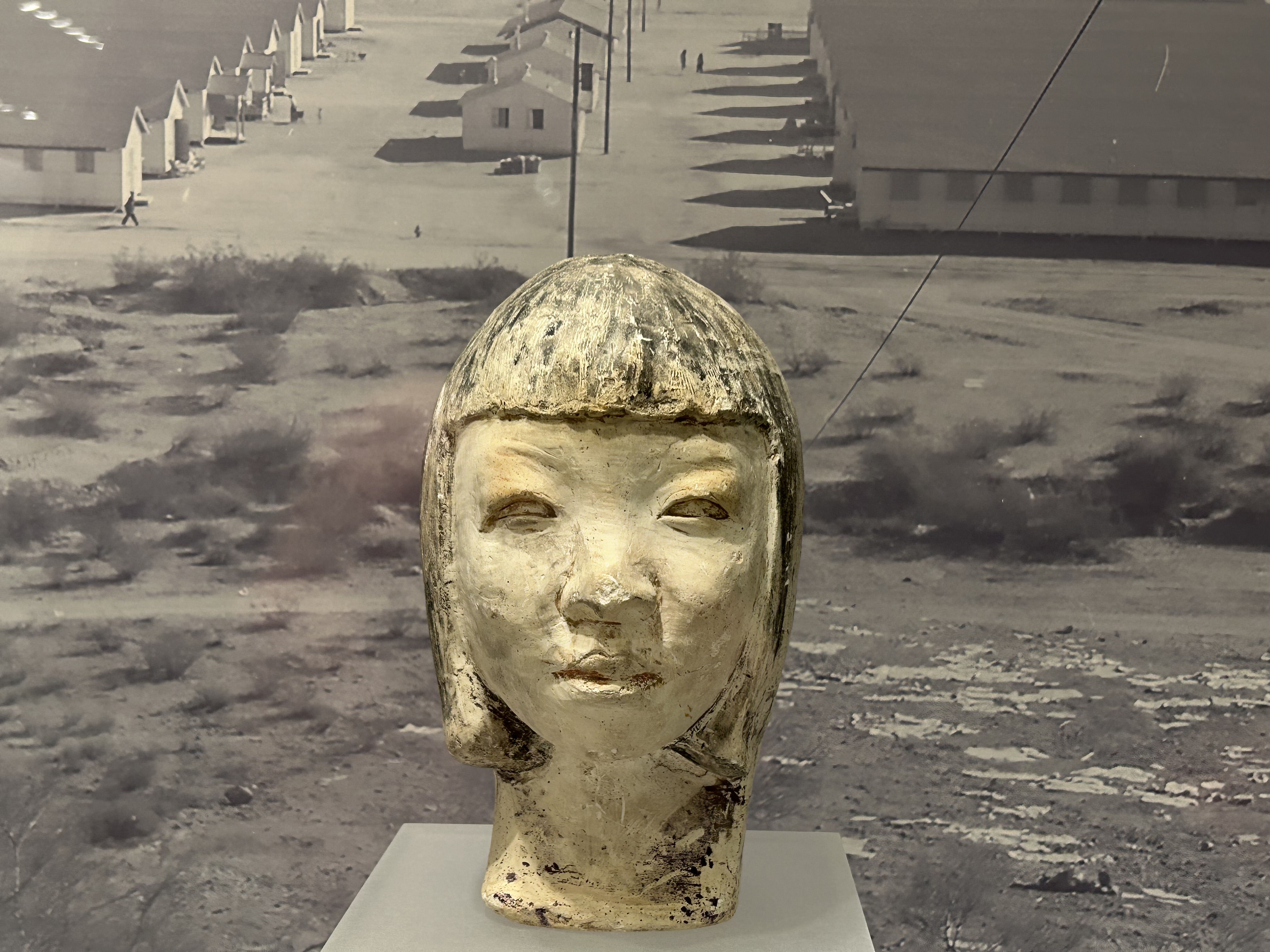
The Gila River Tribal Community runs the excellent nearby Huhugam Culture Center free museum, which contains a small display case of ‘relocation center’ artifacts, including two busts of young prisoners. The one pictured is Sayoko ‘Jean’ Kawamura, and the other has no name, forgotten to history. 

Poston

In Arizona, across the Colorado River from California, there’s a desert hamlet called Poston in an area governed by the Colorado River Indian Tribes. Spanish Missionaries visited in 1775 and their King recognized tribal sovereignty. Mexico lost the whole territory after the War, and the US government established reservations to ‘protect’ the Mohave, Chemehuevi and others here. Today, despite some irrigation improvements, much of the population is poor, and each winter many RVers spend months living cheaply in the desert nearby. 

But from 1942 to 1945, the US concentrated as many as 17,000 US citizens of Japanese ancestry forcibly relocated from their homes on the west coast to three camps, known as Roastin’, Toastin’ and Dustin’. The highs are over 105° all summer long. Besides the 50 year memorial (pictured above) to the families, children and highly decorated WWII veterans once incarcerated here, there’s not much left to see, except a few origami cranes left by visitors. 

But there’s much to think about. Constitutional rights and freedoms, so cherished in this country, are an ‘all or nothing’ deal. For you to enjoy a right or freedom, you must recognize that same right belongs to all your fellow citizens, regardless of their background or beliefs. Our legal system depends on the idea that the law applies equally to everyone, that no one man is above the law and that there are no permanent classes of people entitled to extra privileges. If we want to continue to enjoy our own full rights as citizens, we must make sure that no other US citizens are trammeled, as they were here, ever again. 

Heart Mountain

Heart Mountain (above) is the site of an American Concentration Camp in Wyoming. One of the incarcerees left a bequest for ‘something to be done’, and now much is being done here to teach people about the injustice sustained here from 1942 until 1945. There is an original barracks, a guard tower ‘built to spec’, memorials, artwork, and a remarkably personal and revealing museum. Renovations, expansion, acquisitions and outreach are ongoing.

While most sites choose not to use the term “concentration camp”, due to its association with the Holocaust, one of the incarcerees in the film uses that term plainly, the then Governor used the term in arguing in favor, and that was the term used most commonly at the time. Many of the Americans who were sent there had never seen so many people of Japanese descent in one place at the same time. What else are you going to call a facility that literally concentrates one group of citizens based on racial/ethnic identity in a prison camp?

What makes the exhibits here better than other sites is that they go one or two steps deeper in describing the experience. When the site started, “it was like pulling teeth” to get incarcerees to talk about it, but then gradually the stories started coming out: a dog left behind that refused to eat and died alone, a beautiful older lady describing how she was spat on and called a slur as a child, and a family recounting the suicide of their father after being robbed and rejected by their community upon release with $25.

The museum pulls no punches in their descriptions, making it plain that these innocent American civilians had their rights abrogated and in many cases lost everything, due to racism. Instead of recognizing that we were at war with an enemy nation, our government and most Americans also declared war on a racial/ ethnic group of their fellow citizens. While J Edgar Hoover and Eleanor Roosevelt counseled against the program as ‘unfounded’ and ‘unjust’ respectively, FDR approved the military’s ‘relocation program’ recommendation for ‘sensitive military areas’, which the military interpreted as the entire west coast.

“The Japanese race is an enemy race
and while many second and third generation Japanese born on United States soil,
possessed of United States citizenship, have become ‘Americanized’,
the racial strains are undiluted.”
“A Jap is a Jap.”

Lt. Gen. John DeWitt,
architect and overseer of the American Concentration Camps