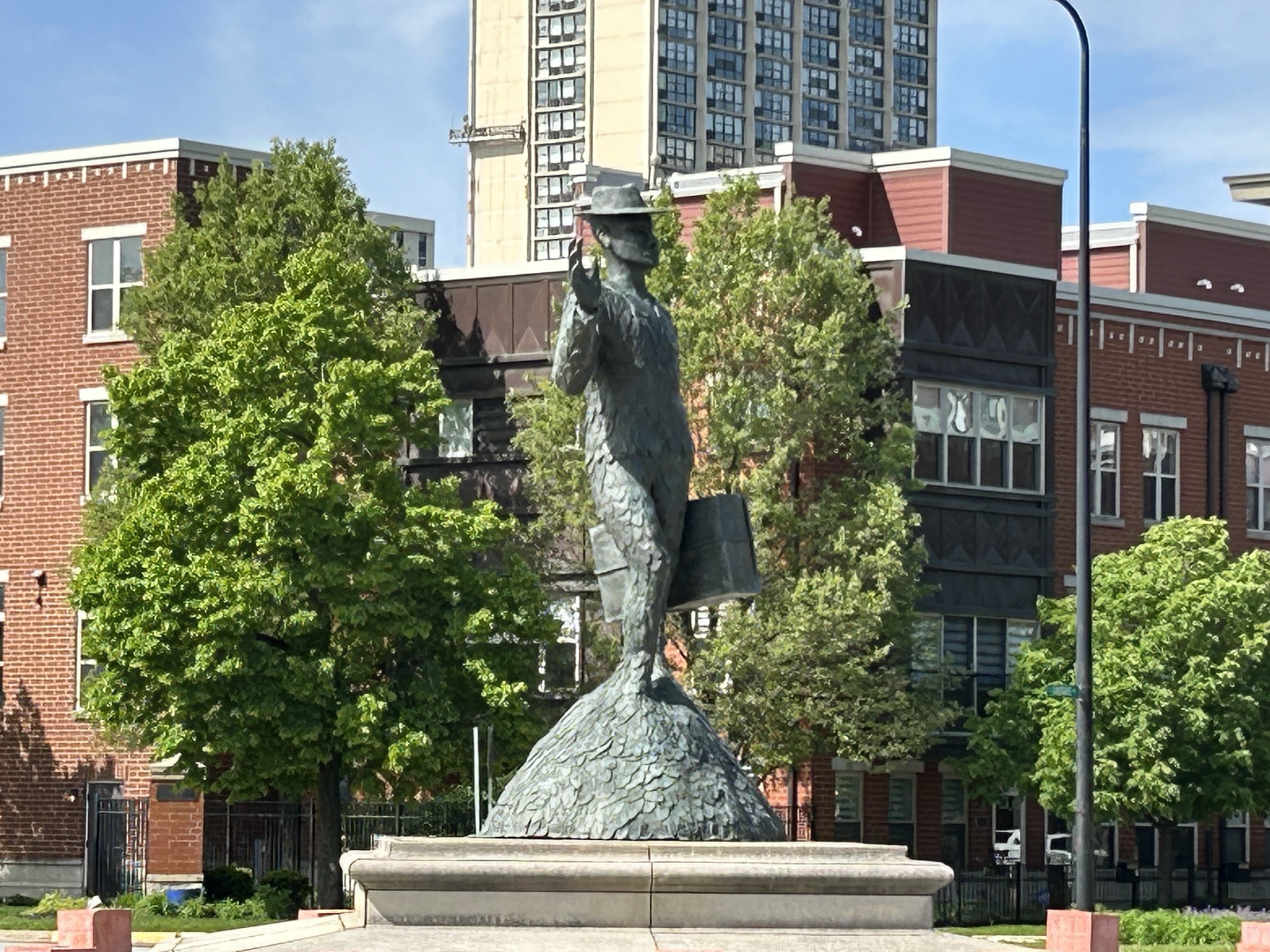
The South Side of Chicago has long been a historic district, and now it will be recognized as its own National Heritage Area. This is the neighborhood of activist Ida B. Wells, the church for Emmett Till’s funeral, of poet Gwendolyn Brooks, boxer Jack Johnson, musicians Louis Armstrong and Nat King Cole, and where a young community organizer named Barack Obama worked before law school. 1/2 a million African Americans moved to Chicago during the early 20th century. Above is the Monument to the Great Migration at MLK & 25th, welcoming people to join the community, and every so often you will find a bronze plaque recognizing accomplished residents on the walk to 35th, where there’s another statue, honoring the African American soldiers who chased the Germans at the end of WWI.
The neighborhood continues south, with many beautiful brownstone buildings and a few blues venues. Unfortunately, many historic buildings—like the Checkerboard Lounge where Muddy Waters used to play—were lost to poor government planning, an expressway that cut the neighborhood off, and expansion of the University of Chicago. Establishing a specific heritage area helps recognize the unique cultural value of a neighborhood, encouraging more visitors by promoting it. Now, I expect Black Metropolis will continue experiencing its renaissance, and I look forward to trying the food at Bronzeville Soul (closed Mondays) the next time I pass through town.
Way back in 1673, French explorers Louis Jolliet and Father Jacques Marquette were preparing to travel east to return to Canada after exploring the Mississippi River. Though the statue wrongly implies that Marquette pointed out the route, their Native American guides showed them a shortcut, by traveling up the Illinois River and portaging (carrying) their canoes between some muddy lakes to Lake Michigan. Marquette realized that if there were a canal, weeks-long journeys would reduce to days. 175 years later, the government finally built the canal, and suddenly, Chicago became one of the largest and most important transportation hubs and cities in the US.
The site itself is in a small woods between the Des Plaines and Chicago Rivers, and as part of Chicago’s river greenways, it’s managed by Cook County in affiliation with the NPS. The canal itself is 100 miles long with a bike trail, and there is a 1 mile canal boat tour in LaSalle at the Illinois River end. A non-profit association runs summer boat tour as well as the larger Illinois and Michigan Canal National Heritage Area, which includes Chicago Portage, the Pullman National Historical Park and promotes tourism to neighboring communities and parks. The canal is a key part of the Great Loop, a boat trip around the eastern part of the country, from the Great Lakes down the Mississippi, around Florida, up the eastern seaboard to New York, and back to the Great Lakes.
There are five NHAs in the Rocky Mountain Region: three in Colorado, one in North Dakota and one in Utah. I’ve visited all of them (plus the Great Basin that extends into Utah), and I encourage you to visit too. As befits the region, they are areas of great natural beauty, but each differs distinctly.
Cache La Poudre(Buried Gunpowder) River National Heritage Area follows the river through Fort Collins, a fair sized city north of Denver. The headwaters of the river begin in Rocky Mountain National Park, outside the NHA, and the beautiful upper portion is a popular rafting Wild & Scenic River run by the Forest Service. I love the naturally-flowing sections of the river, which are remarkable, even in a state known for whitewater rafting. The NHA includes historic water works, irrigation canals, a bridge for sugar beet effluent, picnic areas, lakes & reservoirs, bluffs, wildlife areas and a whitewater practice area. The cooperative water district is considered a model for preserving early water rights, although it diverts water through tunnels that would otherwise flow west or north to drier states. Water policies need to be decided nationally, even if it means changing water rights established over 100 years ago. While I’m impressed with how industrious people have been making money with the river, the Climate Crisis is affecting the snow-pack, causing wildfires, and threatening species that depend on the river. So, I believe there’s still much work to be done.
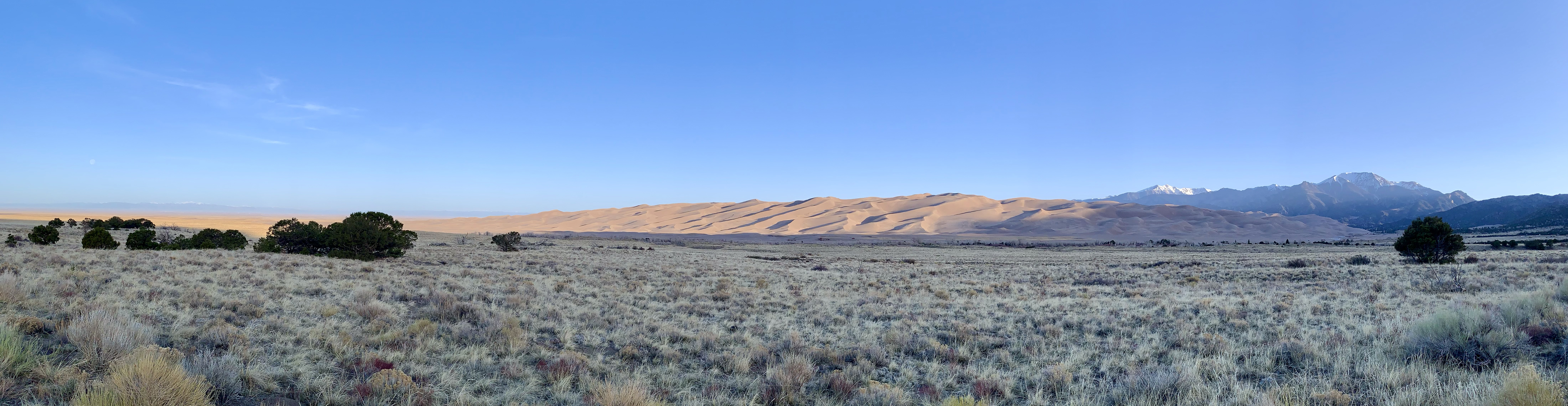
Sangre de Cristo—Blood of Christ, referring to color of the mountains at sunset—National Heritage Area includes Great Sand Dunes National Park & Preserve (above) and many forests and wildlife areas in southern Colorado. The area figures often in the novels of Louis L’Amour, loved by my grandfather, and there are still stark stretches of remote beauty along the Old Spanish Trails below and among the towering mountains. This NHA borders the Northern Rio Grande NHA in New Mexico, and the headwaters of that river begin here. Some of the oldest settlements and churches in Colorado were built here by Spanish-speaking settlers, following the Rio Grande up from Santa Fe, as I did, enjoying the scenery.
I drove through South Park National Heritage Area looking for a scenic route from Florissant Fossil Beds to the Black Canyon of the Gunnison, and there are half a dozen scenic historic auto tours here, amidst many wildlife refuges, historic ranches, canyons and old mining outfits. I spent my time gawking at the peaks, vistas and fall colors, without taking photos. Colorado has that kind of indescribably rugged beauty that makes you want to change your life, sell your belongings and move into the mountains, although I admit I haven’t spent winter there.
The Northern Plains National Heritage Area in North Dakota is also ruggedly beautiful. I remember driving great distances to see Knife River Indian Villages NHS before it closed, and I stayed at several state parks to charge. Maybe half a dozen state parks are in the NHA, and they have good facilities, are uncrowded, and are in beautiful spots, often near lakes or rivers. Several of the state parks are stops on the Lewis & Clark NHT. The Native American tribes who assisted them on their journey were later described and painted by European artists and authors, fulfilling great curiosity across the Atlantic and inspiring many Europeans to immigrate to the New World. As with other NHAs, there is a unique sense of place, fleeting historic moments and cultural details that enrich the land with atmosphere, and of course, great natural beauty. But you have to drive, stop, pay attention, keep your eyes open, read, try to understand and make connections, or the whole country just appears to be empty space that you fly over, recklessly burning carbon.
The Mormon Pioneer National Heritage Area includes Bryce, Canyonlands, Capitol Reef, Cedar Breaks and Zion. But besides those geologic wonders, the idea is to encourage more travel on routes 89, 12 and 24. There’s a Scandinavian community around Ephraim in the pretty Sevier Valley on 89. There’s Grand Staircase-Escalante, Goblin Valley, outlaw hideouts, ghost towns, old theaters, and more. I’ve traveled through the NHA in every season taking different routes, and I don’t remember any ugly or boring scenery. Utah is an extremely beautiful state. I occasionally wish it were easier to get something stronger to drink, get a table at a decent restaurant for dinner, or find out more about the Native Americans who used to live there, but it’s unquestionably easy on the eyes.
There are only three NHAs in the Southwest Region, two in Louisiana and one in New Mexico. While not official park units, they are uniquely interesting and beautiful areas to visit.
Atchafalaya National Heritage Area in Louisiana runs from the Natchez NHP and Natchez Trace NST, down past Lafayette and Baton Rouge, to the Gulf Coast west of New Orleans. Culturally, the focus is on the Acadians or Cajuns. 150 years after settling Acadie, now Nova Scotia, the French speaking Acadians were expelled by the British beginning in 1755. Longfellow wrote his epic poem Evangeline about the tragedy. Skilled fishermen and wetland farmers, many settled in French Louisiana, growing rice, beans and catching crawfish. They mixed with Native Americans, slaves, freed blacks and other immigrants, but kept their French roots. The French pirate Jean Lafitte, a successful smuggler in the area, was captured, but offered to help the Americans in the War of 1812 in return for his freedom. Lafitte knew the swamps (waterlogged land) and the bayous (shallow waterways through the swamps) expertly, and Andrew Jackson employed him as his aide-de-camp. Lafitte also provided troops, cannon and ammunition. The Battle for New Orleans was won, and Jackson was credited as the hero. Lafitte was likely responsible for defeating the superior British forces, but he received no credit from the US military, just a pardon. But the Cajuns still thrive here, and their history and culture is preserved at the Jean Lafitte NHP & Preserve, which includes three different Cajun Cultural Centers in the NHA. Their music, Zydeco, is from the French word for beans, “Les Haricots” (say it fast). And Breaux Bridge, of course, is La Capitale Mondiale de l’Écrevisse, or the Crawfish Capital of the World.
Cane River National Heritage Area is the other NHA in Louisiana, and it is best known for the well preserved plantations of the Cane River Creole NHP. However, the whole river area from Natchitoches between the national forests, down past the plantations is fascinating. This is the northern terminus of El Camino Real de Los Tejas, one of the Old Spanish Trails that runs through Texas, and there are state historic parks highlighting the forts and cultural sites that predate the Louisiana Purchase. I try to get lost at least a few times every visit to Louisiana, as there’s always something surprising to find and plenty of delicious food!
The Northern Rio Grande National Heritage Area in New Mexico is at the crossroads of both the ancient and old west. El Camino Real de Tierra Adentro connects Santa Fe to Mexico City. The Old Spanish Trails connect Santa Fe to Los Angeles, and the Santa Fe Trail connects Santa Fe to St Louis. Route 66 goes right through town. And before they were Spanish, they were all Native American trading routes. The natives once expelled the Spanish during the Pueblo Revolt, planned at Pecos. There are caves and Petroglyphs showing where people camped. Bandelier with its tall ladders to cliff dwellings is also in the NHA. But it’s not just history. Taos Pueblo (above) is still occupied today, continuously for over 1,000 years. All this I had seen, but then I got lost again, taking an improbable route through the mountains towards the headwaters of the Rio Grande in Colorado. And there are canyons, gorges, wild and scenic rivers, Georgia O’Keefe’s ranch, more cliff dwellings & petroglyphs, and even more storied trails. Some of my most memorable scenes of America are on the drives between official sites, intangible culture, storied heritage, true wildlife, and sheer beauty on the road not often taken.
South Park City, an old western summertime tourist trap in Fairplay Colorado, is only an hour and a half drive southwest from Denver, and yes, the cartoon is based on this tiny town surrounded by mountains. The mining and ranching town is at ~10,000 feet, and there’s an old railway roundhouse nearby. Some of the ranches organize riding tours, and there are plenty of scenic mountains, canyons, creeks and old mining sites to explore. The trout fishing is renowned. The South Park National Heritage Area is building a good track record of saving old buildings, protecting natural areas and boosting tourism.
About an hour drive north of Denver in Fort Collins is the Cache la Poudre River (French for Gunpowder Stash). Below is the Poudre River Whitewater Park, perhaps the best example of a how planning can turn an urban river into a recreational star. Due to a long-term cooperative water district that balances various stakeholder interests, the river is surprisingly well managed. The wild and scenic section up in the mountains preserves nature, protects wildlife and is enjoyed by whitewater rafters and kayakers. But I saw a kayaker preparing to raft the short stretch of whitewater in town, after changing out of work clothes. The Cache la Poudre River National Heritage Area also includes museums, historic sites and open natural areas in and around Fort Collins.
[At the bottom of the web post, there’s a short video surprise! No peeking until after the story!]
Once upon a time, not far from the Black Forest in Germany, where many old fairy tales began, there were two friends, Johann and Eberhart, who believed that being inspired by God should be a personal experience. They shared their views with others, and many joined them, meeting under an old castle, happily. But other people were angry with them for being different, so some of their followers got on a boat and traveled to a new country, where people were free to believe whatever they wanted. The first place they settled grew too crowded and busy for them, so they moved again, to a magical land between two great rivers, where their friends and families settled in seven tiny villages in the middle, along the much smaller, but pretty little Iowa River.
Their way of speaking (High German) was difficult for others to understand, so they decided to call their first village Amana, since it was easy to say. The law made them buy a village called Homestead (near the train), but they decided to call their other villages High Amana, Middle Amana, South Amana, West Amana and East Amana. They really liked the name Amana, and others just called all their villages the Amana Colonies.
The Amana colonists worked hard, but kept to themselves. Like the other farms in Iowa, they kept some of the food they grew in Silos, that look like giant tin cans. Everyone in the villages worked together, cooked together, ate together and prayed together, happily. They learned to speak the language of their new country, but they also kept up with their old language. After many years, they spoke three languages: new, old and a mix of both that they invented themselves. They didn’t have much need for money, since mostly they stayed in their own village. But curious people would visit them to buy the interesting things they made, like eggs dyed dark brown with golden flowers on them (see picture).
Then, there was a dark time in the new country, when 1/4 of the people could not find work, and the President, who grew up in a Quaker village nearby, lost his job too. The village was worried that no more curious visitors were coming to buy their golden flower eggs, so they decided that some people should go out into the outside world and work for money. Unlike their friends the Amish, the Amana community believed in technology. One, named George, was very smart and invented a machine to keep food cold for a long time, so the village added a factory next to the river with Smokestacks to build his machines. Later his company made many other machines you may have in your home, like a magic machine for cooking food very quickly. George’s Amana household appliances became known around the world.
The people in the village were very happy. If they wanted to go outside the villages, they could go anywhere. But many villagers loved Amana and chose to stay. Every Sunday at 8:30 am, they have a church service in their old language, and at 10 am in the new language. They enjoyed preserving their old way of life and kept many of their old buildings just like they were over a hundred years ago. You can still go into the old general store in High Amana and even buy a dark brown egg with beautiful golden flowers. But the villagers also built some newer stores for all the curious people who came back to see their pretty little villages, like a toy store, an ice cream store, a chocolate store, and a store that only sells old-fashioned Christmas ornaments. They have restaurants too that cook food and special drinks just like they had in the old country.
And, on the first weekend in May, the ladies of the village dress up in their fanciest dresses, that their mothers and grandmothers saved and taught them how to make, put flowers in their hair, sing in their old language, and dance in the middle of the Main Street, pulling on long colorful ribbons tied to the top of a pole, just like their ancestors did in the old country many, many years ago to celebrate Spring. And do you know what? This whole story is actually and completely true, and not a fairy tale at all! The End.
Maifest 2024, “Mai the Fest be with you”, on Main Street in Amana, Iowa.
[And, no, I haven’t had a stroke, yet. If you think you’re too old for my favorite fairy tale post, then find a kid, and read it to them.]
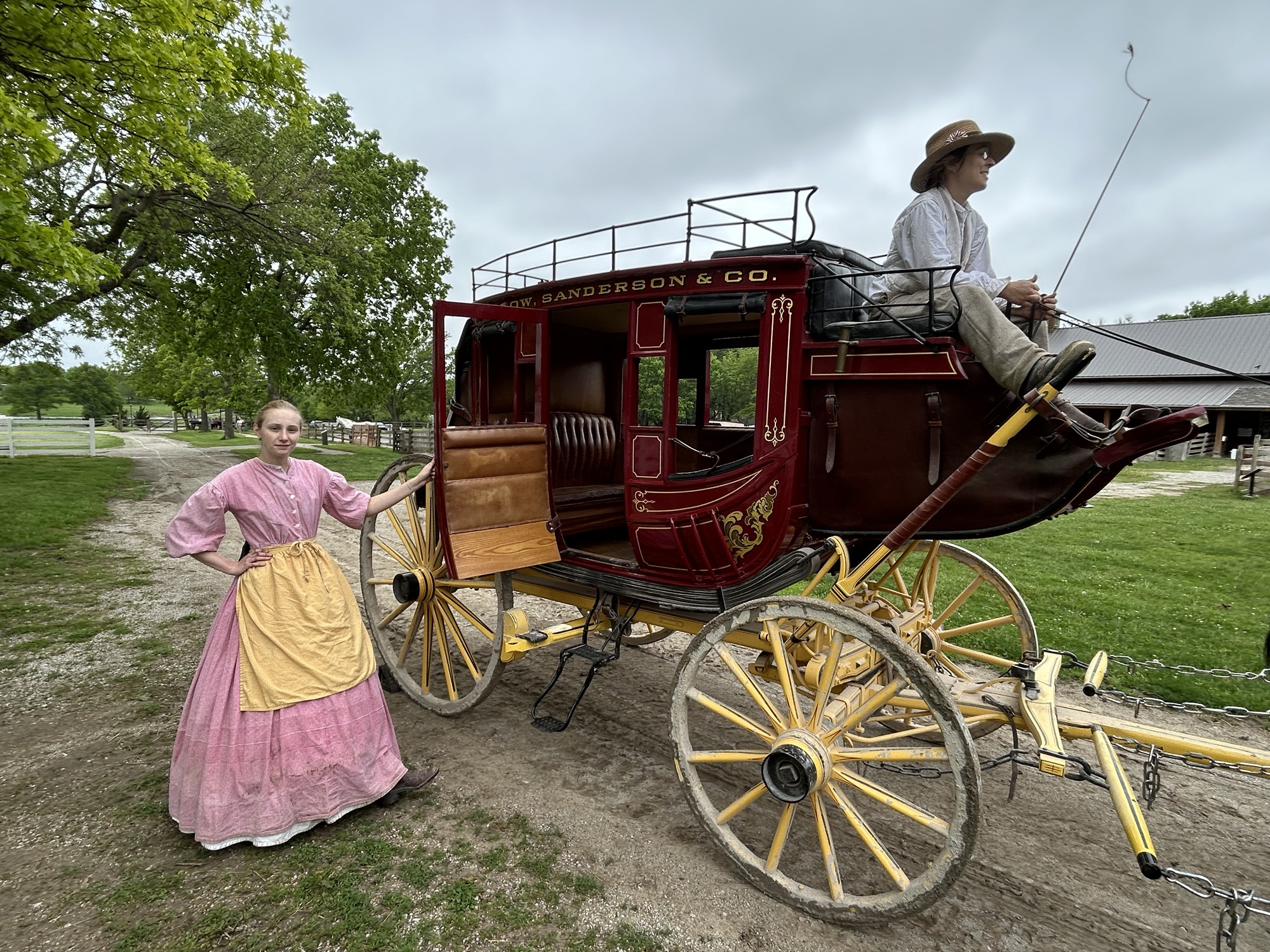
Kansas does not deserve the short shrift it often gets. At the state-managed Mahaffie Stagecoach Stop and Farm, for $7 I rode in the Santa Fe Trail stagecoach above, ate a quick bite as the passengers did in the original house, dodged heritage chickens in the yard, saw a ‘prairie schooner’ in the barn, carefully watched a blacksmith demonstration, and learned how differently vintage baseball was played in 1860. Living history is so much better than a regular museum, although they have one of those here too. The staff is bright and answered all my dumb questions quickly and cheerfully. This is my favorite trail stop.
Turns out that John Brown’s half sister lived here and insisted on strident ‘free state’ politics, doubtless supporting the Underground Railroad. John Brown freed slaves from Missouri, and one of his sons was killed fighting ‘border ruffians’ in front of his half-sister’s cabin nearby. Bushwhackers from Missouri frequently crossed the river to try to rig the election in favor of slavery, but they were fought by local Jayhawkers. Around 100 people were killed in the violent fighting known as Bleeding Kansas that is considered a prelude to the Civil War. Kansans’ staunch and courageous support for freedom was the hope of the nation, at a dark time in our history.
The greater area is also the starting point for basically all the trails going west, including Lewis & Clark, the Pioneer Trails and the Pony Express, all of which have museums nearby. And the first documented Civil War combat by African American Union soldiers—the 1st Kansas Colored Volunteers—occurred at Island Mound (YouTube) in Missouri, although not the first regiment. Oh, and Amelia Earhart’s birthplace, the Negro Baseball League and other interesting sites are also part of the NHA, along with official NPS sites like Fort Scott, Fort Larned and Brown v Board. So, let’s give Kansas some overdue credit.
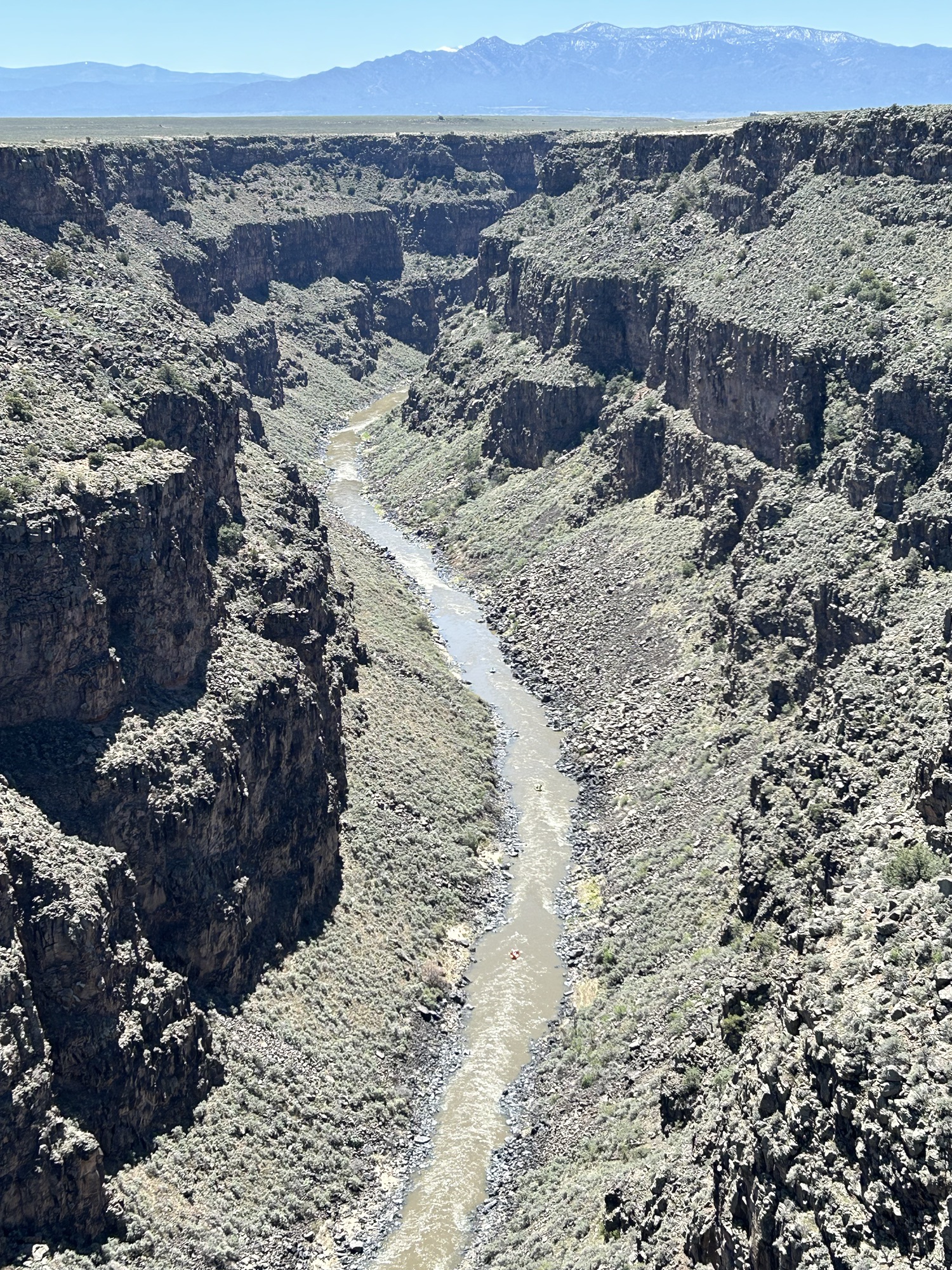
Quick logistical update: until summer, Mondays are Mexican World Heritage Sites, Thursdays are eclectic, and Saturdays are bonus park photos. I took the photos above yesterday in New Mexico and Colorado.
While technically in different regions, both National Heritage Areas are linked by the river, the mountains and our cultural heritage. The Rio Grande begins in the San Juan Mountains in south central Colorado and flows east through the San Luis Valley where it turns south into New Mexico. The scenic north section is called the Río Grande del Norte to distinguish it from the southern section that defines the Texas-Mexico border. The river flows through the Rio Grande Gorge and is now popular for whitewater rafting (see three rafts above left). In the distance are the Sangre de Cristo Mountains (both photos).
Native Americans and Spanish explorers traveled up and down the river, settling on the fertile valleys. The native land was claimed by the Spanish, Mexicans, and Texans, and for a dozen years, the Río Grande del Norte defined the US-Mexico border in Colorado, before the US claimed the land all the way to California by treaty in 1848. In the Civil War, Texas secessionists battled Colorado volunteers at Glorietta Pass in New Mexico to decide the war in the southwest.
The Northern Río Grande National Heritage Area in New Mexico celebrates this magnificent natural scenery and the cultural heritage it guided. It also includes Taos Pueblo, wild & scenic rivers, historic trails, scenic byways, and several cliff dwellings. Much of the land is also a BLM managed National Monument. The area is both beautiful and fascinating, and I was not going to miss another chance to drive through on my way northeast.
The Sangre de Cristo Mountains tower over the east side of the Río Grande del Norte from east of Santa Fe NM up into Colorado past the Great Sand Dunes. Meaning ‘blood of Christ’ in Spanish, the name likely refers to the scarlet colors of the mountains at sunset. The helpful illustration (my favorite photo above right) is on the Stations of the Cross trail up to a church that overlooks the historic San Luis Valley.
The Sangre de Cristo National Heritage Area in New Mexico borders the Northern Rio Grande National Heritage Area in Colorado, and includes the Cumbres and Toltec Scenic Railroad featured in Indiana Jones and the Last Crusade, the Monte Vista National Wildlife Refuge famed for Sandhill Cranes in March, and Fort Garland, a fine restored Kit Carson fort with an interesting museum on Buffalo Soldiers—one turned out to have been a woman who served for years as a man undetected. The area is lovely and pastoral amid snow-capped mountains, with many other worthy attractions, but I’m on the road again.
National Heritage Areas are run by local communities, with technical support and limited federal funding, so they’re not official park units. They’re certainly worth visiting, and they include some of my favorite places in the USA. Each has its own unique character, some preserve history, some culture and some nature, and together they showcase the tapestry of our country. I’ve visited the four NHAs in the Western Region by EV, so here’s a quick summary for you to explore.
The Santa Cruz Valley National Heritage Area in Arizona is part of the Gadsden Purchase of 1854. The NHA includes Saguaro National Park, Tumacácori National Historical Park—a small, but exceptionally beautiful place above—, San Xavier del Bac Mission, the Tucson Presidio Museum, the Arizona-Sonora Desert Museum, Native American tribal lands, and many other parks, preserves, ranches and gardens. The Juan Bautista de Anza National Historic Trail begins in the Santa Cruz Valley south of Tucson, at the Nogales Mexico border crossing.
Yuma Crossing National Heritage Area, in Arizona just across the Colorado River from California, is only a few blocks from Mexico, and it still carries some of that old frontier atmosphere. Yuma Territorial Prison, a state park, is a good place to start, and it figures in many of the old western tales of Tombstone and Hollywood. Be sure to visit the riverside parks, where 400 acres of wetlands have been restored, turning back time to before the Spanish came up river almost 500 years ago. The crossing is also part of the Juan Bautista de Anza National Historic Trail.
And the same trail ends up in San Francisco, where I used to live and work. One of my favorite escapes from that city was to explore the Delta, a huge area of farmlands, levees, and artificial islands upriver from the Bay. Built by Chinese laborers—later denied residency or citizenship—, the agricultural and boating area is sparsely populated, compared to the large cities nearby. My favorite town is Locke, which still has many old buildings used by Chinese laborers and merchants from over 100 years ago. It was one of the last towns of its kind, fortunately avoiding many of the “mysterious” fires that burned out other Chinese immigrant communities. While visiting John Muir’s home and Port Chicago, I took the opportunity to get lost there again, visiting Isleton and small harbors known only to locals. Fortunately, the entire area is part of the Sacramento-San Joaquin Delta National Heritage Area, including more civilized spots in Walnut Grove and Benicia California.
The last NHA in the Western Region is Great Basin National Heritage Area. While most folks think of Great Basin National Park, the Great Basin Desert is actually a huge geologic area, including a piece of southeastern Oregon, bits of California, the western half of Utah and almost all of Nevada. (Utah is part of the Rocky Mountain Region, but as most of the NHA is in Nevada, I count it here). So, anyone who’s followed the Pony Express or driven America’s loneliest road, Highway 50, knows the area. To call it sparsely populated is an understatement: one of the most populous places around is Eureka, Nevada, population 414. There is a remarkably undisturbed drugstore museum in McGill, and there’s a hot spring in Duckwater (pop 228). Topaz is in the Basin, as is part of the epic Pahvant-Valley Heritage Trail, one of the Mormon pioneer trails beyond the capability of my electric car. One of the trail stops is Hole-in-the-Rock in Glen Canyon, across from Rainbow Bridge. Good place to visit if you can get there and like solitude.





 Zero Carbon Travel