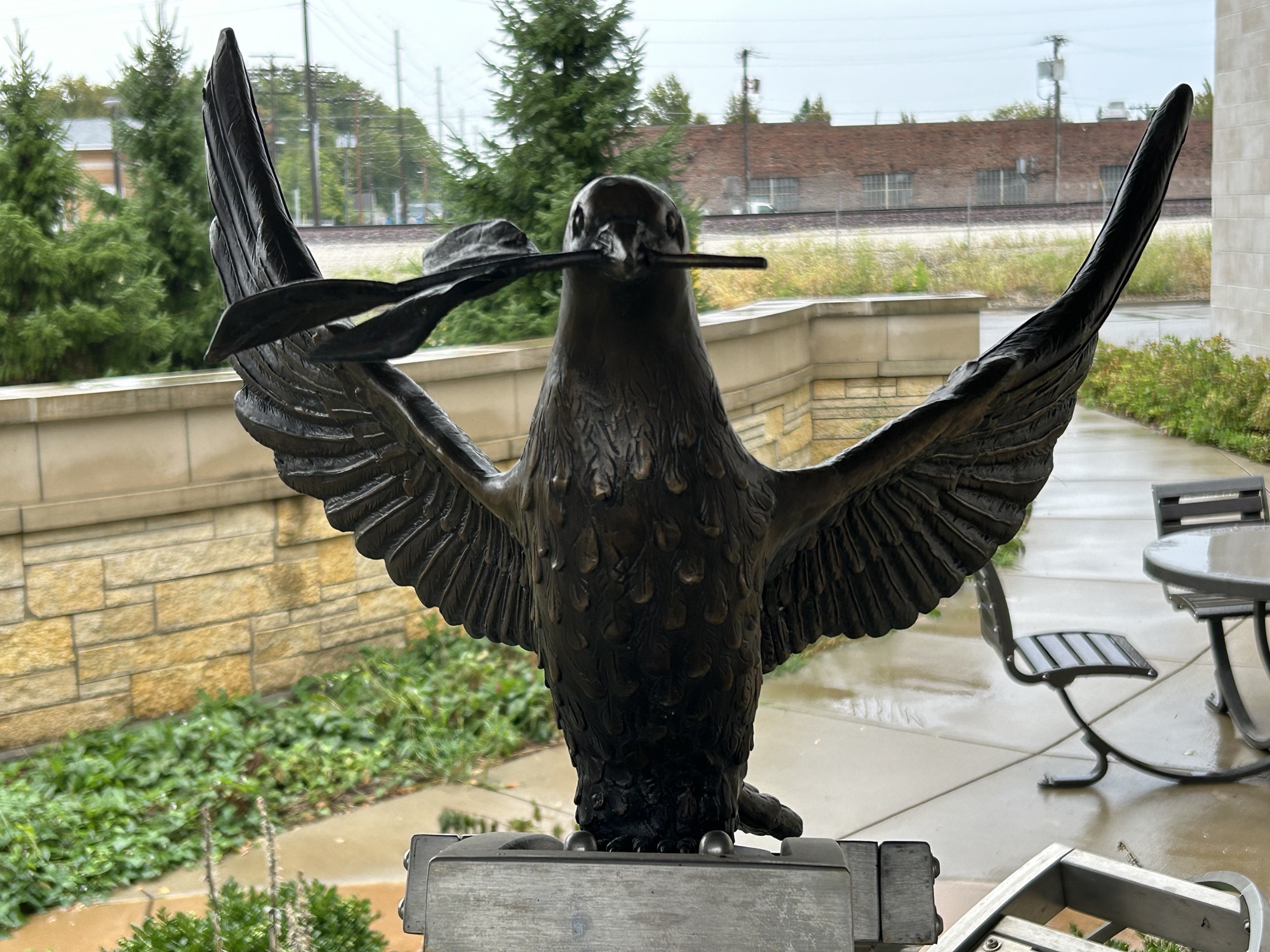
This new park established by President Biden this August is still a fenced off construction area next to the railroad tracks, but there are several art installations dedicated to the riot, including the dove above and a mural at the Children’s Hospital next door. 11th Avenue along the site is known as Reconciliation Way, to commemorate the terrible events here in 1908.
In mid August 1908, in Springfield Illinois, a white mob of five thousand lynched 2 black men, killed 7 others, burned out millions of dollars worth of black homes and businesses and also targeted Jews and whites deemed sympathetic to the black community. The police did nothing to stop the riot. The burning, looting, ransacking and violence lasted 3 days until put down by the state militia, which resulted in 6 dead rioters.
Church leaders blamed the victims for being “sinful”. Although everyone knew the perpetrators and many were arrested, only one 15 year old was convicted after he confessed to stealing revolvers, shooting at black people and starting 15 fires. The others denied any responsibility, the witnesses denied seeing them, and the charges were dismissed. The judge denied that there was racism in Springfield.
Many Americans were shocked by the scale of the violence in Abraham Lincoln’s home town, and civil rights advocates like W.E.B. Du Bois and Ida B. Wells helped form the NAACP in 1909 in response. In 1910 speaking before the NYC Republican Club (the party of Lincoln), Du Bois argued that if racial hierarchy were the natural order of the world, then there would be no need to use social and physical weapons to oppress a race.
“So soon as the prejudiced are forced into this inevitable dilemma, then the real bitterness and indefensibility of their attitude is revealed; they say bluntly that they don’t care what [slurs] may be capable of—they do not like them and they propose to keep such folk in a place of permanent inferiority to the white race—by peaceful policy if possible, but brute force if necessary. And when a group, a nation or a world assumes this attitude, it is handling dynamite. There is in this world no force as the force of a man determined to rise. The human soul cannot be permanently chained.”
Before there was a United States, the Spanish were here first. Over five centuries ago, Spanish explorer Ponce de León arrived in Florida, somewhere near St Augustine. That settlement is older than Plimoth and even older than Jamestowne. Hernando de Soto landed in 1539—at the mouth of Tampa Bay near where Hurricane Milton just landed—, and he led his expedition through what would later become 8 US states. Before the celebration of Hispanic Heritage Month ends on October 15th, we should take a moment to reflect on the deep Hispanic roots of America, reflected in the Spanish names of many of our city, county and state names.
Arizona is ‘Arid Zone’
California is named after a 16th century Spanish fictional island
Colorado was named for it’s rich colors
Florida is ‘Flowery’ since de Leon arrived on Easter, 1513
Montana is ‘Mountainous’
Nevada means ‘Snowy’ in Spanish
New Mexico was part of the Spanish Empire’s reach to Alaska and the Great Lakes
Oregon was first recorded in Spanish
Texas comes from Tejas for ‘Friend’, used to describe Native American allies
And Utah derived from how the Spanish referred to the natives there
The Spanish began European exploration of our country, beginning by funding Columbus. One reason there are Spanish place names throughout the US is due to explorers like De Soto, Coronado, and Cabrillo. How many Americans know that St Augustine is our oldest permanent European settlement? We love Historic Route 66, but do we recognize that such Old Spanish Trails were mapped by Spanish colonizers like de Anza and de Oñate? At El Morro, early settlers carved messages in the rock in Spanish. Spanish speaking traders were at the ancient Casa Grande and at the still open Hubbell Trading Post. 100 years before we gained our Independence from the British, the Pueblo Revolt kicked the Spanish out of what’s now the US southwest. We know that Jefferson bought Louisiana Territory from Napoleon in 1803, but do we know that Napoleon got it from Spain in 1800? Our Midwest roots are both French and Spanish. The Presidio in San Francisco was Mexican for decades before the US Army took over.
And yet for some reason, we persist in ignoring our Hispanic Heritage. The Canadian River flows from Colorado, through New Mexico, Texas and Oklahoma, and it was mapped by Governor Oñate in 1601. The river’s most remarkable geographic feature is in Texas, where it runs through Palo Duro Canyon, the second largest canyon in the US, described as a cañada in Spanish. And yet for generations, English speakers have tried finding non-Spanish explanations for the river’s name, such as lies that the French trappers didn’t know any Spanish, didn’t trade with the Spanish there and confusedly thought that the river came from Canada. Ridiculous!
While the ignorant falsely view Spanish speakers as only recent immigrants, in much of the country the Spanish speakers were here first, remaining for generations, even as wars and borders changed their lands from Spain or Mexico to the US. Over 40 million Americans speak Spanish at home, as they have for generations. Spanish speakers and their descendants should be rightfully recognized as founding members of our country, as their experiences and lives here predate English speaking settlers, and Spanish speaking citizens have continued contributing to our country, despite prejudice against them.
Unlike the war-shrine Alamo, the San Antonio, Tumacacori and other missions today are dedicated to peace and understanding. Despite some politicians trying to divide us, the Mexican border has long been peaceful, with disputes negotiated at places like Chamizal above in El Paso. César Chávez organized the first permanent agricultural union in the US, to lift up the lives of millions of people. And when Brown v Board of Education ended segregated schools for African Americans, it also ended segregation for Spanish speaking students at places like Blackwell School in Texas.
We should learn about our Hispanic Heritage and our past discrimination—including tragedies of mob violence and mass deportations—, so that we reject hatred and division. We can be a more just, inclusive and a better society.
“Those who cannot remember the past are condemned to repeat it.”
The trail is not straight. It meanders through Michigan’s wooded hills, green valleys and along its rivers and lakes. The trail begins along the Niagara Escarpment that separates Green Bay from Lake Michigan, then south below Madison, before crossing the Wisconsin River at Lake Wisconsin. Then it passes up across the bluff on the right with its characteristic rough rock glacial remnants on the steep slope to the north beach of Devil’s Lake above before continuing north to the Wisconsin Dells with iconic eroded rocks. Eventually it crosses the state to end at the St Croix River.
President Biden elevated the trail to a full national park unit, but many of the most scenic sections are in state parks or affiliated scientific reserves. Wisconsin Dells itself is quite commercialized, with water parks and pricey tours, even though the layered rock can be seen in several different places along the Wisconsin River. State parks like above or Mirror Lake have fine scenery, camping and miles of maintained trails. I tend to rush around and then spend too much time at supper clubs, but it’s worth slowing down a bit here to enjoy the natural beauty. For more, read my earlier post about the Ice Age Trails.
Traditional historians have generally argued that the War of 1812 was about defending US maritime rights, especially of US citizens who were involuntarily ‘impressed’ into the British Navy. Jefferson had certainly left some trade issues with Britain, but such disputes rarely go to war. During the war, the northeastern states continued trading with Britain, and the treaty at the end of the war did not change the maritime rights status quo legally. Americans worked harder at getting compensation for slave owners whose slaves were freed by the British than for US citizens impressed into the British Navy. So that whole explanation for the war is obviously wrong.
More enlightened historians have argued that the War of 1812 was about expanding US territory at a time when the British were busy fighting Napoleon, as stated by the dominant party in Congress and President Madison, who called acquiring Canada “a collateral benefit”. During the war the US invaded Canada 10 times, took land in the southeast including in Alabama, Florida, Georgia, Louisiana and Mississippi, and took land in the then northwest including Indiana, Illinois, Michigan, Ohio and Wisconsin. Most of the US territorial expansion around the time of the war was from Native American lands, regardless of whether they fought for the British or the Americans. So that whole ‘expansion’ explanation checks out.
If we think about the war at all, most Americans view the War of 1812-1815 as about nationalism, patriotism and rallying around our flag, perhaps because we did not achieve any of our objectives, failed to take Canada and had our national capital burned. Canadians tend to view the war more as a heroic defense against our ill-conceived and unpopular aggression, as after all, the Americans burned York—their capital of ‘Upper Canada’ in Ontario province—first. The truth is always more complicated, as you can see comparing the capital burnings. After the British general retreated from York, local militia started fires to prevent the Americans from seizing their supplies, and the resulting gunpowder magazine explosion killed the American general along with ~200 other casualties. The American troops, not under official orders, burned public buildings and businesses. When the British seized Washington DC, they burned most public buildings, including the White House, under orders. Which gives you a sense of the animosity at the time.
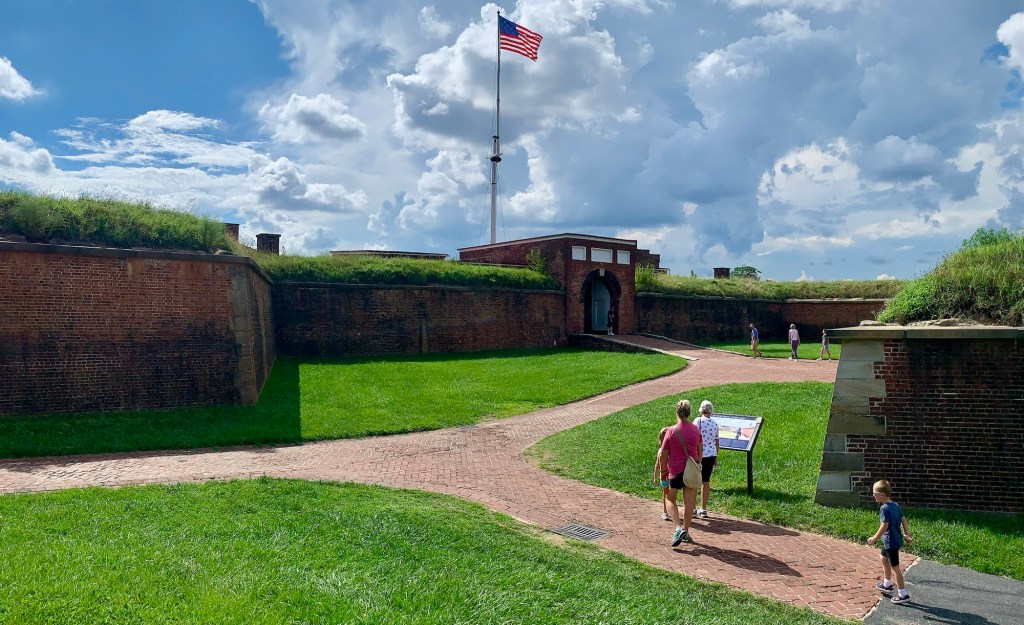
Fort McHenry, Fort Washington and the Star Spangled Banner trail focus on the dramatic events around DC and Baltimore, but there are other US park sites that tell more of the story. Along with failing to continue Washington’s peaceful tactics and trade agreements with Britain, the expansionist Jefferson hired Albert Gallatin to reduce the national debt, and Gallatin cut the military budget, leaving successor Madison the contradictory problems of war and a weak military. The US could not match the British Navy in the Atlantic, except for the USS Constitution: Old Ironsides. So the British blockaded the US ships along the eastern seaboard, except for smugglers in New England. So, technically port forts like Monroe and those guarding Mobile Bay had roles in this war, but their primary historical importance is based on events of other times.
The old Northwest Territories around the Great Lakes were long contested by the Americans, British, Native Americans, French and Spanish. River Raisin, near Detroit, is a good place to learn how we provoked the War of 1812 to take native lands. The Americans had two great naval victories during the war, first in 1813 on Lake Erie, where Perry broke the British inland fleet and cut off their supply lines to their western forts, and second in 1814 on Lake Champlain, where Macdonough thwarted a British invasion via the Hudson. The Americans made several incursions into Canada, but were unable to hold territory north of the Great Lakes and even lost their poorly manned Old Fort Niagara in New York, returned by treaty. The war encouraged the French and British in Canada to join together for common defense, eventually forming Canada in 1867. The military stalemate clearly defined the eastern border between Canada and the US, contributing to our long peaceful history since.
In the American southeast, the more consequential war was the simultaneous Creek War and related actions. At Horseshoe Bend Andrew Jackson used Cherokee and Creek allies to defeat other Creeks, even as his allies took lands from both sides. When Napoleon abdicated, the British no longer needed to kidnap American sailors to fill their fleet, and they were able to turn their full attention to their former colony. The American diplomats, led by John Q. Adams along with Gallatin and others, wisely negotiated a peace treaty. But before the news arrived stateside, Andrew Jackson took New Orleans, with the help of the French pirate Jean Lafitte in a story told here. Jackson leveraged his victory to win the White House and used office to enforce the Trail of Tears. He also invaded Florida in 1818, convincing the Spanish to sell the territory to us in 1819. While the Native Americans lost the most in the lead up, during the war and in its aftermath, many African Americans took the opportunity to escape to Canada along the Underground Railroad.
Often overshadowed by the Revolution and the Civil War, the War of 1812 offers many lessons of popular patriotism driving greedy expansionism, reckless militarism and brutally unfair racist policies, with costly, unforeseen consequences. Rather than simply look at flags or teach our kids one heroic story, we should think critically about history so we can make better decisions in the future.
About 15 scenic miles north of Niagara Falls on the US side of the Niagara River is Old Fort Niagara overlooking Lake Ontario. The fort is run by a non-profit licensed by New York State, and it preserves the 17th century stone building, ramparts, drawbridge, cannon and the various accoutrements of French, British and American soldiers who served there from before the Revolution till after the War of 1812. The British took the French fort in a siege in 1759, and then they took it again from the Americans in 1813, bayoneting around 6 dozen. Otherwise the fort changed hands by treaties. The visitor center, fort and grounds make a pleasant, educational diversion from the falls if you’re in the area.
But if you’re interested in forts and war history, I recommend crossing the Niagara River border and visiting Old Fort Erie in Canada. That British fort predates the US and was the site of the bloodiest battle of the War of 1812. Hotly contested for control of the area during that war, the Americans took the fort in 1813, relinquished it, took it again in 1814 and held it against a ferocious siege where each side had over 1000 casualties. While not part of the US Niagara Falls NHA, it is a highlight of Niagara Parks right over the bridge in Canada.
Ignore the famed waterfalls and focus on Goat Island cliff in the middle. That wall is the Niagara Escarpment, caused by relatively hard rocks at the top holding the land underneath together, until it erodes away from the side. This two level land break—all erosion and not earthquake fault—is the key geologic feature to understanding the Great Lakes.
Much of the escarpment is in Canada, and even where it crosses the border to form Niagara Falls, it’s easier to see from the Canadian side as above. It runs along the south shore of Lake Ontario, across Niagara Falls (above) where it sets the level of Lake Erie, northwest through Ontario where it guides the Bruce Trail, up along the north shore of Lake Huron where it splits off Georgian Bay and shapes Lakes Huron and Michigan, along Michigan’s Upper Peninsula where it separates Lake Superior, and down the Door Peninsula past Green Bay in Wisconsin. After driving around the Great Lakes, it’s apparent how the water levels depend on the escarpment: Superior is the highest above both ends, Michigan and Huron are the same level in the middle, and shallow Erie is a little lower, held back at Niagara Falls, before that river drains into the lowest lake, Ontario.
UNESCO defines the Biosphere as the mostly forested area of Ontario between Niagara Falls and Tobermory on the tip of the Bruce Peninsula next to Georgian Bay, roughly 500 miles along the escarpment. The geologically interesting landscape holds great biodiversity in wetlands, coastline, deciduous & conifer forests, and rocky bluffs, perhaps the most in Canada. And there are many opportunities to explore, photograph wildlife, hike, drive or boat nearby. I hiked on the Cup & Saucer Trail on Manitoulin Island, the world’s largest freshwater island, when traveling around the Great Lakes. There, the escarpment is eroded on both sides, providing many views along its edge, including Lake Manitou below.
The trail runs from the Appalachian Trail in the Green Mountains of Vermont, through the Adirondacks in New York, past the old portage trail at Fort Stanwix (above), through the Allegheny Forest in Pennsylvania, south into Ohio near Fort Miamis, north through Michigan, west in the upper peninsula past Pictured Rocks, down to the upper St Croix River in Wisconsin, through Minnesota from near Grand Portage to Knife River in North Dakota.
President Biden elevated the trail to an official park unit last November, and the trail is not yet continuous. But having explored various sections at different times in all 8 states across 4 regions, it is undeniably scenic, especially along Lake Superior, in the Adirondacks and other lesser known areas. There are many quirky old rural towns along the way, atmospheric local restaurants and adventures to be found, along with thousands of miles of hiking, of course.
There are five affiliated sites in the North Atlantic region: Kate Mullany NHS, Lower East Side Tenement NHS, Roosevelt Campobello IP, Thomas Cole NHS and Touro Synagogue NHS. Campobello (above) is actually in New Brunswick Canada, just across the Maine border. Touro is in Newport Rhode Island. And the others are in the Empire State.
All five are among my favorite sites in the country.
The congregation at Touro predates our country, and they have the promise of religious equality made by George Washington in writing.
Take the tour, sit in the pews, and listen to the stories of freedom to believe.
In the early 1800s, Cole painted romantic landscapes and historical scenes, inspiring a school of painters.
Tour his house and studio, see the exhibits and listen to the stories behind his work.
From the late 1800s to early 1900s, the garment district immigrants toiled in sweaty tenement buildings and built futures in their new country.
Go to a neighborhood deli, tour the tiny rooms, and listen to the stories of strikes and hope.
FDR’s summer home in Canada immaculately preserves over 100 years of precious memories.
Tour the estate, have a cookie at Eleanor’s tea, and listen to the stories of recovery and advocacy.
The newly open Mullany house tells the little known story of the woman who started the first official female union in the country.
Make a reservation for a tour, see the history of American labor on the walls, and listen to the stories of the workers who built our country.








 Zero Carbon Travel