Favorites from All 508 Sites in 48 States

Late this year, I visited my 395th park site, earning a rare park stamps award for all official NPS sites in the 48 contiguous states (see map). Plus I drove my EV to 29 NPS affiliates, 60 heritage areas, and 24 national trails (not on map). Read about my favorite sites below.

Screenshot of my NPS unit Visitation Map from the National Park Travelers Club website.

Best’ is subjective, as it depends so much on your individual taste and experience. If you are lucky enough to have great weather, a lucky wildlife sighting, or an inspiring ranger-led tour, that day will be one of your favorites. Click on the links to read my past favorites from 100, 200, and 300 park units visited, and here are favorites from 400 park sites, including affiliates, heritage areas and trails. I have no changes to my previous favorite park units, but I have a few additions.

Best Civil Rights Affiliate: Robert Russa Moton Museum.

Best Flightseeing Tour: Dry Tortugas.

Best Garden: International Peace Garden.

Best Handshake: Red Hill.

Best National Heritage Area: Muscle Shoals.

Best Paddling Tour: Channel Islands.

Best Partner Site: Acadian Village.

Best Revolutionary War Affiliate: Camden.

Most Demolished Since My Tour: White House.

Most Hauntingly Evocative Past: Cumberland Island.

Most Irrevocably Damaged by Climate Change: Biscayne.

Southwest Nova

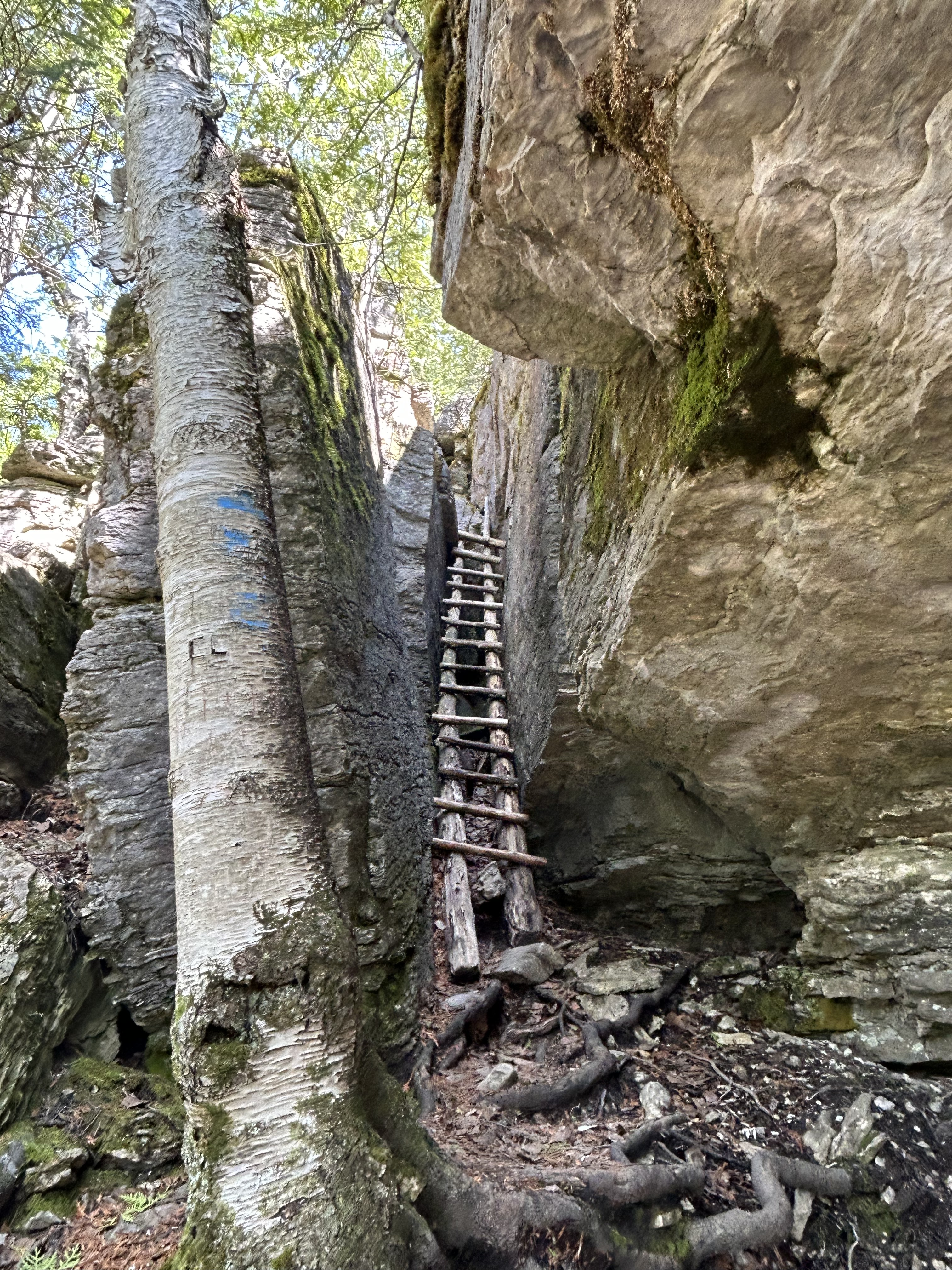
Much of southern Nova Scotia belongs to this UNESCO Biosphere, and the at the center is Kejimkujik Lake, historic site and national park above. My cousin was instrumental in gaining early recognition for the area’s exceptional starlight and dark skies, making it a great place to stargaze. The visitor center has a couple beautiful birchbark canoes and exhibits on the First Nation people who have lived in the area since time immemorial.

Due to extreme fire conditions, the backcountry was closed during my visit, but a few lakeside trails were open. The lake was low, the air and forest dry, but the day was lovely and quiet. The climate change is even more visible to the north, and there were many fires burning in Newfoundland in September. The national park includes a seaside section on the southeast coast with nesting piping plovers on a (closed) beach from April to September, but the biosphere covers far more land, outside the core park, from Yarmouth to both southwest and southeast Nova Scotia.

All NPS National Recreation Areas

There are 18 NRAs managed by the park service for biking, boating, camping, fishing, hiking, horse riding, swimming and other activities. (I should note that there are also 13 NRAs managed by the US Forest Service, and I plan to visit some of those too.)

Two are in the North Atlantic region: Boston Harbor Islands and Gateway, which is shared with the Mid-Atlantic region. Both are great for birdwatching and hiking along the shorelines.

The Mid-Atlantic has two more: Delaware Water Gap and Gauley River, plus the Upper Delaware Scenic and Recreational River. All are great for paddling, although Gauley is more challenging.

Three are in the Pacific Northwest: Lake Chelan, Lake Roosevelt and Ross Lake. All have great lakeside camping.

Three are in the Rocky Mountain region: Bighorn Canyon, Curecanti and Glen Canyon, which is shared with the Western region. Each has great views.

The Western region has four more: Golden Gate, Lake Mead, Santa Monica Mountains and Whiskeytown, each unique.

The Southeast has one: Chattahoochee River, which is great for hiking and maybe tubing near Atlanta. Plus they have the Big South Fork National River & Recreation Area, which is great for paddling.

And the Southwest region has Amistad, Chickasaw and Lake Meredith, which all take advantage of dams for boating.

Oh, and while the Midwest doesn’t have any NRAs, they do have the Mississippi National River and Recreation Area and the Missouri National Recreational River, both with lovely hiking and paddling.

Fundy

This UNESCO Biosphere Reserve is in New Brunswick Canada, although the Bay of Fundy is also formed by Nova Scotia to the east. The photo is from the north end at Fort Beauséjour looking south towards where the water comes rushing in with the highest tides in the world. The shape of the bay both funnels the water and creates oscillation that magnifies the tidal surge. The tide is fairly low at this time but already covering some of the vast mudflats that attract thousands of shorebirds, especially sandpipers in mid summer that bulk up on mud shrimp to fly to South America.

Due to the silty water, tidal power has not been harnessed here yet. The Acadians built aboiteaux or sluice gates and dykes here to reclaim some of the nutrient-rich salt marsh land for the fields below. The star fort was taken by the British during one of their conflicts with the French, played a role in the expulsion of the Acadians, and was successfully defended against the Patriots during the American Revolution. But I visited the Bay of Fundy mainly to see the tides, and one of the few places in the world that you can actually see the tide rising is where the rivers empty into the bay. I watched the tidal bore come in near Maitland Nova Scotia, creating waves as the tide forced its way up river.

Best of the North Atlantic

Best Park: Acadia. Wildlife, wilderness, views, varied hiking, boating, camping, forests, mountains, waters. Acadia National Park, above, is the only National Park in the region, the best North Atlantic park in many categories, plus proximity to fresh lobster rolls.

Best State: Massachusetts. Oh, sure, New York has more sites overall, more presidential sites, more historic sites, more Civil Rights sites, more recreation areas, plus 2 world heritage sites, but Massachusetts is still better. Just like the Red Sox are better than the Yankees.

The North Atlantic specializes in history, exemplified by these best-in-class parks.

Best Affiliate: Touro Synagogue.

Best Art: Saint Gaudens.

Best Bicycling: Cape Cod.

Best Forest: Marsh-Billings-Rockefeller.

Best Heritage Area: Upper Housatonic.

Best Ranger: Women’s Rights.

Best Trail: Climb Mount Katahdin on the Appalachian Trail.

Best World Heritage Site: Statue of Liberty.

Hidden Gem: New Bedford Whaling.

Read more about all parks in the North Atlantic region.

Acadian Village

One of the finest historic sites in the country is Maine’s Acadian Village in the Acadian Culture area of Saint John Valley in the northern tip of the state, open from mid June to mid September 12-5pm. Over a dozen buildings were donated and moved here overlooking the river that marks the border with Canada. Due to a penchant for large families, the Catholic agricultural community grew quickly, and many descendants trace their roots back to the rough hewn wooden buildings gathered here. Nearby towns also preserve their Acadian heritage, and the area has a partnership with the national park service.

What makes the place special is that you can walk in each building, including an art gallery, a church, a dentist office, a barber shop and a one room schoolhouse, and, unlike, many historic sites, you can go upstairs too. The tour guide had called in sick, but I was happy to have the place to myself for a while. Many of the exhibits have tags explaining the provenance of each item, and I was able to open a trapdoor to see how water was collected by wooden pipes. Every room seems furnished with authentic pieces evoking the lives and stories of inhabitants long ago.

I have a very old memory of hiking along a railroad bed to an old station in a French speaking village up here, so I believe this area is a revisit for me. But now I come with knowledge of the Acadian or ‘Cajun’ diaspora from Nova Scotia to Louisiana and many other areas, having eaten buckwheat cakes in Quebec, and having danced to Zydeco in the Bayous down south. Evangeline, Longfellow’s epic poem about the 18th century expulsion of the Acadians, strikes me more deeply now that I have grown children. I also have a greater appreciation for the meticulous love required to assemble such a beautifully moving collection of memorabilia from a unique culture that still thrives today, albeit out of sight of those who deny our non-English heritage.

”Silently, one by one, in the infinite meadows of heaven,
Blossomed the lovely stars, the forget-me-nots of the angels.”

From Henry Wadsworth Longfellow’s Evangeline: A Tale of Acadie

Vermont in Photos

I’m wrapping up my park photos for each of the 48 contiguous states this year, just three left in New England, full of childhood memories. Like Connecticut & New Hampshire, Vermont has only one national park unit, Marsh-Billings-Rockefeller, a long-protected wooded area. Only one park photo, but the state is well worth celebrating. The Green Mountain State also has parts of the Appalachian and North Country trails and the Champlain Valley heritage area.

Great Artists Steal

When I first heard the quote in 1983, it was attributed to Victor Hugo (1802-1885), not Pablo Picasso (1881-1973), and it was phrased as “poor artists imitate, good artists copy and great artists steal”. To me, it meant that a lesser artist doesn’t even have the skills to reproduce another artist’s work well, that a good artist has the skills to match the original artist’s work, and that a great artist can steal the essence of another idea and make it their own surpassing the original artist’s work entirely. Despite the invention of the Internet since then, I have not been able to find that particular line in any writing by Hugo, but I have found reasons to give him partial original credit nonetheless.

In February 1846, Victor Hugo observed a thin young man being arrested for stealing a loaf of bread, and he realized that the man was the “specter of la misère, of poverty”. Hugo thought deeply about theft, motive, desperation, and justice, and he wrote extensively on social injustice for the rest of his life. Ten years after witnessing the young man’s misfortune, writing in exile, Victor Hugo immortalized this indelible inspirational image in his novel, Les Misérables, making it the fateful event in his character Jean Valjean’s life.

“In days gone by, to live I stole a loaf of bread; today, to live I will not steal a name.”

Years after Hugo’s death, his compatriot Anatole France wrote another of my favorite quotes, doubtless inspired by Hugo’s ideas on theft and injustice.

“The law, in its majestic equality, forbids the rich and the poor alike to sleep under bridges, to beg in the streets and to steal bread”.

Hugo was a strong lifetime advocate of two sometimes opposing positions. First he believed that ideas are inevitably free, writing that “an invasion of ideas cannot be resisted” and that “nothing is more powerful than an idea whose time has come”. And second that artists deserved credit for their work. Hugo co-founded the movement for intellectual property to be protected by international copyright, believing that ideas added something of value to the world, constructively.

Anatole France, by juxtaposing “majestic equality” with the poverty-driven crime of stealing bread, distilled Hugo’s original epic rant about how the law unjustly criminalizes poverty and adds an unfair burden upon the poor in an unequal society into a quotable thought-provoking insight. Hugo perhaps would have been flattered by the imitation of his observation, and Hugo understood that each value-added portion of an idea deserves recognition. When someone merely takes another person’s idea without attribution to sell as their own, that’s plagiarism, which Hugo fought against.

But Hugo also certainly knew that it is the truth of the idea that gives it its power, which raises the question of whether the artist truly owns the underlying truth of an idea or not. Does the whale’s song belong to the scientists who recorded it, the artist who first set it to music, the company that now owns the digital rights, or to the whale? Often, theft is essential for ideas to be free.

While I believe the debate over stealing ideas began in France, it was the Harvard-educated poet T.S. Eliot who first framed it well in English when he wrote the following.

“Immature poets imitate; mature poets steal; bad poets deface what they take, and good poets make it into something better, or at least something different. The good poet welds his theft into a whole of feeling which is unique, utterly different from that from which it was torn.”

Here is the essence of value-added creativity. When an artist steals an idea and transforms it into something unique, better or at least different, then they deserve recognition for adding value. They are helping the idea evolve and improve, if it can.

Make no mistake, most stealing is terribly uncreative. Digital piracy alone is worth hundreds of billions annually, and the pirates are literally producing copies, by definition uncreative. Shoplifting isn’t original. And wage theft happens like clockwork, paycheck after paycheck.

The motive for most theft is instinctual—I want it—, or rational—I can take the money without anyone knowing—, but the motive for common theft is neither moral nor creative. In contrast, the motive for an artist to steal an idea is that they recognize that an idea still has untapped potential, and that they have the unique skills or viewpoint to express it in a new, different and better way. The artist works to free the idea by helping it evolve.

Pablo Picasso certainly exhibited this artistic felonious habit in his work, taking ideas and transforming them into something unique and utterly different, so there’s something appropriate about crediting the great artist with the quote. But I still think Victor Hugo deserves credit, since he helped us understand that good people sometimes have to steal for good reasons, that laws can be inflexibly misused by the powerful against the powerless, and that ideas are an irresistible force that cannot be imprisoned.

Detail from ‘Man Controller of the Universe’ by Diego Rivera.  He recreated the mural in Mexico City after the original in Rockefeller Center in New York City was destroyed by his patron who did not appreciate Rivera’s subversive  Communist message.

Frances Perkins National Monument

Mainers are tough. While other Americans talk incessantly, wear flashy clothes, and spend every day seeking attention, folks here say little, dress simple and get stuff done. It’s a pleasant sail from Boston to coastal Maine in the summer, downwind and northeasterly or ‘down east’ as the area became known. But the coast is rugged and dramatic, with rocky beaches, serious storms, cold winters and endless forests. Not the place for overly dramatic flights of fancy.

Perkins was tough too. Her family made bricks on their large piece of land overlooking the oyster farms on the Damariscotta River south of Newcastle—a “Slow Village” warns a road sign. An ancestor protested ‘taxation without representation’ and survived having his skull cracked by a ‘lobster back’ redcoat in return. Frances got an exceptional education, saw firsthand the social problems of her time, and buckled down to do the hard work of solving them.

She found social worker allies in alleys, witnessed the Triangle Shirtwaist Fire, learned the tough politics of Tammany Hall, reinvented herself to join the powerful and got stuff done. She worked on worker safety, health and poverty with two Governors of New York, and was singularly qualified when FDR asked her to be his Secretary of Labor. Frances Perkins was the architect and driving force behind his New Deal, including minimum wage and social security.

Perkins had practical training, the courage of her convictions and a moral authority to improve the lives of those in need, especially during the Great Depression. She did not seek the spotlight, but she wielded more power than any other woman in US history. Have you benefited from having drinking water & clean restrooms at work, a sprinkler system & fire escape, unemployment insurance, or not having to work weekends? Then you should remember and thank Frances Perkins.

Her Brick House family home isn’t open yet, but there are photos & exhibits in the barn. And the walk through the woods and meadow to the river is lovely. With this new park unit I re-complete the North Atlantic region and finish all park units the contiguous 48 states, until the next one is designated.