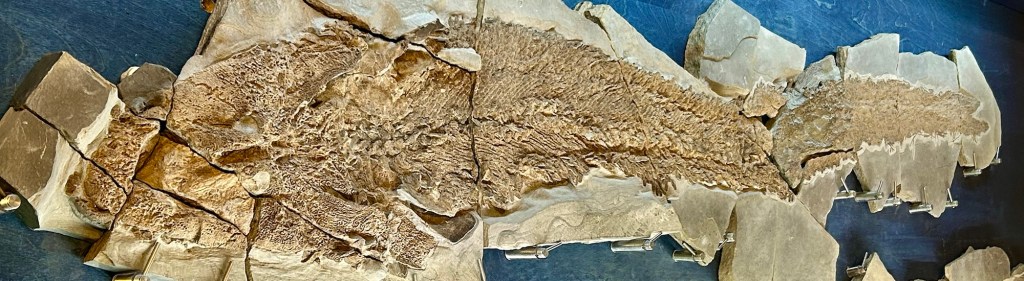
This Canadian world heritage site reveals the age of fishes, the Devonian Period of evolution around 400 million years ago, when sharks and cod invented themselves. In 1938 in South Africa, a fishing captain showed a local museum curator a weird looking fish they caught, and it was identified as a coelacanth, despite being presumed extinct some 65 million years ago. That ‘living fossil’ also dates back to the Devonian Period, as does another fish you may have heard of, the African lungfish.
In evolution, we see the development of vertebrae and lungs as important, as we inherited them from fish. But obviously, we didn’t descend directly from cod, coelacanths, lungfish or sharks—except maybe lawyers. Paleontologists, or fossil folk, figure out such distant ancestry. And Miguasha is a good place to look for fossils, as it lies in the Canadian Appalachian Mountains. Americans may believe the trail ends in Maine, but the International Appalachian Trail continues into Canada, up to the Gaspé Peninsula and continues on Newfoundland. The Appalachians are much older than the Rockies, and they were a defining land feature during the age of fishes.
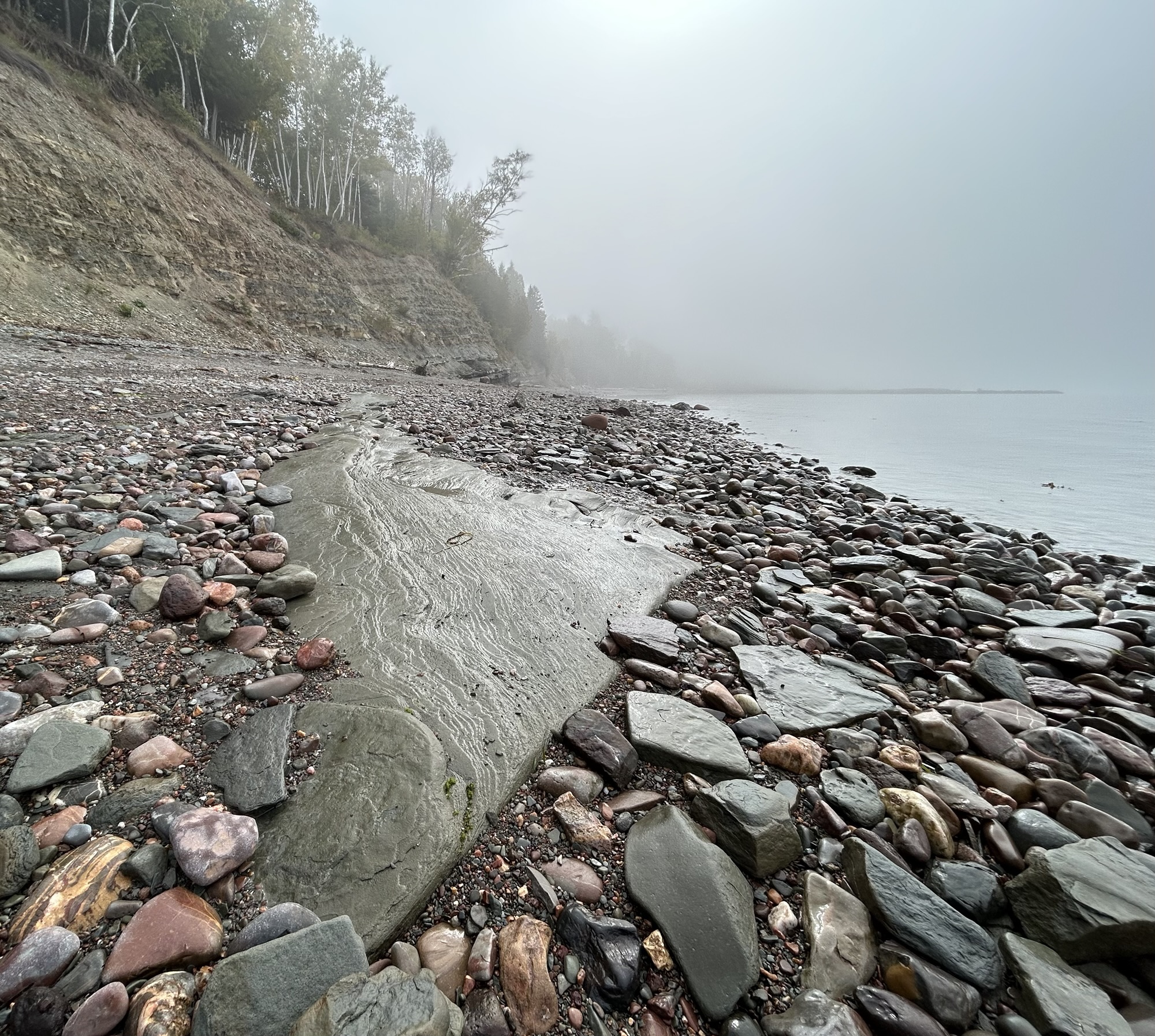
Miguasha is on the south side of the Gaspé, with high sedimentary cliffs, lots of pretty rocks, and many fossils, often well preserved in large flat layered rocks, like in the photo. Around 15 years ago, a visitor apparently found a rock at the water’s edge that had split, revealing a large fish tail. They did the right thing and left it for the local fossil experts to examine. Shortly thereafter, the experts found more pieces, fit them together with the earlier find, and put together a 5’ 3” fish fossil puzzle. While the site had been producing Devonian fossil finds for decades, this one was the King.
Not only was this a complete Epistostegalian, it also had the bone structure of a Tetrapod. In common words, that means it had vertebrae, lungs, and a bone structure resembling not just our arms, but our wrists and fingers as well. That put it within the strict definition of a tetrapod, previously believed not to include fish. This big guy used his fingery fins to climb up out of the water and breathe. Most of the animals you can think of have arms, wrists, and fingers bones, although they may appear very different on the surface: frogs, turtles, bats and horses. Oh, and whales too, although their ancestors decided life on land too hectic and returned to the sea trading in hooves for flukes. The fish fossil found here may have been our ancestor. Exciting evolution!
I learned (or relearned) a lot in the museum from the informative exhibits, and a bilingual guide was kind enough to answer a whole bunch of questions without throwing me off the cliff. Tours are mostly in French. There’s a 2 mile hiking trail on the bluff for exercise, but when the site is open, you can access the beach by stairs from the beginning of the trail. If you visit, note that the park is on Quebec time, not Atlantic, although most cell phones still show the latter. I used my unexpected extra hour to charge my car on the Flo-compatible J1772 charger, while I hiked around on my own.
Here are my visits to all UN sites in Quebec province.
 Zero Carbon Travel
Pingback: All UNESCO Sites in Quebec | Zero Carbon Travel