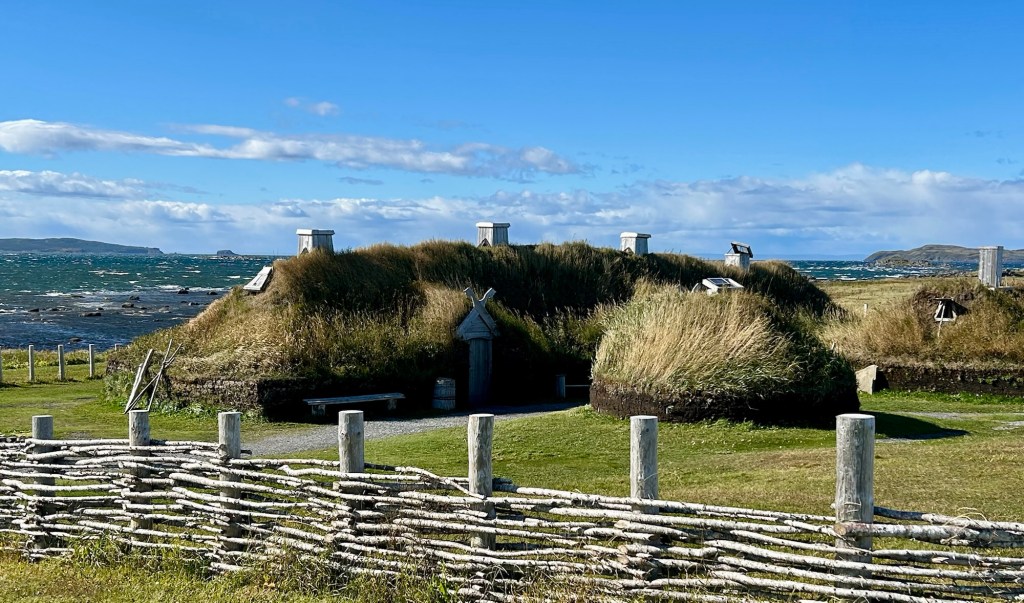
If you visit Fort Raleigh, you’ll see a monument to the first English child born in America, but there’s no monument at Castillo de San Marco about the first African American child born 50 years earlier in Florida. In any case, some 600 years before those colonies began, the Norse established this base camp on the north coast of Newfoundland, and here they recorded the birth of Snorri Thorrfinnsson around 1000 CE. And of course the first people here were Native Americans whose ancestors left their mark on the land thousands of years ago, long before history began in the Americas.
The fine film in the visitor center explains the even greater significance of this Norse settlement. Here the circle of humanity’s exploration of the world completed the circle. Modern humans began in Africa roughly 1/4 of a million years ago, populating Eurasia next, the Polynesians spread humanity into the Pacific, and humans crossed the ice to North America some 25,000 years ago. The Vikings, meaning the seafaring raiders of the Norse people, explored the North Atlantic a thousand years ago. Although they did not settle permanently, the Norse left their foundations here. They traded cloth and milk with natives for furs, and they explored at least as far as New Brunswick on the border of what is now the US. That meeting reintroduced two distant branches of humanity for the first time since our common ancestors left Africa 100,000 years ago.
Apparently the meeting did not go well enough for the Norse to remain. The expeditionary camp was established primarily to provide wood for the colony in Greenland, but it was a long way away from Scandinavia. Outnumbered and without significantly superior weaponry, the Norse eventually packed up the sporadically used camp after a single generation. Then they mostly forgot about Vinland, leaving it for scholars to speculate without evidence about the Norse having visited North America centuries before Columbus. Until a Norwegian researcher started digging around some square foundations here with his family in the summer in the 1960s. And they found proof.
L’Anse aux Meadows, or Meadows Cove, is now a UNESCO world heritage site with living history interpreters, and the reconstructed longhouse village is an excellent place to visit, photograph and ask questions. There is a statue of Leif Ericsson at the small harbor and various Viking themed tourist attractions nearby.
I dropped off the Tesla supercharger network in Nova Scotia, and PlugShare has poor coverage up here. So I switched to ChargeHub to find CCS chargers and made good use of my CCS adapter in Newfoundland. Some road construction unfortunately had cut off power for most of the day both to the park and to a crucial fast charger on the way, but since I often plan to skip a charger if needed, I made it anyway. By the time I arrived at the visitor center, the power had been restored, and while chatting with docents in the wood framed peat-sod house above, I charged at the free Tesla destination chargers (at the second entrance). Canada has a reliable EV charging network coast to coast, including helpful chargers at sites like these, and they’re stretching it northwards too.
 Zero Carbon Travel