This photo looks down from the High Bridge at the end of the road 11 miles from Stehekin (rent an e-bike) on Lake Chelan. Here the bridge connects to the Pacific Crest Trail which cuts northeast across the southern wilderness on the last leg to Canada. The northern wilderness section of the multi-park complex is across the Skagit Wild & Scenic River and west of Ross Lake up to the Canadian border.
Both the north and south roadless wilderness areas have many high peaks with receding glaciers, so the hiking isn’t easy. And the wildlife includes black bears, cougars, gray wolves and grizzly bears. Careless campers closed one campsite by leaving food for bears to find, and another was closed due to grizzlies fighting over a nearby carcass. Being long of tooth and short of courage, I just hiked the short Agnes Gorge Trail on the edge of the wilderness to catch some more glimpses of rushing Stehekin River.
Wilderness, of course, has now ended. Now that our carbon pollution is changing the climate globally, there is nowhere on earth unaffected by humans. With that change comes responsibility. Since we no longer allow nature to keep itself in equilibrium, we must act to restore balance. We broke it, so now we own it. The park has increasingly fierce wildfires, which we exacerbated. So the extra damage is our fault, and we must fix it.
John Smith was an explorer, adventurer and leader whose stories, maps and detailed descriptions of life in the ‘New World’ helped convince many early immigrants to cross the Atlantic to the colonies. As a young soldier John Smith was held captive by the Turks, as a leader of the first British colony he was captured by the Powhatan, and as an explorer in New England he was held hostage by French pirates. Respectively, he escaped, was saved by Pocahontas (more than once), and negotiated his own release. He learned the local native language, forced upper class colonists to labor for food, and didn’t return to England until after some gunpowder exploded in his canoe.
The affiliated “trail” covers the rivers that flow into the Chesapeake Bay, but to be clear, Captain Smith only explored the rivers as far as he could navigate in his exploratory small ship. His maps show the bays, not the lengths of non-navigable rivers shown as part of the trail. The trail extends far up various rivers, but neither Smith nor crew went to most of those places. I was confused on this point until the Susquehanna visitor center expert answered my questions.
The trail extends from Hampton Roads near Fort Monroe where the bay opens to the Atlantic, up the James River past Jamestowne, past places that would later be Grant’s HQ in Petersburg, the Confederate Capital of Richmond, and across the Appalachian Trail and the Blue Ridge Parkway where the James becomes the Jackson River. The trail goes past Yorktown and up the two rivers that form West Point. And the trail goes up the Rappahannock River past Fredericksburg.
Smith also later explored and named much of New England, but this Chesapeake trail alone is certainly worthy of exploration. Someday, I’d like to return and see it by boat! And speaking of hopping around the country, Monday posts are going to cover National Parks on the West Coast, while Thursday posts will range more widely, covering more trails across the country. Enjoy!
I have dreamed of Voyageurs since childhood. Imagine, a park dedicated to canoeists, fur trappers, traders and explorers, with remote boat-in campsites along the Canadian border in Minnesota! The Kabetogama Peninsula is almost an island with only a short portage around some rapids connecting it to the mainland. To the north lies the large Rainy Lake. Kabetogama, Namakan, Sand Point & Crane Lakes lie to the south, with three visitor centers open in summer.
Time limited, I focused on Ash River and took a tour boat out to Kettle Falls, where the southern lakes flow north on their way to the Arctic Ocean. There’s an old hotel there with a wide porch & lawn for enjoying sandwiches & summer sun. There’s another busier portage here, along with a dam and one of the few places in the states where you look south to see Canada. The highlight of the tour for me was going through the islands and stopping briefly at an old resort (see photo).
The park is on the old trading route from Montreal to Great Slave Lake all along the southern edge of the Canadian Shield. Glaciers pushed most layers of soil and rocks south, revealing some of the oldest bedrock in the US at 2.8 billion years ago. The Ojibwe are the traditional gatekeepers of the lands northwest of the Great Lakes. After the Voyageurs, or French fur traders, came miners, lumberjacks, and eventually a few hearty resort owners tried living here. Huge blocks of ice were cut and dragged out of the lake and stored through summer. Logging was massive and filled the coves with timber to be loaded on rail.
Now the forests have begun regrowing, and some wildlife, like elk, have mostly moved north due to climate change. I saw maybe a dozen bald eagles total, including juveniles flying high. The few remaining moose are rarely seen, preferring the swampiest areas far from trails.
I hiked a scenic trail out to Kabetogama Lake Overlook from the Ash River Visitor Center, and there are a couple of other boat tours, one which goes to a rocky garden. I stayed in Chisholm to be near a CCS charger (Combo Adapter needed) and a delicious ‘supper club’ called Valentini’s (order the Walleye). The biggest improvement opportunity would be to have more electric vehicles. There are a lot of noisy gas-powered fishing boats, some being towed by large houseboats. Sound carries far across the lakes, so they definitely detract from the natural setting (and pollute with carbon). Houseboats, slow-moving, sitting in the sun for long periods with large flat roofs, would convert well to solar-electric.
I recently completed visits to all national park units in the Rocky Mountain region by electric vehicle, including 3 in North Dakota, 5 in South Dakota, 5 in Montana, 6 in Wyoming, 10 in Colorado and 12 in Utah. I count multi-state parks where I spend my time, and I pick a favorite from each state at the end.
North Dakota’s parks are each glorious. At Knife River early Native American life is revealed in middens, plants, a round earthlodge, and living exhibits. At Fort Union the early interactions between Native Americans and fur traders also come to life. And Teddy Roosevelt’s 3 park areas protect both wildlife and the formative experience of our greatest conservationist president. And the state has the only affiliate in the region, International Peace Garden.
South Dakota’s parks cluster in the southwest corner, but they are varied. Wind and Jewel Caves give entry to the subterranean world, Badlands to the wall across the wide foreboding landscape, Mt Rushmore to the Black Hill cliffs, and Minuteman to the Cold War apocalyptic thinking.
Montana has two powerful parks describing our tragic history of brutal war against Native Americans: Big Hole and Little Bighorn. Grant-Kohrs preserves a piece of the old cowboy west, and Bighorn Canyon has striking views and wild horses. Glacier is stunning, rugged and a great place for horse riding, backcountry camping, kayaking and hiking.
Wyoming has parks in each corner, but the best are in the northwest. Fossil Butte does an admirable job of illustrating the full scale of evolution on earth, Devils Tower evokes some otherworldly monolith, and Fort Laramie recalls the days of wagon trains and unjust war on Native Americans. But Grand Teton, the Rockefeller Parkway and Yellowstone, in particular, are spectacular.
Half of Colorado’s parks preserve some of its impressive scenery, and half preserve the past. Black Canyon, Great Sand Dunes and Rocky Mountain National Parks are self-explanatory and awesome. Curecanti and Colorado also have dramatic canyon views. Bent’s Old Fort is a trading post out of a western movie, and Florissant protects fossilized trees, plants and animals from eons ago. Mesa Verde National Park (one of four in the state) and Yucca House preserve early native dwellings and artifacts, and Sand Creek preserves a shameful massacre of Native Americans by US troops and volunteers.
My favorite parks in each state are wildlife refuge Teddy Roosevelt, starkly scenic Badlands, dramatic drive & trails Glacier, geyser popping Yellowstone, native dwelling etched Mesa Verde (see Cliff Palace photo above) and stunning hikes Zion. While other regions may have more total park units, Rocky Mountain has many of the most spectacular parks in the system.
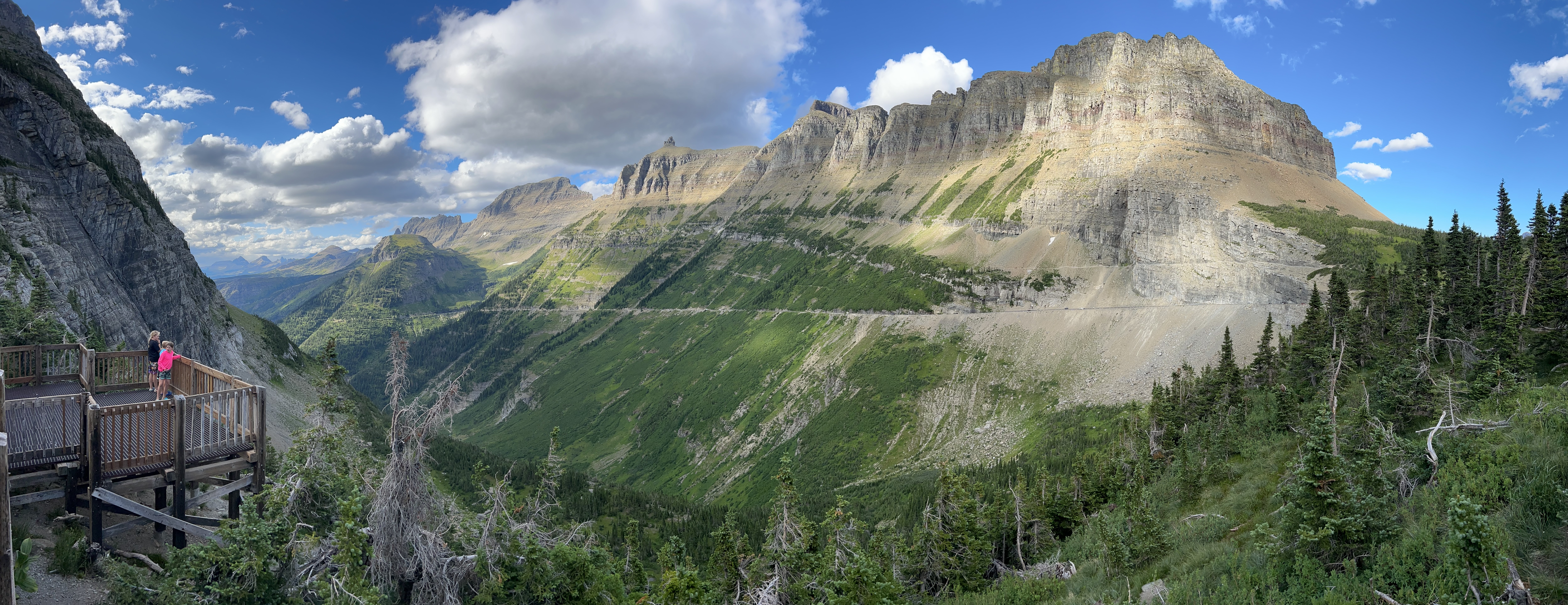
The horizontal line across the Garden Wall on the other side of the valley is the Going-to-the Sun Road, which I finally drove—3rd time’s the charm. This year the dramatically scenic road opened on 13 June with little ice & snow visible in July. Just over the wall in Many Glacier, old photos show the many large glaciers are now very small, rapidly melting glaciers. My son and I rode horseback up in 2018, and the area should be renamed Many Lakes. Combined with its neighbor across the border, Waterton Glacier International Peace Park is still a UNESCO World Heritage Site, despite the obvious melting problem.
Melting ice and glaciers are one of the tipping points that will flip our Climate Crisis into a catastrophe. Consider the Arctic ice cap. Every year recently, the multi-year ice has been shrinking at an accelerating rate. Eventually, the ice will disappear in summer. Then the same energy that currently raises ocean surface temperatures by 1° will raise it by a multiple of that amount. There are two reasons for that. First, the white ice will no longer reflect the sun. Second, the existing ice will no longer be there to act as a temperature break. When you boil water with ice, it takes something like three times the energy as water without ice, because most of the energy goes into melting the ice first. So, not only is it bad that glacial ice is melting due to flooding and dry rivers in the fall, but once the ice is gone, the surface temperature rise will accelerate much more rapidly. Please, reduce your carbon footprint.
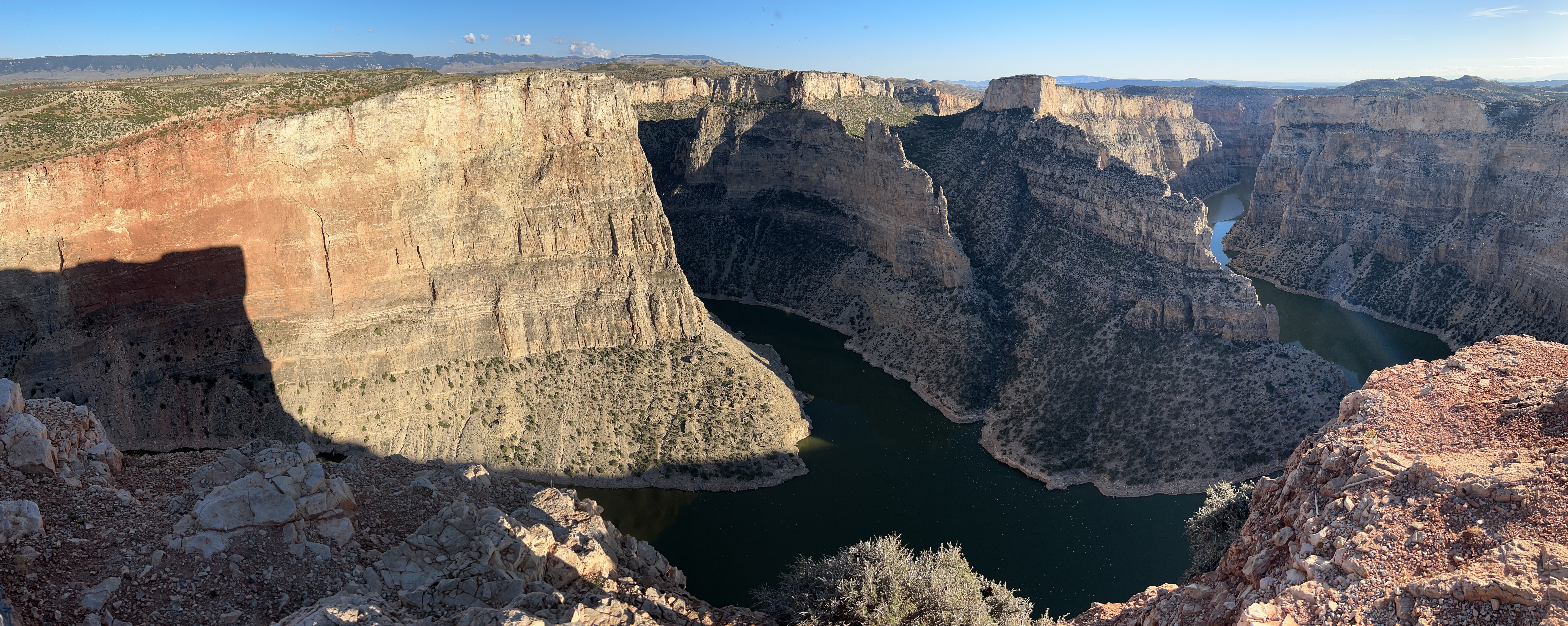
The choice is either to start at the dam in Montana and go up the canyon by boat or to start in Wyoming and take in the views from the rim. It was a long way for me to dodge power boats without easy stopping points, and the water level is obviously artificial. So, I chose to admire the views from above, passing through the wild horse refuge area and finding Devils Canyon Overlook above. I didn’t see any horses, but a turkey vulture flew right by my head so close the loud whoosh and sudden breeze startled me. Maybe he was hoping I’d fall over the extremely steep edge.
The topography of the area is disconcerting, as you see mountains & high ground and assume the Bighorn River would run south, but for all the uplift, the river has just carved its way deeper through the partially flooded canyon. Far upriver further south, it does the same thing, but there it’s called Wind River and cuts through Wind River Canyon. Ultimately, the basins and lesser mountain ranges in Wyoming matter far less to the river direction than the Rocky Mountains, which on this side of the Continental Divide cause the rivers like the Shoshone and Bighorn to flow east and north, joining here before flowing into the Yellowstone River on its way to the Missouri River. In the photo above, that flow is from the upper right to lower left, below the large shadow on the cliff across the canyon. The stretch of water in the upper middle, below the fans is Devil’s Canyon, partly filled by the dam’s backwash and sometimes fed by Porcupine Creek. The foreboding names match the inhospitable scenery. This is a rough and remote area, but it’s also starkly beautiful and dramatic.
Heart Mountain (above) is the site of an American Concentration Camp in Wyoming. One of the incarcerees left a bequest for ‘something to be done’, and now much is being done here to teach people about the injustice sustained here from 1942 until 1945. There is an original barracks, a guard tower ‘built to spec’, memorials, artwork, and a remarkably personal and revealing museum. Renovations, expansion, acquisitions and outreach are ongoing.
While most sites choose not to use the term “concentration camp”, due to its association with the Holocaust, one of the incarcerees in the film uses that term plainly, the then Governor used the term in arguing in favor, and that was the term used most commonly at the time. Many of the Americans who were sent there had never seen so many people of Japanese descent in one place at the same time. What else are you going to call a facility that literally concentrates one group of citizens based on racial/ethnic identity in a prison camp?
What makes the exhibits here better than other sites is that they go one or two steps deeper in describing the experience. When the site started, “it was like pulling teeth” to get incarcerees to talk about it, but then gradually the stories started coming out: a dog left behind that refused to eat and died alone, a beautiful older lady describing how she was spat on and called a slur as a child, and a family recounting the suicide of their father after being robbed and rejected by their community upon release with $25.
The museum pulls no punches in their descriptions, making it plain that these innocent American civilians had their rights abrogated and in many cases lost everything, due to racism. Instead of recognizing that we were at war with an enemy nation, our government and most Americans also declared war on a racial/ ethnic group of their fellow citizens. While J Edgar Hoover and Eleanor Roosevelt counseled against the program as ‘unfounded’ and ‘unjust’ respectively, FDR approved the military’s ‘relocation program’ recommendation for ‘sensitive military areas’, which the military interpreted as the entire west coast.
“The Japanese race is an enemy race and while many second and third generation Japanese born on United States soil, possessed of United States citizenship, have become ‘Americanized’, the racial strains are undiluted.” “A Jap is a Jap.”
Lt. Gen. John DeWitt, architect and overseer of the American Concentration Camps
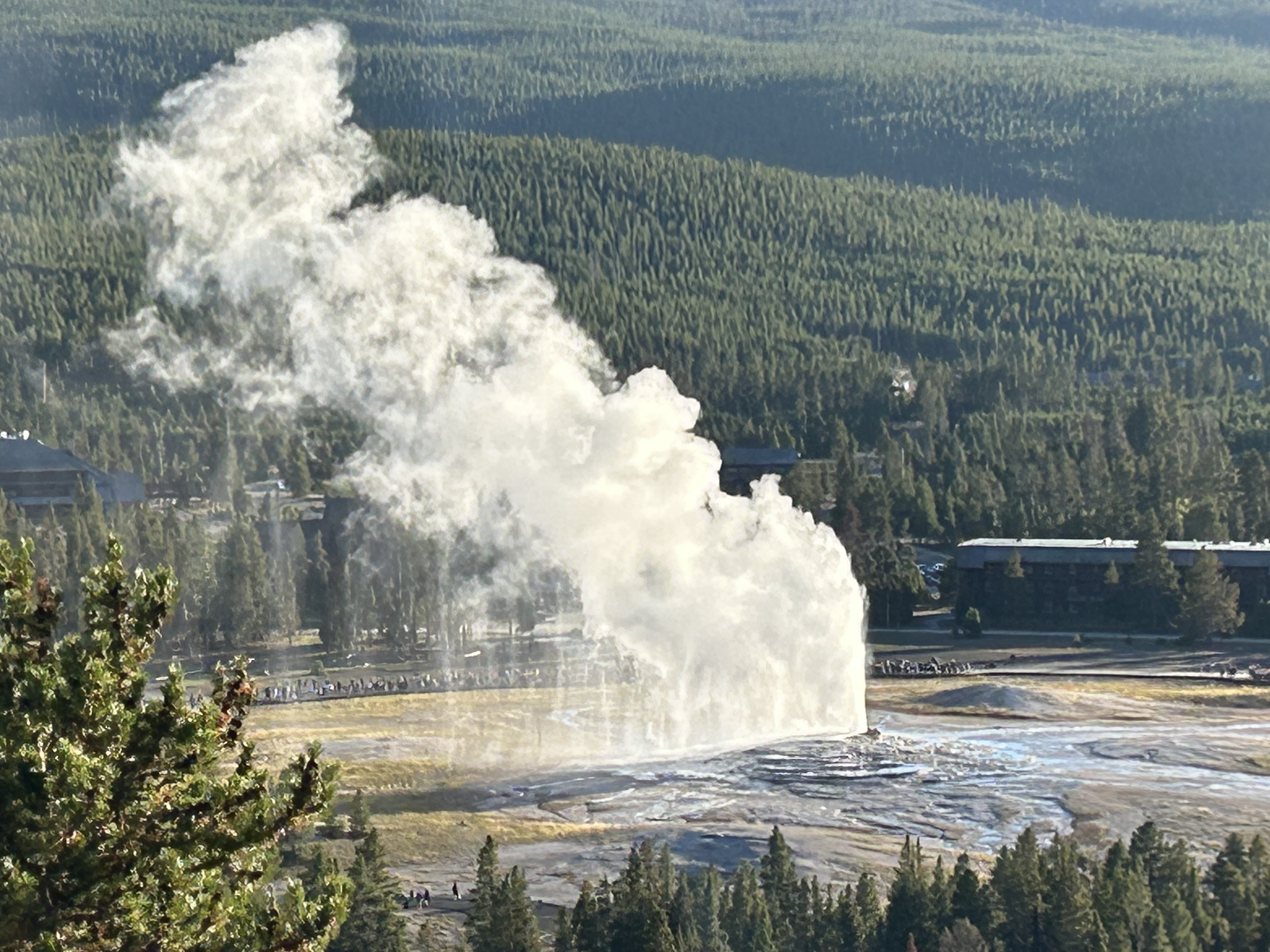
Clockwise from top: Morning Glory pool, Daisy, Grand and Old Faithful geysers.
Most of the world’s geysers are here, near the country’s largest high elevation lake and the headwaters of the longest free-flowing river in the lower 48, in a park bigger than some states. For wildlife alone, this is my favorite national park, plus the geysers are my favorite geologic feature in a park. There’s a lot to see and do, but I’m not going to write more about it. Come see for yourself.
The parkway runs along the Snake River (above) connecting Grand Teton and Yellowstone, but the park includes a 24,000 acre land & river corridor for wildlife, without which we couldn’t enjoy seeing as many migratory animals in the two famous parks. The Rockefellers were instrumental in a number of national parks, including Acadia, Smoky and Marsh-Billings. Despite opposition from local ranchers, they purchased huge tracts of ranch lands and donated them to us. Laurance Rockefeller later donated his family’s 1,000 acre ranch to become part of Grand Teton, and his Preserve Center there near Phelps Lake is the best place to get in tune with their legacy. Considering the damage being done every day by burning the oil that created their fortune, it’s really the least they could have done.
”How we treat our land, how we build upon it, how we act toward our air and water, will in the long run tell what kind of people we really are.”
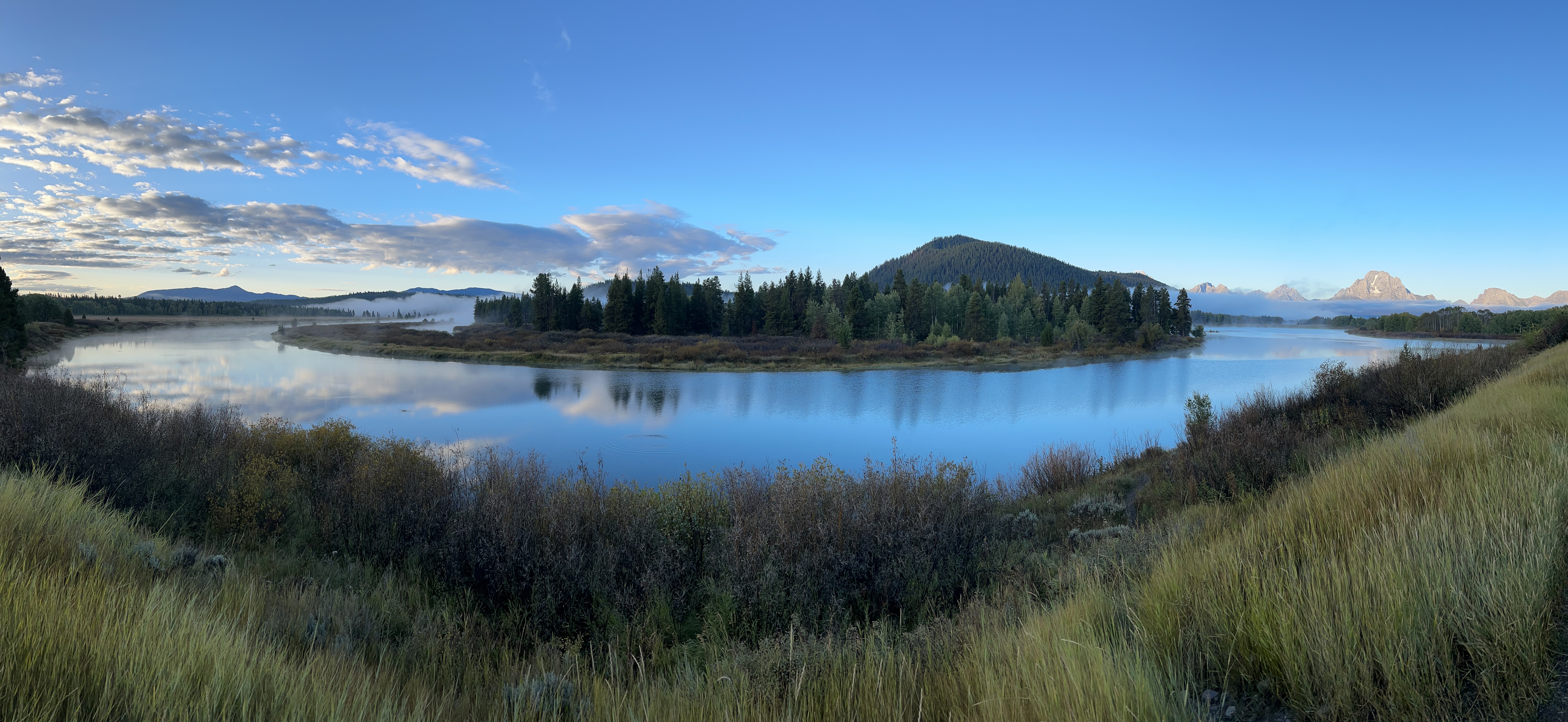
Oxbow Bend (above) is popular at sunrise as wildlife gathers in the coils of the Snake River and the light hits the Teton Range high on the right. Owls, a bald eagle, beaver and bugling elk all appeared out of the mist. Elsewhere in the park, pelicans, geese, ducks, osprey and many different small birds, then foxes and a large herd of bison wandered into view. Black bears foraging for hawthorn berries forced a trail detour, but I only saw scat.
Pronghorn migrate from here in Wyoming as far as New Mexico, and the headwaters from the nearby Continental Divide eventually reach the Pacific. This is an important park, ecologically, more than just a great photo stop. Still, the many lakes provide lots of flat hikes with steep mountain backgrounds, and lots of mountain hikes with water vistas. Or you could take the Jenny Lake boat across for even more views. Kayaking is a hassle with the permit & inspection process, and the views are wonderful on scenic drives and trails. Jackson Hole is crowded and expensive now, so look elsewhere for a place to stay.





 Zero Carbon Travel