While it is easy to see the impressive semi-circular pueblo ruins on the valley floor and peek in the various rooms along the canyon wall, Alcove House was open to those willing to hike a bit further and climb the series of steep ladders 140 feet up. I imagine it would have been much more difficult carrying supplies, children or elderly relatives up the ladders when the Native Americans were living here. There’s a creek running down the canyon from the large volcano which makes a pleasant place to consider the climb or to cool down on the hike back.
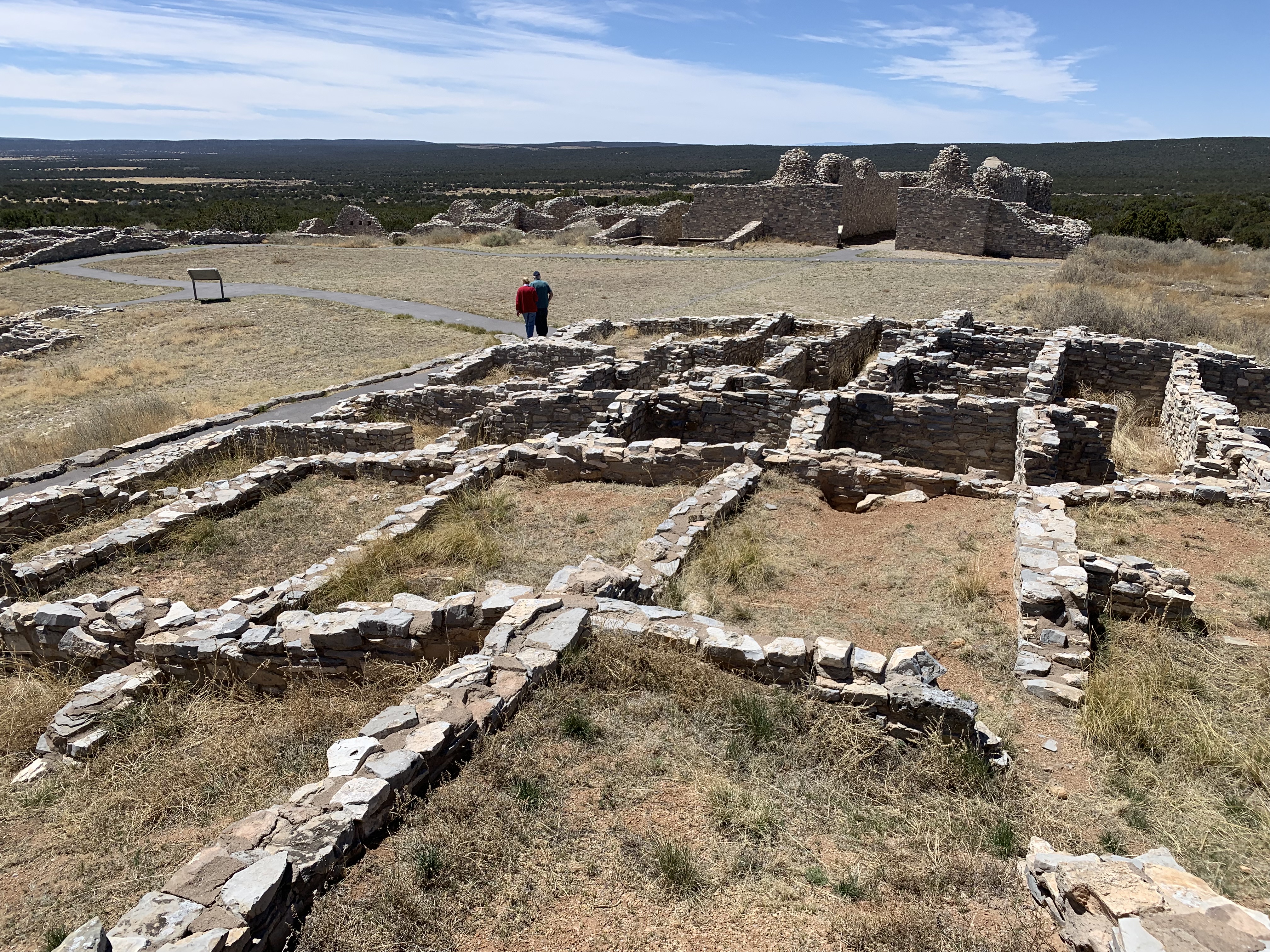
I chose to visit Gran Quivara, since it has the largest pueblo ruins of the three missions, although the churches are better preserved at the other monument sites. The original pueblo ruins are in the foreground. The Spanish claimed the land for the King and forced the people here to build two churches, first the low ruin to the left and then the taller structure in the back. Some accounts describe the relations between the natives here and the Spanish as friendly and positive. From what I can tell, it’s hardly a coincidence that the pueblo was abandoned a few years after they started constructing the larger church for the missionaries. The local people endured Spanish diseases, grew Spanish plants that were ill adapted to the drought-stricken area, and other native tribes mistreated or attacked them as collaborators. They were prohibited from practicing their own religion, including singing native songs or performing dances, due to the strict rules of the Spanish Inquisition. If I had to go through any of that, I would leave too.
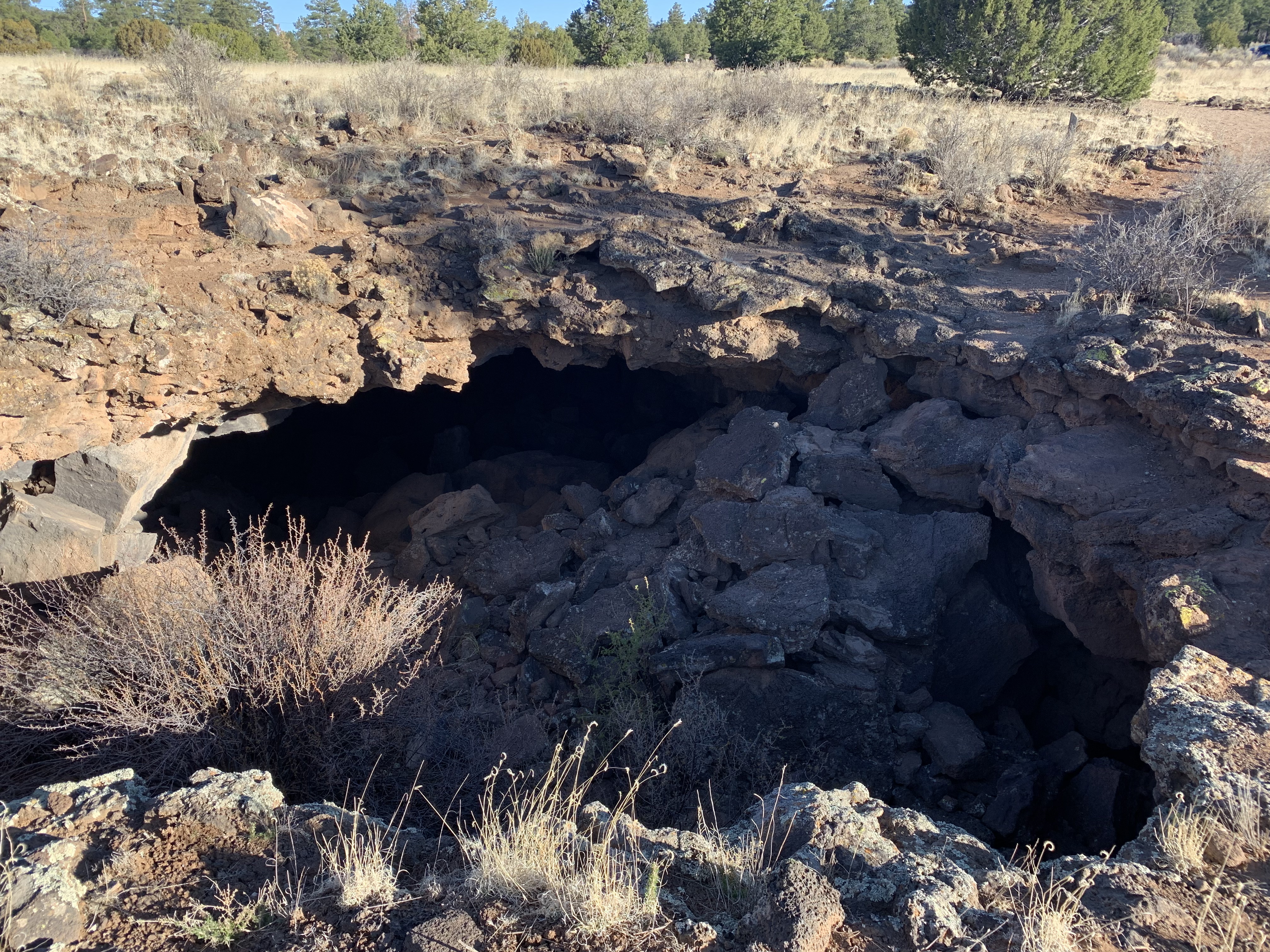
The caves were closed by Covid, but I enjoyed the hike and wildlife. There’s a private site nearby that apparently is still conducting “ice cave” tours. I’m happy to leave the bats alone underground and not risk introducing fungus or disease. I suppose it’s ironic to have the cave closed here when Covid likely originated from a bat cave in China. But the larger problem is that climate change is spreading more diseases globally, affecting both us and other species, so we need to be more responsible.
I should add that beyond the borders of the monument, there are both wilderness and conservation areas protected in El Malpais, meaning badlands.
This rock is interesting. Rock climbers would enjoy the many tall vertical crevices. There’s a spring with a pool in an alcove at the base. At the top, there’s a ruin with a good view of the surrounding valley. And all along the base there are carvings made centuries ago by travelers, from those who didn’t have a formal written language, to Spanish speakers who named this place ‘El Morro’ meaning ‘the hill’, to other pioneers.
This park unit has nine free campsites in a pleasant loop with toilets, tables and water (except during the winter). Since New Mexico offers many electric sites at their reasonably priced state campgrounds where I can charge my EV overnight, I generally try to stay there. Sometimes I stay at a private RV campground, and sometimes I stay at a hotel, especially when I really need a shower. The Tesla easily powers my 12v camping fridge. The least common denominator everywhere is a toilet and a trashcan. The model 3 is small, but I manage to sleep in it. Without a big rig to pull, I can easily park anywhere, and I don’t have to burn a gallon of fossil fuel every 10 miles.
This site, one of my favorites for native ruins, is also a UNESCO World Heritage Site. There are numerous pueblos located in the park, and the largest one pictured is actually missing a few rooms due to a rockslide from the cliff above. These great houses were several stories tall, including storerooms for trade and many ceremonial kivas. Due to the well preserved nature of the site, it’s easier to get a sense of the scale of human activity a thousand years or so ago. At other more degraded sites, you’re really looking at the small basement room foundations. Here, you can see that some of the rooms above were much larger with windows and wider passages. The road out here is miles of washboard dirt, which helps reduce human impact.
There’s an interesting display at the visitor center showing several of the other great builder civilizations around the world at the time Chaco thrived. For me the comparison that comes to mind is Rapa Nui, or Easter Island. They were also a civilization of great travelers and explorers who build large stone markers and then move on to other locations. Manmade ecological collapse contributed to the rapid population declines at these sites. Chaco no doubt boomed when it improved its agricultural yields by building a vast network of canals, but natural systems have natural limits that can break when pushed too far. Obviously, when the natural limits are pushed too far globally, the problem is that there will be nowhere to move that’s unaffected. And the crisis part of climate change is that we won’t have enough time to respond. For those unable to think more than a year or two into the future, it’s worth looking back over centuries since Chaco’s population collapsed due to over exploitation. We may think of ourselves as advanced, but we’re not (and won’t be) if we can’t avoid the coming climate catastrophe we created.
Again, we keep using the wrong name for a national park site (like Montezuma’s Castle). The Aztecs had nothing to do with building this pueblo or reducing it to ruins. By now, I’ve had it. Even the park service uses the term “Indians”. Well, Indians are from India, and we’ve known for centuries that Columbus was wrong to believe the natives he encountered were from the Indies. Geographically, it’s difficult to find two places more diametrically opposed on our globe than India and New Mexico. It’s frankly insulting to keep referring to people by using a mistaken term for centuries. And it shows a profound and reckless disregard for addressing past mistakes and thinking about how to correct them, when we continue making the mistake every day. I’ve been using the term “Native Americans” to discuss the people who still live here and still practice their religion at sites like these. In Canada, the official term is “First People”, which is certainly an improvement in accuracy. Navajo use the term “Diné”. Unless we’re referring to the south Asian country of India, we need to stop saying “Indian” now.
Rant over. The ruins are primarily worth visiting in my opinion to see the spectacularly restored Kiva pictured above, as well as to duck through a long row of low doorways to explore the many rooms along the longest wall here. If you have time to visit a number of these native cultural sites in one trip, then you begin to get a fuller picture of the various migrations, trade routes and pueblos along the river valleys. Each park visit helps open my eyes to both the ancient people and their living descendants.
The canyon is sacred to the Navajo. As is too often the case with Native American places, the name is confusing. De Chelly (pronounced ‘du Shay’) is from a Spanish borrowing of a Navajo word meaning “canyon”. So, many people out there are mispronouncing a word in two languages in order to try to say “Canyon Canyon”. This is my favorite canyon.
I only made a brief stop at Antelope House Overlook on the north rim to get a photo of this spectacular canyon. Fortunately, I toured the canyon a few years ago with my kids. That’s really required to experience the history, culture and beauty. Our guide was a Navajo who explained some of the history and beliefs of her people who still live in the canyon. Although Kit Carson’s troops cut down the peach orchards and modern people have diverted water, the bottom of the canyon is still both productive land and a protected ecosystem. If you have the time and money, a horseback tour would be incomparable.
I don’t normally talk about traveling between park units, but the drive from the canyon to Farmington was spectacular. The combination of green forests, snow, and red & tan rock formations in the winding mountain pass is stunning, as was the view of Shiprock on the other side. I feel some sense of culture shock when passing through Navajo Nation, accentuated by the stark differences between communities on each side, and this time felt acute.
The post is still in use today, selling jewelry, blankets and other handcrafted goods. Navajo Nation spans a large part of northeast Arizona, and its border extends into Utah and New Mexico. Note well that they follow daylight savings time (unlike the rest of Arizona).
In the 1860’s, US troops under Kit Carson “burned villages, slaughtered livestock, destroyed water sources” and force marched thousands of Navajo to internment camps in New Mexico. The Long Walk and subsequent re-education programs damaged Navajo culture, breaking ancient familial bonds of language and traditions.
America has not dealt with this tragic history nor its consequences. And I’m not talking about Kit Carson’s legacy or that his name is ubiquitous in the west. I mean the US government’s responsibility for ordering people like Carson to execute this atrocity, against his personal views. We need to understand the mistakes of the past, atone and choose more wisely in the future.



 Zero Carbon Travel