Ocmulgee Mounds National Historical Park

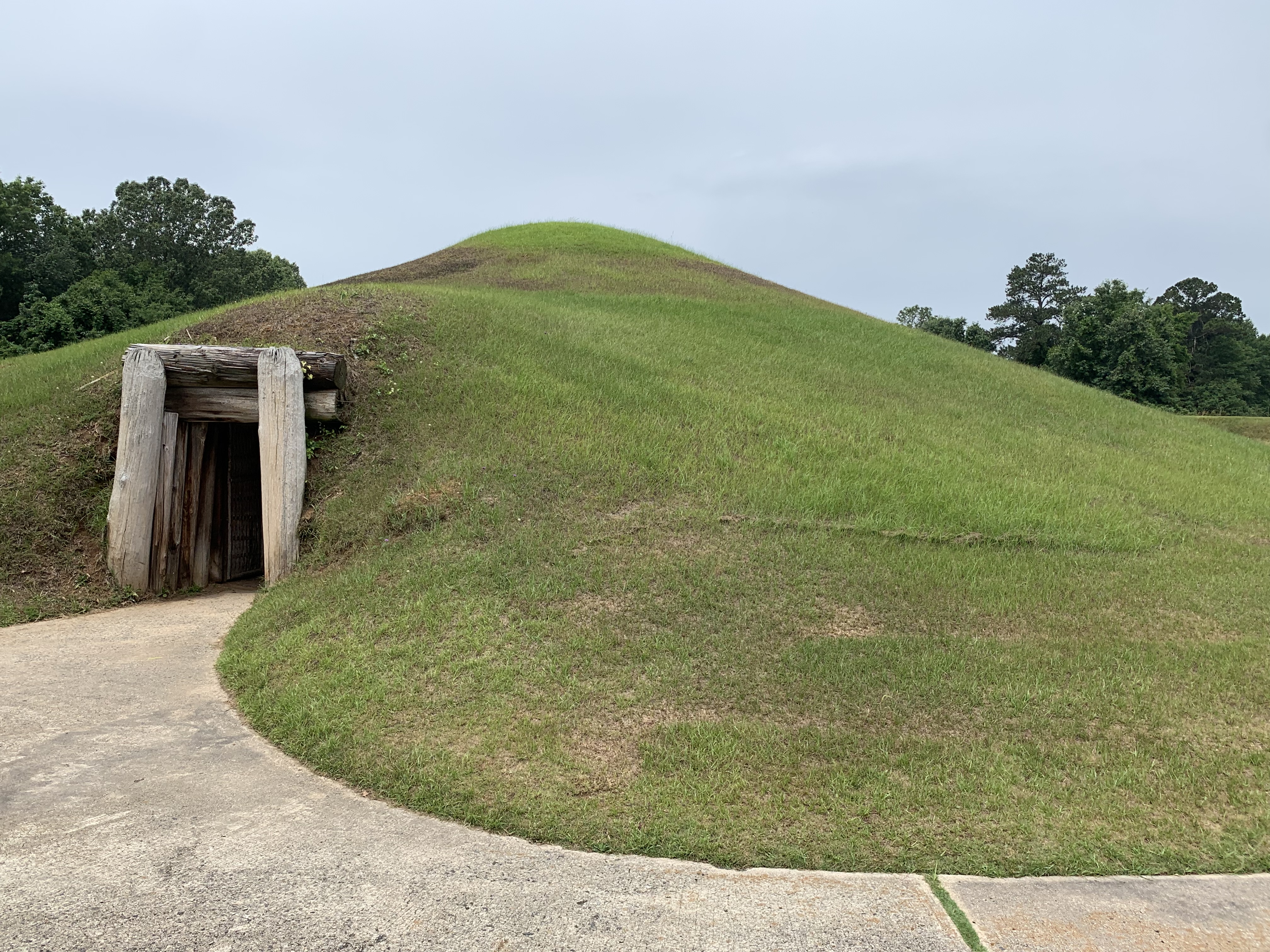
The large mounds here date back over 1,000 years, and include the reconstructed earth mound above, temples and funeral mounds of the ancestors of the Creek people. Despite tremendous challenges, the culture continues today, as seen in the Creek Nation Supreme Court Building in Ocmulgee Oklahoma, which is patterned after this mound. The ground inside dates to 1015, and appears similar to kiva I’ve seen in the west. During the Depression the Civilian Conservation Corps reconstructed the roof and built an Art Deco style visitor center. The entrance tunnel is low, carpeted and well ventilated, and it opens into a glassed-in viewing area. Despite not being half as old as Poverty Point, the mounds here also have bird symbols and other similarities. The Creek Nation farmed corn, squash, beans, pumpkin and tobacco here, fished and traded deer skins with the Spanish, French, British and Americans. They largely westernized and had multiple treaty rights to their lands, but they were nevertheless forced to abandon their homeland by Andrew Jackson.

Driving through the southeast, especially in rural areas, you see a great many churches. I’m no expert on the Bible, but I’m pretty sure the ”thou shalt not steal” is in there (Exodus 20:15). Almost all of the land was stolen from the Native Americans, yet I don’t often hear people expressing any regret for the sins of our ancestors, even in church. Obviously, it’s not God’s will that his commandment be broken. I’ve been to church services from coast to coast, and I’ve never heard a sermon about how we live on stolen property, how that was a sin and how we should try to make amends. Seems like that would be the proper Christian attitude. Of course, the church has been wrong on this issue for centuries, but reflecting on our sins and seeking forgiveness are supposed to be core values of Christianity. Why not start reflecting on this sin and our responsibilities today?

Martin Luther King, Jr. National Historical Park

Every year winning poems are chosen from children around the world for visitors to admire along with the roses. The sentiments are moving testimonials to his life, ideals and inspiration, expressed with the moral clarity and unbridled hope of children. This is my favorite Civil Rights site.

The short films & exhibits in the visitor center capture Dr King’s life as the heart and soul of the Civil Rights movement, as well as his wish that we continue. His birthplace, church, center for non-violence and grave are overwhelming, but I was struck by how the community continues to gather here daily for many different events and causes. His passion for justice and righteousness inspire action every day.

Today I’m inspired by one of his thoughts in his letter from a Birmingham jail, about how difficult it is to be told to wait after enduring centuries of suffering. Earth has suffered centuries of pollution, and always the message to environmentalists is to wait. Wait for new technologies, wait for laws, people and society to change, and wait until the polluters have made more money, and then, maybe…. But now we have no more time to wait. We’re moving quickly to catastrophe, wasting precious time on inaction, and extinguishing species without pause. Unless we act to stop burning fossil fuels now, we condemn much life on earth to end.

Kennesaw Mountain National Battlefield Park

Union forces fought for weeks to break the long line of confederate fortifications northwest of Atlanta, but were unable to climb the steep hills under heavy fire. There was one “dead angle” or blindspot at Cheatham near the photo where soldiers climbed all the way up the hill and over the earthen walls only to be repelled in hand to hand combat.

5,300 soldiers died in a few weeks of fighting here in the summer of 1864, before the war moved to Atlanta.

Ninety Six National Historic Site

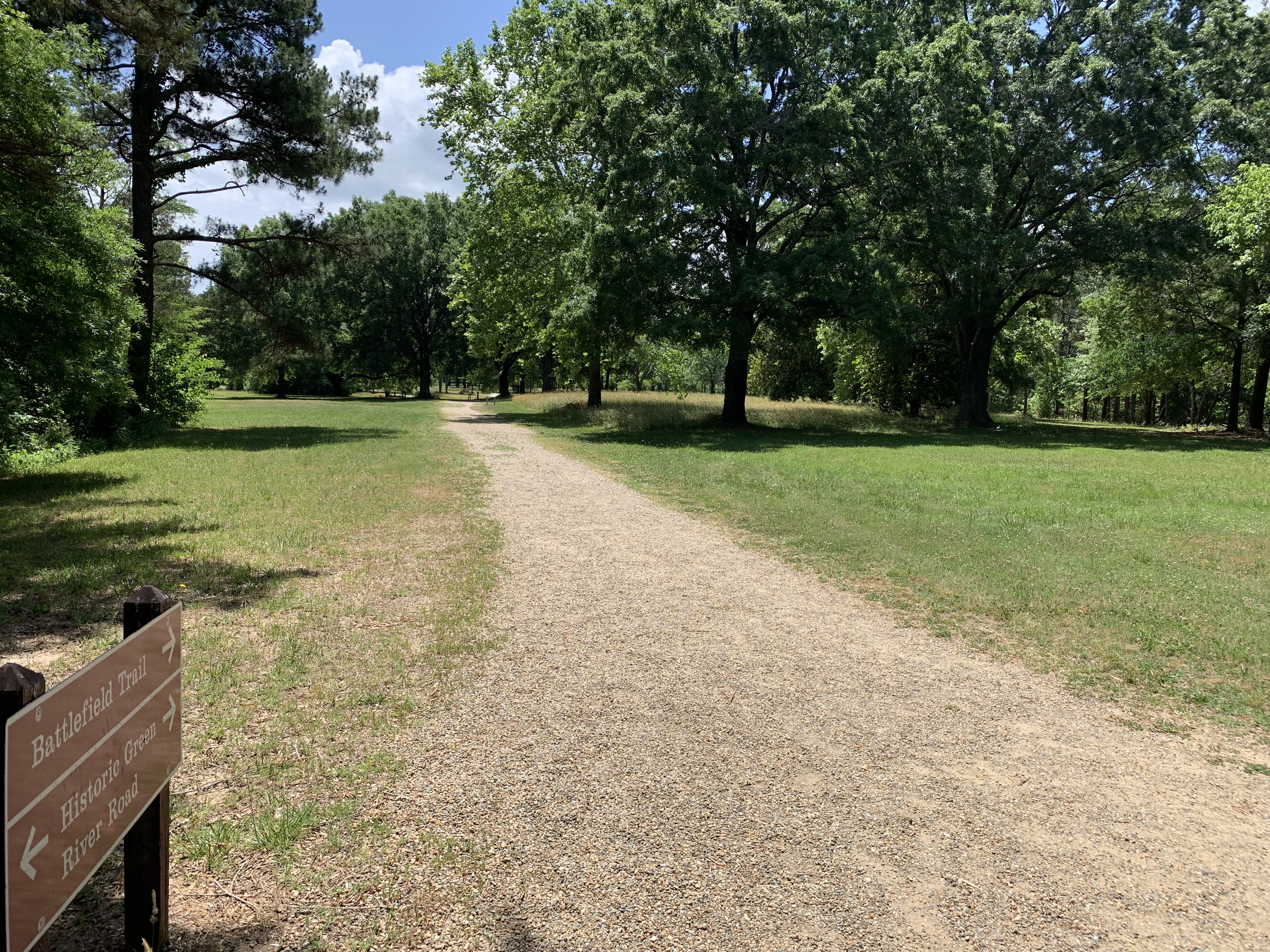
Like several of the Revolutionary War sites in the south, the park is closed Sunday through Tuesday, but I was able to enter the reconstructed stockade above. The patriots briefly captured it in 1775 but failed to take the star shaped fort nearby. The earthwork remains are still preserved after centuries. The star fort design was used by the Spanish in St Augustine, the British here and by both the Union and the confederates. With just a few troops needed to defend it, the design provides overlapping fields of fire protected by crossfire gauntlets.

Carl Sandburg Home National Historic Site

As a teen, Sandburg rode the rails in boxcars, like a hobo, to see the country, from Illinois to Colorado. ”I’m an Idealist.” He once wrote. ”I don’t know where I’m going, but I’m on my way.”

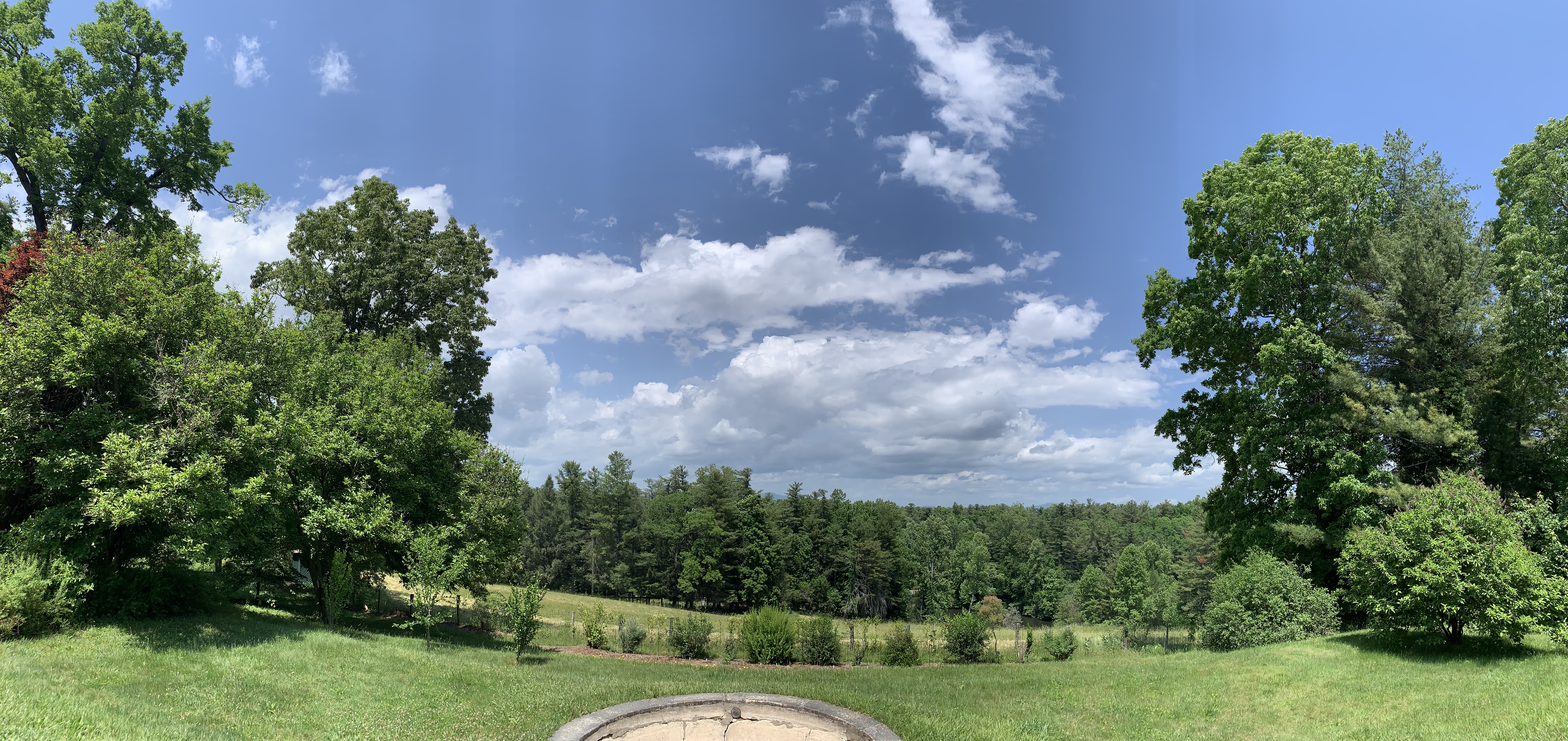
The prize winning poet & author enjoyed solitude in nature, and he bragged that his home up in the foothills here included “millions of acres of sky”. It’s a beautiful and peaceful spot with a fish pond and goats.

It is necessary now and again

for a man to go away and experience loneliness;

to sit on a rock in the forest and as himself,

”Who am I, where have I been, and where am I going?”

— Carl Sandburg

Cowpens National Battlefield

Popular among war buffs, here the patriots won an impressive victory against the British. The British commander was a young hothead named “Bloody” Tarleton who had recently killed over 100 men flying a flag of truce at Waxhaws. The patriot commander was 45 year old veteran Daniel Morgan. Morgan chose the site due to thick woods and canebrakes (sugar cane thickets) that would make flanking difficult for the advancing British. His light skirmishers volleyed and fell back, and then his next line was to do similarly. They muffed it, and the British rushed forward, expecting a rout. The patriots about-faced and fired point blank. The British front line faltered while the back was still advancing, and then William Washington’s cavalry, which had emerged from a low spot to keep the enemy cavalry at bay, turned and flanked from the other side. This classic pincer or double envelopment movement is difficult and rare, yet it has won victories for thousands of years.

Tarleton was forced to retreat with his cavalry, reporting over 100 dead and 700 captured. He blamed his troops. After the war he served in the House of Commons, where he argued for continuing the slave trade.

The Mel Gibson movie “Patriot” is based in part on the battle between Morgan and Tarleton here.

Kings Mountain National Military Park

After the British took Charleston, they moved inland trying to gain momentum and more loyalists. Here, they lined this narrow ridge with skilled marksmen prepared to defend the high ground. The patriots had troops moving overland from the northwest and local milita massing on the other side. Using Native American tactics of advancing from tree to tree, the patriots were able to get close on both sides and catch the defenders in a deadly crossfire. Having learned that the British commander was wearing a checkered jacket, they targeted and eliminated him, winning a decisive battle here.

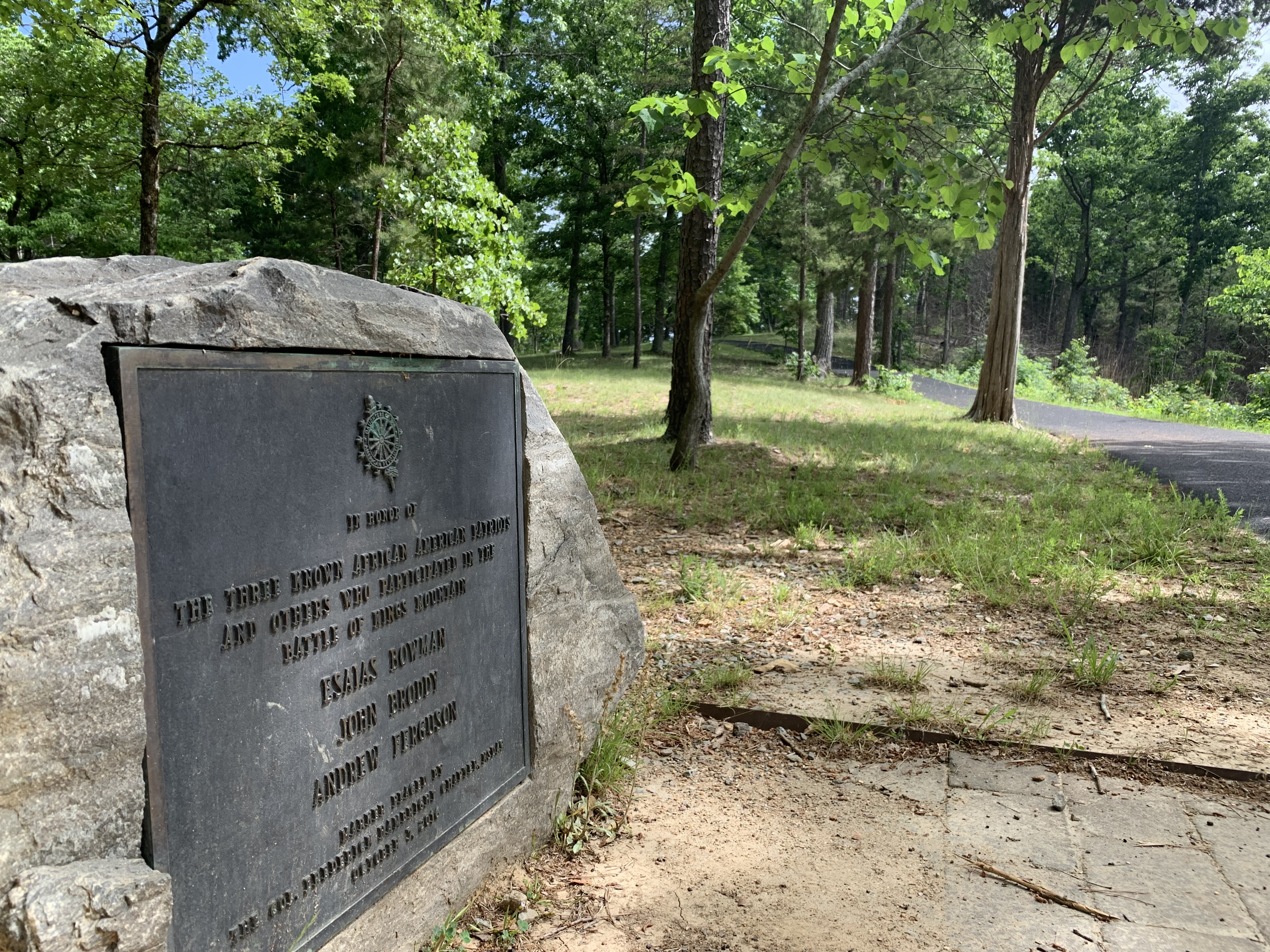
The first of the three African American patriots memorialized above, Elaias Bowman, was a free militiaman, one of several who shot the British commander. For some reason that I can’t fathom, there’s a far bigger memorial to the British commander, a Scot named Ferguson, and local visitors speak of him fondly, often leaving stones near his marker. I left a stone for the patriot Bowman instead.

Moores Creek National Battlefield

As at the Old North Bridge in Concord, Patriots removed many of the bridge planks and greased the beams. Once the loyalists crossed, they found themselves surrounded by Patriots behind hastily built earth walls with muskets, one medium sized cannon and a swivel gun. The British-employed highlanders attacked with broadswords, which was the last time that tactic was ever tried. Here on February 27th, 1776 the Patriots won a clear victory in the War for Independence.

Normally, I would stop here, but the ranger expressed some views which were misleading and incorrect. The battle is described in the visitor center as America’s “first civil war”. The ranger described the Patriots as ”fake news” northerners and corrupt townspeople who hypocritically denied the people in the backwoods their rights while over-taxing them, using the Regulator rebellion of 1761 to support his argument. Which is poppycock.

Let’s start by noting that the battle took place before America was a country. The Patriots were British colonists in open rebellion, and the loyalists were British mercenaries and colonists paid to put down the rebellion. Any over-taxation and denial of rights was done at the behest of the British Governor, who used a variety of means to control the colony, including bribery, hanging, and dividing the colonists into factions. Without sanctifying the Patriots, some who owned slaves, or condemning the loyalists, some who had been forced to swear oaths, there’s simply no honest way to recast this colonial battle as civil war. The Regulator history is interesting, but it was a tax revolt and was neither a part of the Revolutionary nor Civil War.

Guilford Courthouse National Military Park

The Revolutionary War may have started in Concord Massachusetts, but it was won in the Carolinas and Virginia, at places like this. Rhode Island Quaker Nathaniel Greene was given the southern command by General Washington, and he fought a critical battle here with Cornwallis, with Washington’s cousin William leading the dragoons (cavalry). Technically, the British won the battle, but Greene inflicted more than 1/4 casualties upon them while keeping his own force ready to fight again. The British recognized it as a Pyrrhic victory, and Cornwallis had to regroup. The two sides would clash repeatedly before Yorktown.

Blue Ridge Parkway

A couple of elk were crossing the parkway, and I managed to take a quick photo. As I slowly started to pass, trying not to scare them, the complete idiot behind me decided that would be a good time to pass me on the right, inches from the elk, practically pushing them away into the woods. Who hates mega fauna that much? So I decided to demonstrate what instant acceleration looks like in a Tesla, and I never saw him again.

The parkway isn’t the fastest way to get anywhere. My navigation kept telling me to get off and take a straighter road, so I turned it off. Anybody who is in too much of a hurry should take another route. It winds along the ridge line from Great Smoky through North Carolina and Virginia to Shenandoah, and it is delightful. I saw some kind of light pink rhododendrons blooming along the wet ridge rocks above 5000 feet. I think Catawba, named after a local Native American tribe, or maybe Vaseyi, named after the famous botanist who discovered them 150 years ago. The former would be early, but it’s unseasonably warm now, due to the climate crisis.

The parkway is best enjoyed at leisure or in segments, and people who don’t care about nature should avoid it.