César E. Chávez National Monument

I returned here today to see the exhibits, as they were closed when I visited last year. The black & white photos of the Delano grape strike and Chávez’s hunger strike remarks are particularly moving. Pesticides were not regulated at all then, and labor was denied rights by growers. Chávez’s national boycott of grapes helped change both.

Today, growers drain rivers, lakes, wetlands and water tables, even as the western half of the country suffers in drought. In Kern County, where the Monument is, the Kern River no longer flows to the Kern Lake, due to diversion for agriculture. In order to sell more produce, growers are ruining the environment for fish, animals and people. Climate change and some farming practices also exacerbate Valley Fever, a deadly fungal infection spreading in California & Arizona.

Agriculture is a trillion dollar industry in the US, with $150 billion in exports. But Big Ag prefers to blame Democrats, rather than face the fundamental challenge of the climate crisis. Big Ag needs to convert farm equipment to electric, and they need to stop using fossil fuel to ship their produce around the world. They also need to cooperate to restore wetlands to sequester carbon.

César Chávez devoted his life to raise awareness and lead civil disobedience to make change. He acknowledged that in the struggle against the rich and powerful, poor people only have their lives “and the justice of our cause” on their side. Today, we need more people to be just as devoted to stop the climate crisis.

Wisteria, photographed in my previous visit in 2021.

Click to see my photos of all national park units in California, or click to read an updated site visit here.

Chiricahua National Monument

This hiking paradise of rocks left me feeling inadequate. Something about the vast number of enormous towering spires of hard rock made me feel like a tired old man. Sure, the view of any one of these mighty columns pointing skyward for ages is impressive, and the variety of sizes, shapes and textures of these huge protruding knobs is remarkable, but the well-endowed phallus-shaped columns left me feeling cold and small by comparison. On the other hand, a bevy of older ladies were very excited and pleased to view the tall and stout structures from Massai Point Nature Trail, as they laughed and reminisced about their youth.

One would be remiss for not explaining that the Chiricahua are the tribe of the Apache Chief Cochise and the feared raider Geronimo, who conducted guerrilla warfare against the US in this territory. For 24 years, the Apache skirmished with and hid from the US Cavalry, attacking stagecoaches, wagons, Mexico and even Union troops in 1862. The rugged and remote territory (below) shows the difficulty the US had in tracking them down. Eventually both were forced onto reservations. 

Click to see my photos of all national park units in Arizona.

Fort Bowie National Historic Site

Three of the graves in the fort’s cemetery are of captured Native American children. The center one belongs to a three-year-old Apache girl, buried under a Christian name given to her by her captors. The one on the right is of an Apache child unnamed with no age, buried like the others in the manner of his or her captors. And the left grave belongs to the two-year-old son of Chief Geronimo, Little Robe, who likely died of a disease spread by his captors, and whose father’s name will be remembered as synonymous with bravery, long after everyone else here is long-forgotten.

Click to see my photos of all national park units in Arizona.

Gila Cliff Dwellings National Monument

This park is surrounded by real wilderness, and any intelligent visitor would plan on camping overnight to take a longer hike or maybe even a trail ride on horseback. Of course, I drove through on my way back to Arizona, practicing my hairpin turns on mountain switchback roads. Well, at least I didn’t burn any species-ending fossil fuels on the drive.

The cliff dwellings are spectacular, with details like a wall mural and a pictogram, well worth the brief hike along the pretty creek and up the cliff side. Unlike Montezuma Castle NM, I was able to climb right into the main room and climb ladders to peer into the past. There was even a volunteer there who reminded me that pictograms are painted and petroglyphs are carved.

Click to see my photos of all national park units in New Mexico.

White Sands National Park

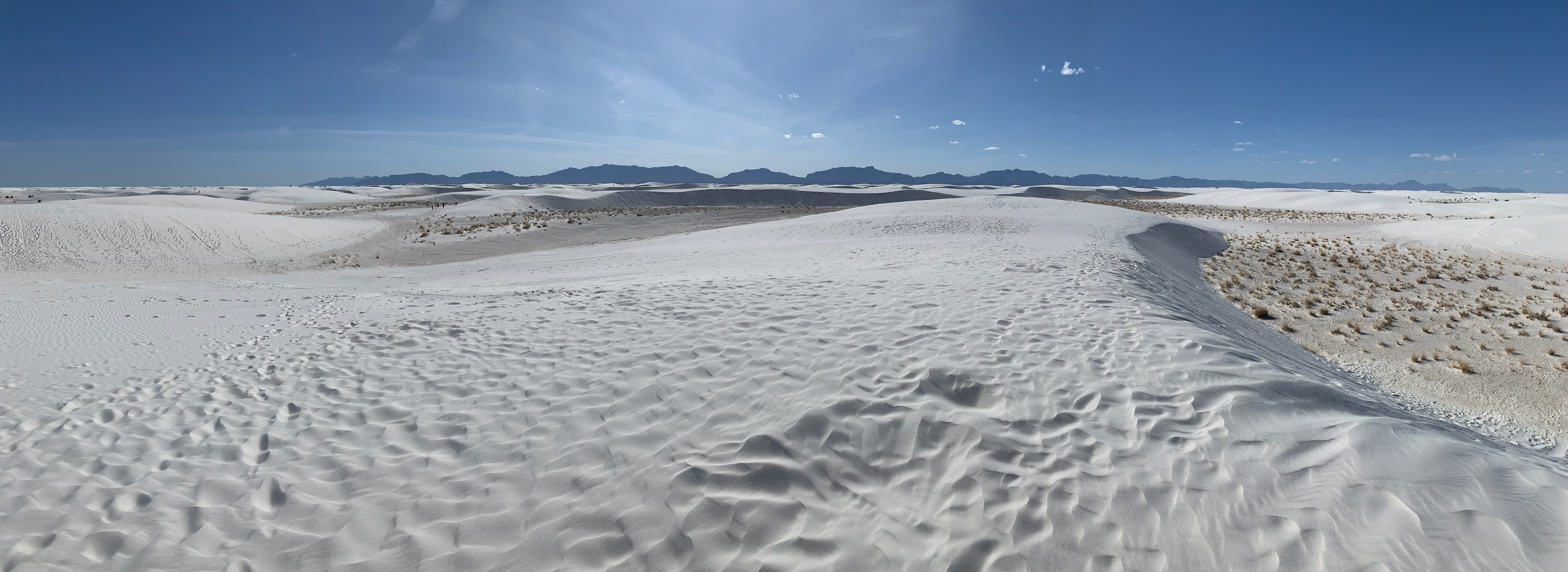
One of only three large gypsum sand dunes on earth, the others being nearby in Guadalupe Mountains NP and in Coahuila Mexico. If I had more time, I would have enjoyed camping overnight in the “back country” away from the road or a ranger lead evening program. But I enjoyed the nature hike and the otherworldly views. I was glad to have the long-range version of the Tesla Model 3, since the round trip distances to charging stations cross the vast missile range and mountains you can see in the distance.

Click to see my photos of all national park units in New Mexico.

Petroglyph National Monument

Worth going to the visitor center first. They directed me to the trail with the most petroglyphs (400+) and no parking fee. Fascinating to see the signs those travelers left so long ago, preserved by the city of Albuquerque, right behind a residential neighborhood.

Another hiker pointed out a coyote, probably chasing the road-runner I saw too. I heard the distinctive “beep-beep”. They should make a cartoon about that.

Click to see my photos of all national park units in New Mexico.

Petrified Forest National Park

The Triassic forests are gone, and all that remains are fossils like these. Our climate changes frequently, but extremely slowly. Sudden change is a crisis, because plants and animals lack the ability to adapt or evolve quickly. Hundreds of millions of years ago, this area was an equatorial jungle. The trees were buried by volcanic ash and sediment and soaked in mineral rich waters to fossilize, offering a rare glimpse back before the Jurassic dinosaurs.

The park film explains the distant past, the recent past and current attractions. I hope they improve their camping opportunities, so that visitors spend more time here. I enjoyed my brief time here. But it was difficult to find a car-camping campground in the area, so I moved on too quickly.

Our carbon emissions since the industrial revolution are like an asteroid strike against all life on earth. The Anthropocene, or human dominated age, has been very short, but it will be characterized by extensive global mass extinctions. And unlike a meteor, this time the devastation is entirely by choice. We know that we’re killing the plants & animals that we claim to love. But most of us apparently don’t care enough about the future to make any significant changes to save life on earth.

Click to see my photos of all national park units in Arizona.

Tonto National Monument

This cliff dwelling was protected by President Theodore Roosevelt, and the lake in the distance bears his name. My maternal grandfather used to read The Roosevelt Bears to me, and he loved the west, wildlife and birds in particular. So it was especially meaningful for me to wake up beside Apache Lake, spot a hooded oriole, and then drive up to the monument in the morning. Despite a wildfire and protective burns in 2019, the wildflowers were beautiful. Unlike Montezuma Castle, visitors can climb up to and stand in the main alcove to inspect the ruins.

Click to see my photos of all national park units in Arizona.

Wupatki National Monument

The lower part of the Wupatki Pueblo including ball court.

I have mad respect for the ancient people who built these pueblos and traversed this land for centuries. Their descendants are still here, and often they remind the rest of us to protect the land and the wildlife that lives here. Climate change is already creating environmental refugees, more each year. Fossil fuel firm executives continue to make millions, despite the incredible hardships they foist upon our futures. And yet most of us still refuse to take action.

Click to see my photos of all national park units in Arizona.